Roundup
The Best Filament for Outdoor Use
Two things kill a printed part outdoors: ultraviolet light and heat. PLA loses to both. The right choice depends less on the weather than on whether your printer has an enclosure.
By Scooter M. · Published · Last reviewed
How this page is funded: the buy links below are affiliate links. If you buy through one we earn a commission, at no extra cost to you. It does not change the order of the picks or a word of what we say about them. Full disclosure.
Printers we claim to have tested: 0. Everyone in this category says they tested twenty machines. We have not tested any, and we would rather say so. What we did instead is on this page: the manufacturer’s own published specification for every pick, cited and dated; the arithmetic on what it costs to run, with the inputs shown; a live price rather than a remembered one; and a plain answer on who should skip each machine.
The short answer
If your printer is enclosed, print it in ASA. If it is open, print it in PETG. ASA is the only material here its manufacturer actually rates as UV and weather resistant, but it shrinks hard as it cools and needs a chamber. PETG handles weather well, resists heat far better than PLA and prints on any machine. Do not use PLA outdoors, and do not use ABS in sunlight.
Outdoor is one of the few jobs where filament choice genuinely decides whether the part survives. A phone stand printed in the wrong material is a phone stand. A garden bracket printed in the wrong material is a bracket that fails in July.
The two things that destroy outdoor prints
Ultraviolet light. Sunlight breaks down most plastics at the molecular level. The visible result is color fading, a chalky surface and the part becoming brittle enough to snap where it used to flex. This is the failure that takes months, so people often do not connect it to the material choice.
Heat. Not air temperature — surface temperature. A dark object in direct sun gets far hotter than the day does. This is the failure that takes an afternoon, and it is why PLA parts droop on car dashboards.
Rain, frost and wind matter far less than either of these. A part that survives UV and heat will generally shrug off the weather.
How we judged these
We have not put any of these parts outdoors for a year. What we have done is read what each manufacturer publishes and rank on that, and the deciding criteria were:
Does the manufacturer actually claim UV resistance? This is a specific claim and most filament pages do not make it. We treated the absence of the claim as the absence of the property.
What is the published heat resistance? A heat deflection temperature is the closest thing to a real answer. Where a manufacturer publishes one, we used it.
Can a normal beginner printer actually print it? A material that only works on an enclosed machine is the wrong recommendation for most readers, however good it is outdoors.
Material by material
Based on the published properties of the spools in our registry.
| Material | UV resistance | Heat | Printer needed |
|---|---|---|---|
| PLA | Poor | Poor — softens in a hot car | Any |
| PETG | Moderate | Good — around 70 C heat deflection (Polymaker) | Any |
| ABS | Poor — yellows and goes chalky | Very good | Enclosed |
| ASA | Good — Polymaker rates it UV and weather resistant | Very good | Enclosed |
| TPU | Moderate | Moderate | Any, fed externally |
Why PLA is the wrong answer, despite being everyone’s first thought
PLA is the easiest filament to print and the worst one to leave outside. It has no UV resistance worth the name, and its heat resistance is the lowest of the common materials — a dark PLA part in direct summer sun can reach the temperature at which it starts to soften. It will also, over a long enough period in damp ground, slowly break down, which is a selling point for compostable packaging and a problem for a plant pot.
If the part lives on a shaded porch and you do not mind replacing it, PLA is fine. For anything structural or anything in the sun, it is not.
Why ABS is the wrong answer too
This one catches people out, because ABS is tough, heat resistant and the material most associated with durable plastic goods. But ABS is specifically poor in ultraviolet light — it yellows, the surface goes chalky and it embrittles. It is the material equivalent of an old white plastic garden chair.
If you already have ABS and the part lives in shade, it will do fine. In direct sun, ASA does the same job without that failure, which is precisely why ASA exists. Our ABS versus ASA comparison covers the difference properly.
The picks
Polymaker ASA — the right answer, if your printer can take it
Polymaker rates its ASA as UV and weather resistant, and it is the only material in our registry carrying that claim from the manufacturer. Published settings are 240-260 C at the nozzle, 75-95 C at the bed and speeds up to 200 mm/s, with a stated drying procedure of 70 C for six hours.
The catch is in Polymaker’s own con list and we will not soften it: ASA still contracts hard as it cools and still needs an enclosure. Being outdoor-rated does not make it open-frame friendly. On an Ender-3 V3 SE or any other open machine, a tall ASA part will curl off the plate. You need an enclosed printer — and a fabric enclosure is not a reliable substitute.
It also smells while printing, like ABS does, which is worth planning for. See our ventilation and filtration page.
Overture High Speed PETG — what most people should actually buy
Because most beginner printers are open frames, PETG is the honest recommendation for most readers of this page. It resists heat far better than PLA, it does not care about rain, it is tougher and it prints without a chamber on any machine in our beginner roundup.
Overture publishes +/- 0.02 mm dimensional accuracy, a 230-260 C nozzle range and a 30-300 mm/s speed range, which is unusually wide and means it keeps up with a fast printer.
The honest downsides: PETG is moderately UV resistant rather than genuinely UV stable — over several years of direct southern sun it will degrade where ASA would not. It is also stringier than PLA and fussier about the first layer, which our stringing guide and PLA versus PETG comparison both cover.
Polymaker PETG — when you want the numbers
Same material, better documentation. Polymaker publishes 240-260 C, a 60-70 C bed, up to 300 mm/s, a 20-60 percent part cooling fan range and — the useful one — an approximate 70 C heat deflection temperature.
That heat deflection figure is the number to reason with. If the surface your part sits on can exceed 70 C, PETG is not enough and you are into ASA territory. A dark object on a car dashboard in summer can get there. A bracket on a north-facing fence will not.
The honest downsides: Polymaker’s PETG needs drying if the spool has absorbed moisture (60 C for six hours, per Polymaker), and PETG absorbs moisture more readily than PLA. A dryer becomes genuinely useful once you move to this material.
Practical things that matter as much as material
Color matters more than people expect. A black part in direct sun runs much hotter than a white one. If you are near the heat limit of your material, a lighter color buys real margin.
Thicker walls, more perimeters. An outdoor part is usually structural. Extra perimeters cost a little filament and buy a lot of strength.
Design for water to run off. Flat upward surfaces hold water, and water sitting in a printed seam finds the layer lines. This is a design decision rather than a material one.
Nothing printed is UV-proof forever. ASA is the best of these and it is still a plastic in the sun. Expect years rather than decades.
The short version
Enclosed printer, part in direct sun: ASA. Open printer, or a part in partial shade: PETG. Anything structural, in either case: not PLA. And if the part is going somewhere that regularly exceeds about 70 C, PETG is not enough either.
Quick picks
Ranked on how well each one fits the job in this page's title, read off the manufacturer's own published specifications. Tap any row for the full write-up, including who should skip it.
| # | Product | Best for | Beginner fit | Price |
|---|---|---|---|---|
| 1 | 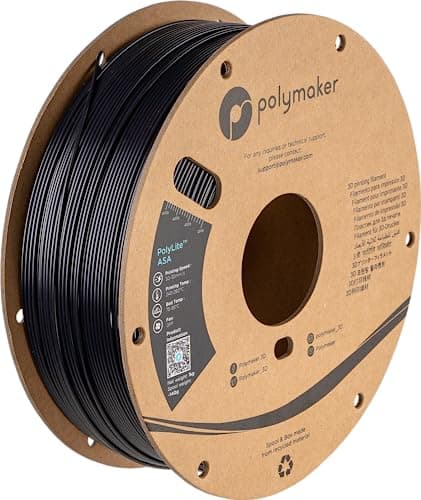 Polymaker ASAPolymaker Polymaker ASAPolymaker | Best for genuine sun exposure | 7.9 | $24.49 - Check price on Amazon |
| 2 | 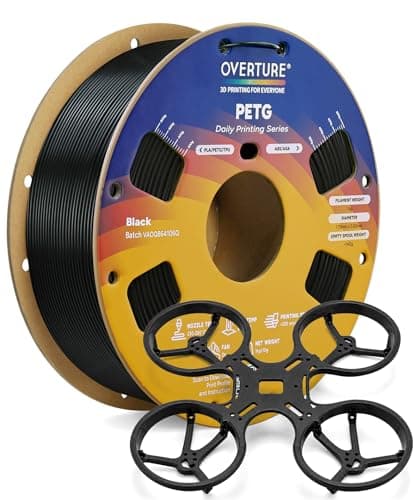 Overture High Speed PETGOverture Overture High Speed PETGOverture | Best on an open-frame printer | 7.9 | $13.22 - Check price on Amazon |
| 3 | 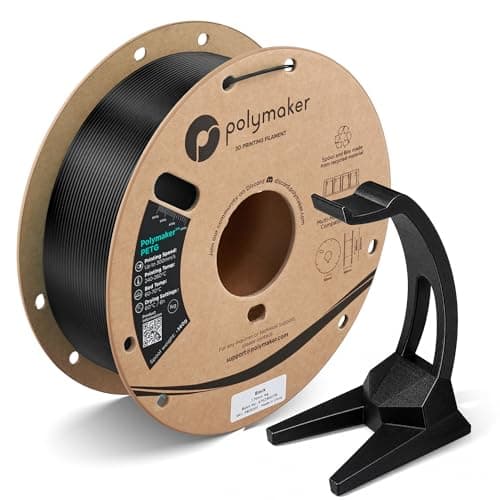 Polymaker PETGPolymaker Polymaker PETGPolymaker | Best documented PETG | 8.6 | $15.74 - Check price on Amazon |
#1 · Best for genuine sun exposure
Polymaker ASA
Polymaker · Parts that live outdoors
ABS that survives sunlight. Polymaker publishes a 240-260 C nozzle, a 75-95 C bed and speeds up to 200 mm/s - a wider and faster envelope than its own ABS - and rates it UV and weather resistant, which is the single reason to choose it.
#ad Price as of September 21, 2026, from Amazon. Prices change. How we make money.
What it actually is
A 1 kg spool of 1.75 mm ASA. Chemically it is a close relative of ABS with the weak link swapped out: the component that degrades in ultraviolet light is replaced, so the part does not go chalky in the sun.
Does it fit this page?
The only material here Polymaker actually rates as UV and weather resistant. Published at 240-260 C nozzle, 75-95 C bed and up to 200 mm/s. ASA is chemically ABS with the component that degrades in ultraviolet light swapped out, so it does not go chalky and brittle in sunlight. It needs an enclosure, which is the whole catch.
What the manufacturer states
| Figure | Value | Source |
|---|---|---|
| Printing temperature | 240 - 260 C | Polymaker ASA published print settings |
| Bed temperature | 75 - 95 C | Polymaker ASA published print settings |
| Printing speed | Up to 200 mm/s | Polymaker ASA published print settings |
| Drying | 70 C for 6 hours | Polymaker ASA published print settings |
| Spool size | 1 kg, 1.75 mm | Polymaker ASA published print settings |
Read from Polymaker, ASA product page and print settings on 2026-09-13. Where a manufacturer does not publish a figure, there is no row for it here.
What is good about it
- UV and weather resistant, per Polymaker's own rating - the one thing ABS cannot do
- A published speed range up to 200 mm/s against 30-50 mm/s for Polymaker's ABS, so it is far less of a wait
- A slightly lower bed range than ABS at 75-95 C, which widens the machines that can run it
- Same solvent-bonding and sanding behavior as ABS for finishing work
What is not
- It still contracts as it cools and still needs an enclosure - being outdoor-rated does not make it open-frame friendly
- The most expensive spool on this site per kilogram
- Emits the same kind of smell as ABS while printing
- Overkill for anything that lives indoors, where PETG does the job for less
Skip this one if
Skip it if the part stays inside. Everything you pay extra for here is ultraviolet resistance, and a shelf in a living room does not test it. Skip it too if your printer is open-frame, for the same reason as ABS.
What we cannot tell you
We have not printed this filament, and we have not left a printed part on a windowsill for a year. The UV claim is Polymaker's, published on their own page, and we are repeating it rather than confirming it.
How it scored for a beginner
- Ease for a beginner4.5
- Published data9.0
- Toughness8.5
- Heat resistance9.0
- Value7.0
Beginner fit 7.9 / 10. That is our editorial read of how well this suits someone buying their first printer, taken off the published specifications — not a test result, and not a verdict on absolute quality. It is deliberately not marked up as a rating in this page’s structured data. How we pick.
#2 · Best on an open-frame printer
Overture High Speed PETG
Overture · Parts that have to survive heat or flexing
The second spool, not the first. PETG is what you move to when a part has to survive a hot car, a bit of flex or the outdoors — and it is fussier about stringing and bed adhesion than PLA in exchange.
#ad Price as of September 21, 2026, from Amazon. Prices change. How we make money.
What it actually is
PETG is a tougher, slightly flexible plastic that tolerates heat far better than PLA. It prints hotter, sticks harder to the plate, and strings more. The same material family as a drinks bottle.
Does it fit this page?
The realistic answer for most people, because most beginner printers are open frames and cannot print ASA properly. PETG handles rain, resists heat far better than PLA and prints without a chamber. Overture publishes +/- 0.02 mm tolerance, 230-260 C and a 30-300 mm/s speed range. It is less UV-stable than ASA over years of direct sun.
What the manufacturer states
| Figure | Value | Source |
|---|---|---|
| Diameter | 1.75 mm | Overture published product specification |
| Dimensional accuracy | +/- 0.02 mm | Overture published product specification |
| Recommended nozzle temperature | 230 - 260 C | Overture published product specification |
| Recommended printing speed | 30 - 300 mm/s | Overture published product specification |
Read from Overture, High Speed PETG filament product page on 2026-09-01. Where a manufacturer does not publish a figure, there is no row for it here.
What is good about it
- Handles heat that would soften a PLA part into uselessness
- Tougher and less brittle than PLA, so it survives being dropped
- +/- 0.02 mm published tolerance, the same as Overture's PLA
- A 30 - 300 mm/s published speed range that fits current fast machines
What is not
- Strings between features far more readily than PLA
- 230 - 260 C means your printer's hot end has to be rated for it — the A1 mini's 300 C ceiling is fine, some older machines are not
- It can stick to a smooth PEI plate hard enough to damage the surface
- Absorbs moisture from the air faster than PLA, so an open spool goes off
Skip this one if
Skip it as a first spool. Learn what a good first layer looks like in PLA before you add a material that sticks too well and strings between everything. PETG is a solution to a problem you have not had yet.
What we cannot tell you
We have not printed this filament. How much stringing you get at a given retraction setting, and whether it damages a specific plate, depend on the machine and we have not tested either.
How it scored for a beginner
- Ease for a beginner6.5
- Published tolerance9.5
- Availability9.0
- Value per kilogram8.0
Beginner fit 7.9 / 10. That is our editorial read of how well this suits someone buying their first printer, taken off the published specifications — not a test result, and not a verdict on absolute quality. It is deliberately not marked up as a rating in this page’s structured data. How we pick.
#3 · Best documented PETG
Polymaker PETG
Polymaker · Functional parts that have to survive heat or a fall
The PETG for somebody who wants a published number for everything. Polymaker states a 240-260 C nozzle range, a 60-70 C bed, roughly 70 C heat deflection and speeds up to 300 mm/s, and it says plainly on its own product page that the material is very hygroscopic and will string if it is wet.
#ad Price as of September 21, 2026, from Amazon. Prices change. How we make money.
What it actually is
A 1 kg spool of 1.75 mm PETG. PETG is the tougher, more heat-resistant step up from PLA: it bends rather than snaps, it survives a hot car, and it is fussier about moisture in exchange.
Does it fit this page?
The same material choice with better paperwork. Polymaker publishes 240-260 C, a 60-70 C bed, up to 300 mm/s, a 20-60 percent part cooling range and an approximate 70 C heat deflection temperature - that last figure is the one that tells you whether a part survives a parked car or a south-facing wall in August.
What the manufacturer states
| Figure | Value | Source |
|---|---|---|
| Printing temperature | 240 - 260 C | Polymaker PETG published print settings |
| Bed temperature | 60 - 70 C | Polymaker PETG published print settings |
| Printing speed | Up to 300 mm/s | Polymaker PETG published print settings |
| Part cooling fan | 20 - 60 percent | Polymaker PETG published print settings |
| Heat deflection | Approximately 70 C HDT | Polymaker PETG published print settings |
| Drying | 60 C for 6 hours, only if the spool has absorbed moisture | Polymaker PETG published print settings |
| Spool size | 1 kg, 1.75 mm | Polymaker PETG published print settings |
Read from Polymaker, PETG product page and print settings on 2026-09-06. Where a manufacturer does not publish a figure, there is no row for it here.
What is good about it
- Polymaker publishes the full print profile — temperatures, fan percentage and separate retraction figures for direct-drive and indirect-drive extruders
- Roughly 70 C heat deflection, which is the specification that lets a PETG part live in a car in summer
- Polymaker states it is less brittle and more impact-resistant than PLA, which is the reason to move up from PLA at all
- Ships in a resealable vacuum barrier bag, so the spool starts dry
What is not
- Polymaker says on its own page that the material is very hygroscopic — a wet spool strings badly and prints poorly
- 240-260 C is hotter than PLA, so a printer with a 250 C ceiling is working at its limit
- More expensive per kilogram than the mainstream PLA on this site
- PETG is stickier on the plate than PLA, which makes first prints harder to remove, not harder to start
Skip this one if
Skip it if your printing is decorative and lives indoors. PLA is easier, cheaper, prints cooler and looks better. PETG is a materials upgrade bought for a reason, and 'I saw it recommended' is not one.
What we cannot tell you
We have not printed this filament. Real spool-to-spool consistency, how much stringing survives a correct dry, and how the color matches the swatch are all things that need a printer and a spool.
How it scored for a beginner
- Ease for a beginner7.5
- Published data9.5
- Toughness9.0
- Heat resistance9.0
- Value8.0
Beginner fit 8.6 / 10. That is our editorial read of how well this suits someone buying their first printer, taken off the published specifications — not a test result, and not a verdict on absolute quality. It is deliberately not marked up as a rating in this page’s structured data. How we pick.
How these were picked
We have not printed on these machines and we do not pretend to have. What we did was read each manufacturer’s own specification page, take their stated build volume, temperatures and speeds, check that every pick genuinely fits the job in this page’s title, confirm it is still being sold, and pull a live price rather than a remembered one. Every figure names the source it came from, so you can check it yourself in about a minute.
How we pick sets out the full method, including what would change a ranking.
Questions people actually ask
+−Can you use PLA outdoors?
Only for parts you are happy to replace, in shade. PLA has poor UV resistance and the lowest heat resistance of the common filaments, so it fades, embrittles and can soften in direct summer sun. For anything structural or sun-exposed, use PETG or ASA.
+−Is ASA or PETG better for outdoor use?
ASA, on UV resistance — Polymaker rates its ASA as UV and weather resistant and makes no such claim for PETG. But ASA needs an enclosed printer, so for most beginners PETG is the better practical answer. Choose on what your printer can do first.
+−Why does ABS go yellow outside?
Ultraviolet light degrades one of the components in ABS, which shows as yellowing, a chalky surface and brittleness. ASA is chemically very similar with that vulnerable component replaced, which is the entire reason it exists as a separate material.
+−Does PETG survive rain?
Yes. Water is not the problem for any of these materials — UV and heat are. PETG is commonly used for outdoor parts and handles wet conditions well. Design the part so water runs off rather than pooling in a seam.