Head to head
PLA vs PETG
Print PLA. Switch to PETG for the specific parts that need to survive heat or bend without snapping. That is the whole answer; the table below is why.
By Scooter M. · Published · Last reviewed
How this page is funded: the buy links below are affiliate links. If you buy through one we earn a commission, at no extra cost to you. It does not change the order of the picks or a word of what we say about them. Full disclosure.
Printers we claim to have tested: 0. Everyone in this category says they tested twenty machines. We have not tested any, and we would rather say so. What we did instead is on this page: the manufacturer’s own published specification for every pick, cited and dated; the arithmetic on what it costs to run, with the inputs shown; a live price rather than a remembered one; and a plain answer on who should skip each machine.
The short answer
Use PLA unless the part will get hot or needs to flex. PLA is easier in every way that matters to a beginner: lower temperatures, less stringing, no enclosure, and it forgives a lot. PETG survives a hot car and bends rather than snapping, and it charges you in stringing and in sticking to the plate a bit too enthusiastically.
The comparison, in one table
Temperature and tolerance figures are from Overture's own published product pages for its PLA and High Speed PETG, read on 2026-09-01. The qualitative rows are our editorial judgment, not measurements.
| PLA | PETG | |
|---|---|---|
| Nozzle temperature | 190 - 220 C | 230 - 260 C |
| Bed temperature | 25 - 60 C | Warmer; check your spool |
| Published diameter tolerance | +/- 0.02 mm | +/- 0.02 mm |
| Heat resistance in use | Poor - softens in a hot car | Good |
| Flexibility | Brittle - snaps rather than bends | Bends, then breaks |
| Stringing between features | Minimal | Noticeably more |
| Bed adhesion | Good | Sometimes too good - can damage a smooth plate |
| Moisture sensitivity | Moderate | High - an open spool goes off faster |
| Needs an enclosure? | No | No |
| Good first filament? | Yes | No |
Which is stronger? A more useful answer than the usual one
“Stronger” hides two different properties and this is where most comparisons of these two materials go wrong.
Stiffness. PLA is stiffer. A PLA bracket flexes less under load than a PETG one, which is why PLA is often the better choice for something that must hold its shape.
Toughness. PETG wins, and it is not close. PLA is brittle: load it past its limit and it snaps cleanly. PETG deforms first. For a clip that has to spring, a hinge, or anything that gets dropped, PETG survives what PLA does not.
So the honest answer to “which is stronger” is: PLA resists bending better, PETG resists breaking better. Pick by which failure you are worried about.
Heat, which is the clearest reason to switch
This is the least ambiguous difference between them. PLA softens at temperatures a parked car reaches on a summer afternoon. If your part is going on a dashboard, in a window, near a radiator, or outdoors in the sun, PLA will eventually droop and PETG will not.
People discover this the same way every time: a perfectly good phone mount, one hot day, and a sad curved thing that used to be a phone mount.
What PETG actually costs you at the printer
- Stringing. PETG leaves fine threads between features far more readily than PLA. It is manageable with retraction tuning and it is genuinely more work.
- Too much bed adhesion. PETG can bond so well to a smooth PEI plate that removing the part takes surface with it. Glue stick is the standard answer — not to help it stick, but as a release layer to stop it sticking too hard.
- Higher temperatures. 230–260 °C means your hot end has to be rated for it. Most current machines publish a 300 °C ceiling and are fine; some older ones are not.
- Moisture. PETG absorbs water from the air faster than PLA, so an open spool goes off sooner. This is the material that makes a dry box or a dryer worth owning.
What about ABS, ASA and TPU?
Briefly: ABS and ASA handle more heat than PETG and want an enclosure, because they shrink as they cool and lift off an open plate. TPU is rubbery and prints slowly. All three are covered in the filament types guide, and none of them belongs in a first month.
If PETG is where you have landed, the spools we would buy — with their published temperatures, tolerances and drying figures — are on the best PETG filament page.
What we would buy for this
Chosen from the same registry as our roundups, on the manufacturer’s own published figures and a live price.
Overture PLA
Overture · Your first spool, and your tenth
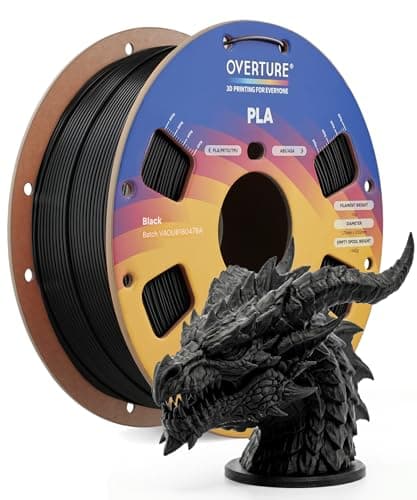
The default answer to 'what filament should I buy'. A tight published diameter tolerance, a conventional temperature range every printer profile already expects, and it is sold everywhere. Nothing about it is exciting, which is the point.
#ad Price as of October 19, 2026, from Amazon. Prices change. How we make money.
What it actually is
PLA is the plastic beginners should print. It is stiff, it needs no enclosure, it barely smells, and it sticks to a plate at low temperatures. This is a mainstream 1 kg spool of it.
What the manufacturer states
| Figure | Value | Source |
|---|---|---|
| Diameter | 1.75 mm | Overture published product specification |
| Dimensional accuracy | +/- 0.02 mm | Overture published product specification |
| Spool weight | 1 kg (2.2 lb) | Overture published product specification |
| Recommended nozzle temperature | 190 - 220 C | Overture published product specification |
| Recommended bed temperature | 25 - 60 C | Overture published product specification |
| Packaging | Dried before packing and vacuum sealed | Overture published product specification |
Read from Overture, PLA filament product page on 2026-09-01. Where a manufacturer does not publish a figure, there is no row for it here.
What is good about it
- +/- 0.02 mm published tolerance, which is as tight as mainstream PLA is quoted
- 190 - 220 C is squarely inside every stock PLA profile you will meet
- A 25 - 60 C bed range means it will stick even on an unheated or barely warm plate
- Vacuum sealed with desiccant, so a spool bought in advance is still dry when it arrives
What is not
- PLA softens in a hot car or a sunny window — this is a property of the material, not the brand
- Not the cheapest per kilogram once you start printing seriously
- Color consistency between batches of any budget filament is a real thing
- No filament is a fix for a machine that is not leveled
Skip this one if
Skip it if the part you are making will live outdoors or in a car. That is a PETG job, not a PLA one, and no PLA brand changes that.
What we cannot tell you
We have not printed this filament. Batch-to-batch color consistency and how it behaves after a year in a cupboard are things only repeated use reveals.
How it scored for a beginner
- Ease for a beginner9.5
- Published tolerance9.5
- Availability9.5
- Value per kilogram8.0
Beginner fit 9.0 / 10. That is our editorial read of how well this suits someone buying their first printer, taken off the published specifications — not a test result, and not a verdict on absolute quality. It is deliberately not marked up as a rating in this page’s structured data. How we pick.
Overture High Speed PETG
Overture · Parts that have to survive heat or flexing
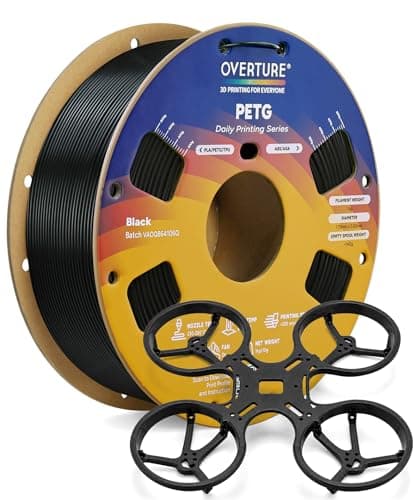
The second spool, not the first. PETG is what you move to when a part has to survive a hot car, a bit of flex or the outdoors — and it is fussier about stringing and bed adhesion than PLA in exchange.
#ad Price as of October 19, 2026, from Amazon. Prices change. How we make money.
What it actually is
PETG is a tougher, slightly flexible plastic that tolerates heat far better than PLA. It prints hotter, sticks harder to the plate, and strings more. The same material family as a drinks bottle.
What the manufacturer states
| Figure | Value | Source |
|---|---|---|
| Diameter | 1.75 mm | Overture published product specification |
| Dimensional accuracy | +/- 0.02 mm | Overture published product specification |
| Recommended nozzle temperature | 230 - 260 C | Overture published product specification |
| Recommended printing speed | 30 - 300 mm/s | Overture published product specification |
Read from Overture, High Speed PETG filament product page on 2026-09-01. Where a manufacturer does not publish a figure, there is no row for it here.
What is good about it
- Handles heat that would soften a PLA part into uselessness
- Tougher and less brittle than PLA, so it survives being dropped
- +/- 0.02 mm published tolerance, the same as Overture's PLA
- A 30 - 300 mm/s published speed range that fits current fast machines
What is not
- Strings between features far more readily than PLA
- 230 - 260 C means your printer's hot end has to be rated for it — the A1 mini's 300 C ceiling is fine, some older machines are not
- It can stick to a smooth PEI plate hard enough to damage the surface
- Absorbs moisture from the air faster than PLA, so an open spool goes off
Skip this one if
Skip it as a first spool. Learn what a good first layer looks like in PLA before you add a material that sticks too well and strings between everything. PETG is a solution to a problem you have not had yet.
What we cannot tell you
We have not printed this filament. How much stringing you get at a given retraction setting, and whether it damages a specific plate, depend on the machine and we have not tested either.
How it scored for a beginner
- Ease for a beginner6.5
- Published tolerance9.5
- Availability9.0
- Value per kilogram8.0
Beginner fit 7.9 / 10. That is our editorial read of how well this suits someone buying their first printer, taken off the published specifications — not a test result, and not a verdict on absolute quality. It is deliberately not marked up as a rating in this page’s structured data. How we pick.
How these were picked
We have not printed on these machines and we do not pretend to have. What we did was read each manufacturer’s own specification page, take their stated build volume, temperatures and speeds, check that every pick genuinely fits the job in this page’s title, confirm it is still being sold, and pull a live price rather than a remembered one. Every figure names the source it came from, so you can check it yourself in about a minute.
How we pick sets out the full method, including what would change a ranking.
Questions people actually ask
+−Is PETG stronger than PLA?
It depends which kind of strength. PLA is stiffer — it resists bending better. PETG is tougher — it deforms before it breaks where PLA snaps. For anything that gets dropped, flexed or clipped, PETG survives more.
+−What temperature does PETG print at?
Overture publishes 230–260 °C at the nozzle for its High Speed PETG, against 190–220 °C for its PLA. Check your own spool: manufacturers differ, and the number on the box is the one that matters.
+−Does PETG handle heat better than PLA?
Yes, clearly, and it is the least ambiguous reason to switch. PLA softens at temperatures a parked car reaches in summer. For anything going on a dashboard, in a sunny window or outdoors, use PETG.
+−Can a beginner printer handle PETG?
Most current machines can — they publish 300 °C hot end ceilings, comfortably above PETG’s range. The question is whether you should as a first material, and the answer is no. Learn what a good first layer looks like in PLA first.