Head to head
3D Printer vs CNC Machine
One builds an object up from nothing, the other carves it out of a block. That single difference decides almost everything else, including which one belongs in a spare room.
By Scooter M. · Published · Last reviewed
How this page is funded: the buy links below are affiliate links. If you buy through one we earn a commission, at no extra cost to you. It does not change the order of the picks or a word of what we say about them. Full disclosure.
Printers we claim to have tested: 0. Everyone in this category says they tested twenty machines. We have not tested any, and we would rather say so. What we did instead is on this page: the manufacturer’s own published specification for every pick, cited and dated; the arithmetic on what it costs to run, with the inputs shown; a live price rather than a remembered one; and a plain answer on who should skip each machine.
The short answer
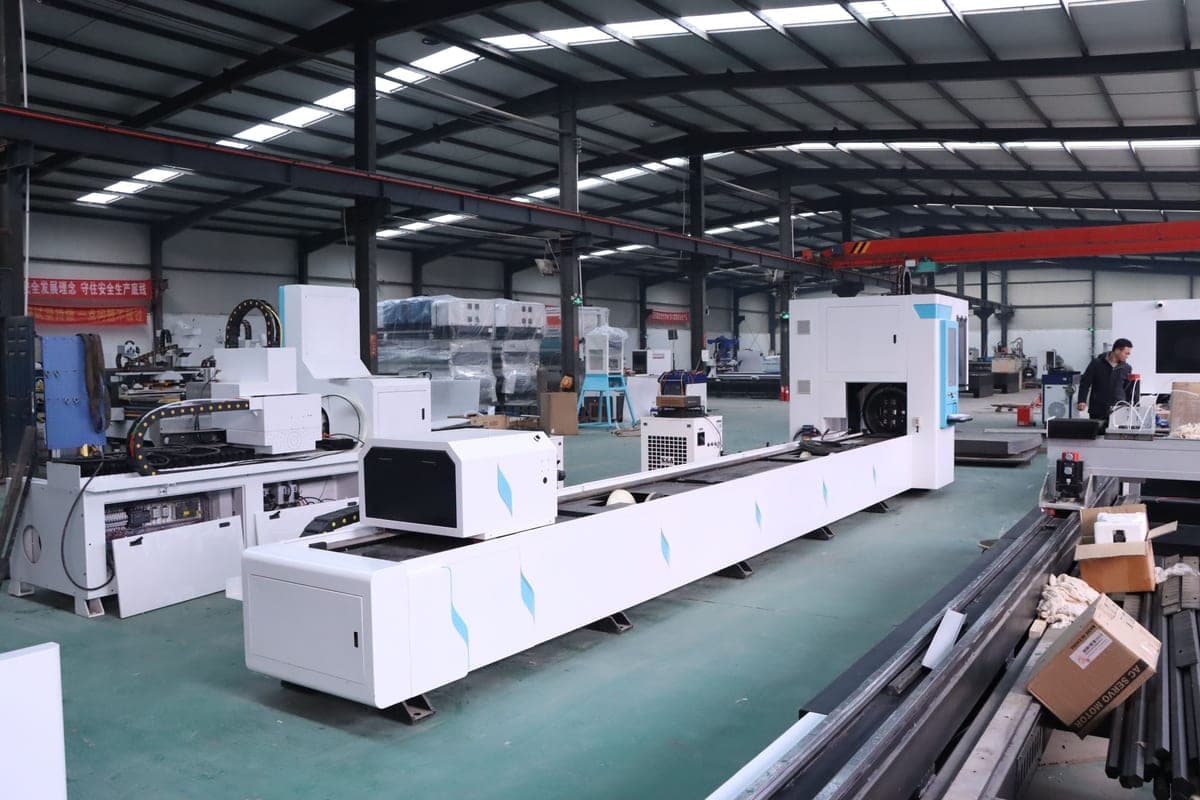
Buy a 3D printer if your projects have shapes. Buy a CNC router if they have to be made of wood or metal. A printer makes complex geometry easily in plastic. A router makes strong, real-material parts and brings dust, noise and a genuine need for space and safety equipment.
The one difference everything follows from
A 3D printer is additive. It starts with nothing and builds the object up layer by layer. Complexity is therefore essentially free: an object with internal channels, nested moving parts or an intricate lattice costs the same effort as a plain block of the same size.
A CNC router is subtractive. It starts with a block of material and cuts away everything that is not the object. That means it works in real materials — hardwood, aluminum, acrylic — and it means anything the cutting bit cannot physically reach cannot be made. Undercuts and internal cavities are hard or impossible.
Every other difference on this page is downstream of those two sentences.
The comparison as it affects a first workshop machine.
| 3D printer | CNC router | |
|---|---|---|
| Method | Builds up, layer by layer | Cuts away from a solid block |
| Materials | Plastics: PLA, PETG, TPU, ABS | Wood, plastics, soft metals like aluminum |
| Complex geometry | Essentially free | Limited by what the bit can reach |
| Part strength | Good to very good in PETG | As strong as the material itself |
| Mess | Almost none | Dust and chips everywhere. Extraction needed |
| Noise | Noticeable, rhythmic | Loud. Hearing protection territory |
| Space | A shelf or a desk | A dedicated area with clearance around it |
| Supervision | Can run unattended | Should be watched |
| Learning curve | Download a model, press print | Toolpaths, feeds, speeds, workholding |
| Consumable cost | Filament, cheap per object | Stock material plus cutting bits, which wear |
Which one fits your projects
The useful question is not which is more capable. It is which one matches the next three things you actually want to make.
A 3D printer suits: replacement parts and brackets, organizers and containers, prototypes, models and figures, anything with a complex internal shape, anything you want to iterate on quickly.
A CNC router suits: furniture components, engraved signs and plaques, jigs and fixtures for other work, anything that must be hardwood, anything that must be aluminum, and parts that need real structural strength.
What a router demands that a printer does not
- Dust extraction. Not optional. A router turns solid material into airborne dust, and fine wood dust is a genuine respiratory hazard as well as a mess.
- Hearing and eye protection. It is loud, and it throws chips.
- Workholding. The stock has to be clamped down securely, and getting that wrong is how material gets thrown across a room.
- Space with clearance. Not just the machine footprint — room to stand at it, room for the stock, and room for the mess.
- More learning. Toolpaths, feeds and speeds, bit selection. It is genuinely a craft, and that is either the appeal or the obstacle.
A 3D printer, by contrast, wants a solid surface out of a draft and nothing else. That difference is why one of these is a spare-bedroom machine and the other is a garage machine. Where to put your printer covers the printer side.
The honest answer for most people
Start with the printer. It is quieter, cleaner, safer to leave running, and its learning curve is shallow enough that you make something useful in the first week. If after six months you keep hitting the limits of plastic — parts that need to be stronger, or objects that must be wood — that is a well-informed reason to add a router, and you will know exactly what you want from it.
Going the other way round is harder, because a router asks for a workshop and a skill set before it makes anything.
What we would buy for this
Chosen from the same registry as our roundups, on the manufacturer’s own published figures and a live price.
Bambu Lab A1 mini
Bambu Lab · A genuine first printer
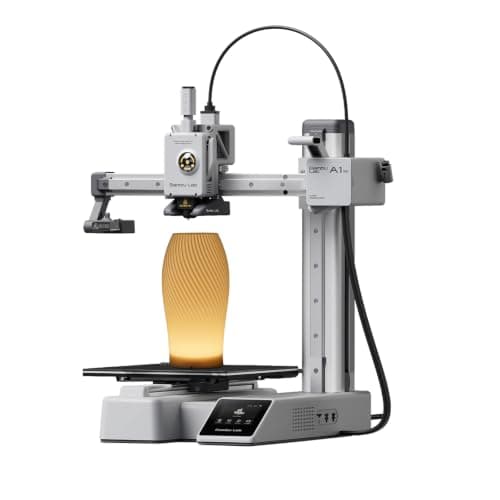
The one to get if you have never done this before. It calibrates itself before every print — bed mesh, Z-offset, flow, resonance — so the part of 3D printing that used to defeat beginners is a step you never see. The build volume is the price you pay.
#ad Price as of October 19, 2026, from Amazon. Prices change. How we make money.
What it actually is
A small open-frame filament printer. Filament is a 1.75 mm plastic string on a spool; the machine melts it and draws your object one layer at a time. Open-frame means there is no box around it, which is fine for PLA and a limitation for materials that warp.
What the manufacturer states
| Figure | Value | Source |
|---|---|---|
| Build volume | 180 x 180 x 180 mm | Bambu Lab A1 mini technical specifications |
| Max hot end temperature | 300 C | Bambu Lab A1 mini technical specifications |
| Max build plate temperature | 80 C | Bambu Lab A1 mini technical specifications |
| Max toolhead speed | 500 mm/s | Bambu Lab A1 mini technical specifications |
| Max toolhead acceleration | 10,000 mm/s2 | Bambu Lab A1 mini technical specifications |
| Filaments rated ideal | PLA, PETG, TPU, PVA | Bambu Lab A1 mini technical specifications |
| Filaments not recommended | ABS, ASA, PC, PA, PET, carbon/glass fiber reinforced | Bambu Lab A1 mini technical specifications |
| Machine dimensions | 347 x 315 x 365 mm | Bambu Lab A1 mini technical specifications |
| Net weight | 5.5 kg | Bambu Lab A1 mini technical specifications |
| Max power | 150 W | Bambu Lab A1 mini technical specifications |
Read from Bambu Lab, A1 mini technical specifications on 2026-09-01. Where a manufacturer does not publish a figure, there is no row for it here.
What is good about it
- Full auto-calibration on every print, per Bambu Lab's own specification — no paper-under-the-nozzle ritual
- Rated ideal for PLA, PETG, TPU and PVA, which covers everything a beginner should print in year one
- 150 W maximum power draw is the lowest of any printer on this site, so running cost is trivial
- 5.5 kg and 347 mm wide — it fits on a desk without rearranging the room
What is not
- 180 mm cubed is genuinely small. A full-size helmet or a large cosplay prop will not fit
- Bambu Lab rates ABS, ASA, PC and fiber-reinforced filaments as not recommended on this machine
- The multi-color AMS lite is a separate purchase, so the headline price is not the multi-color price
- Bambu Lab's own Amazon store lists this machine bundled with an LED lamp kit rather than on its own, so the price on our button is for that bundle. The bare printer is sold direct on Bambu Lab's store
- Open frame, so it is at the mercy of a draft from a window or an air conditioning vent
Skip this one if
Skip it if you already know the thing you want to print is bigger than a shoebox, or if you specifically want ABS or a carbon-fiber-filled filament. Bambu Lab itself lists those materials as not recommended here, and buying a machine you intend to use outside its rated envelope is how a first printer becomes a frustrating one.
What we cannot tell you
We have not printed on this machine. Long-term reliability, real-world noise in a quiet room, and how the textured plate holds up after a year are all things we cannot honestly report without owning one.
How it scored for a beginner
- Setup out of the box9.5
- Auto-calibration10.0
- First-layer forgiveness9.5
- Parts and filament availability9.0
- Running cost10.0
- Help when it goes wrong9.0
Beginner fit 9.2 / 10. That is our editorial read of how well this suits someone buying their first printer, taken off the published specifications — not a test result, and not a verdict on absolute quality. It is deliberately not marked up as a rating in this page’s structured data. How we pick.
Elegoo Centauri Carbon
Elegoo · An enclosed printer without an enclosed-printer budget
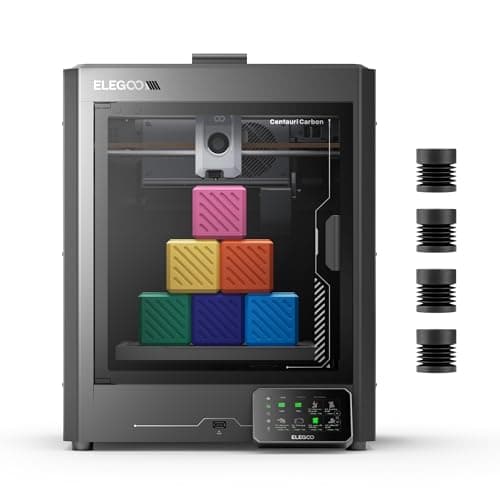
An enclosed CoreXY printer at a price that used to buy an open frame. If the reason you are hesitating about a beginner machine is that you can already see yourself outgrowing it, this is the one that answers that.
#ad Price as of October 19, 2026, from Amazon. Prices change. How we make money.
What it actually is
A boxed CoreXY machine with a steel chassis and aluminum and glass panels. The enclosure holds chamber heat, which is what lets it handle materials that shrink and peel on an open frame.
What the manufacturer states
| Figure | Value | Source |
|---|---|---|
| Build volume | 256 x 256 x 256 mm | Elegoo Centauri Carbon product specifications |
| Motion system | CoreXY | Elegoo Centauri Carbon product specifications |
| Enclosure | Fully enclosed; steel chassis with aluminum and glass shell | Elegoo Centauri Carbon product specifications |
| Maximum speed | 500 mm/s | Elegoo Centauri Carbon product specifications |
| Maximum acceleration | 20,000 mm/s2 (10,000 mm/s2 default) | Elegoo Centauri Carbon product specifications |
| Max nozzle temperature | 320 C | Elegoo Centauri Carbon product specifications |
| Max heated bed temperature | 110 C at 25 C ambient | Elegoo Centauri Carbon product specifications |
| Supported filament | PLA, PETG, ABS, ASA, TPU, PET, PC, PA and carbon or glass fiber reinforced grades | Elegoo Centauri Carbon product specifications |
| Bed leveling | 121-point auto-leveling; full-auto calibration | Elegoo Centauri Carbon product specifications |
| Print accuracy | +/- 0.1 mm | Elegoo Centauri Carbon product specifications |
| Machine size and weight | 398 x 404 x 490 mm, 17.5 kg | Elegoo Centauri Carbon product specifications |
| Rated power | 350 W at 110 V | Elegoo Centauri Carbon product specifications |
| Operating sound | 55 dB or below | Elegoo Centauri Carbon product specifications |
Read from Elegoo, Centauri Carbon product page on 2026-09-06. Where a manufacturer does not publish a figure, there is no row for it here.
What is good about it
- Fully enclosed at a price that competes with open-frame machines
- 20,000 mm/s2 rated acceleration, matching the enclosed Bambu
- 256 mm cubed — the same working envelope as an A1 or a P1S
- The enclosure contains noise and smell, which decides whether a printer can live in a bedroom
What is not
- A newer platform than the Bambu and Creality lines, so there is less community troubleshooting behind it
- An enclosure adds a heat-soak wait to PLA prints in a warm room
- Larger and heavier than any open-frame machine here
- Nothing about the enclosure makes the first print easier — it makes later prints possible
Skip this one if
Skip it if PLA is all you will ever print and your printer lives in a spare room. You are paying for a box you will not use. The enclosure earns its money on ABS, ASA and a shared living space, not on PLA in a garage.
What we cannot tell you
We have not printed on this machine. Chamber temperature in practice, panel fit and finish, and long-term CoreXY belt tension are not published numbers.
How it scored for a beginner
- Setup out of the box8.5
- Auto-calibration8.5
- First-layer forgiveness8.5
- Parts and filament availability7.5
- Running cost8.0
- Help when it goes wrong7.5
Beginner fit 8.3 / 10. That is our editorial read of how well this suits someone buying their first printer, taken off the published specifications — not a test result, and not a verdict on absolute quality. It is deliberately not marked up as a rating in this page’s structured data. How we pick.
How these were picked
We have not printed on these machines and we do not pretend to have. What we did was read each manufacturer’s own specification page, take their stated build volume, temperatures and speeds, check that every pick genuinely fits the job in this page’s title, confirm it is still being sold, and pull a live price rather than a remembered one. Every figure names the source it came from, so you can check it yourself in about a minute.
How we pick sets out the full method, including what would change a ranking.
Questions people actually ask
+−Should I buy a 3D printer or a CNC machine first?
A 3D printer, for most people. It is quieter, cleaner, safe to leave running, needs only a solid surface, and you will make something useful in the first week. Add a router later if you keep hitting the limits of plastic.
+−Is a CNC machine stronger than a 3D printer?
The parts are, yes — a CNC part is as strong as the solid material it was cut from, whereas a printed part is built in layers and is weakest across them. If structural strength in wood or metal is the requirement, that is a router job.
+−Can a CNC machine make the same things as a 3D printer?
No. A cutting bit cannot reach into undercuts or enclosed cavities, so complex internal geometry and nested moving parts are printer territory. Conversely a printer cannot make anything out of hardwood or aluminum.
+−Is a CNC router noisy?
Yes, meaningfully so — hearing protection territory, and it produces dust that needs extraction. That is the practical reason a router is a garage machine and a printer can live in a spare room.