Review
FlashForge Adventurer 5M Review
The Adventurer 5M puts a CoreXY frame in a price bracket where almost everything else is a bed-slinger. That is a real advantage. The 600 mm/s on the box is not what most people think it is.
By Scooter M. · Published · Last reviewed
How this page is funded: the buy links below are affiliate links. If you buy through one we earn a commission, at no extra cost to you. It does not change the order of the picks or a word of what we say about them. Full disclosure.
Printers we claim to have tested: 0. Everyone in this category says they tested twenty machines. We have not tested any, and we would rather say so. What we did instead is on this page: the manufacturer’s own published specification for every pick, cited and dated; the arithmetic on what it costs to run, with the inputs shown; a live price rather than a remembered one; and a plain answer on who should skip each machine.
The short answer
Buy it if you want a CoreXY machine and cannot stretch to an enclosed one. FlashForge publishes a 220 mm cube, a 280 C direct-drive hot end, a flexible PEI plate, quick-detach nozzles in four diameters and automatic leveling — a strong sheet for the money. Two things to know before you buy: the headline 600 mm/s is the travel speed on FlashForge’s own spec table, not a print speed, and the frame is open, so ABS and ASA are not really on the menu without the separately sold enclosure.
We have not printed on this machine, and nothing below pretends otherwise. What follows is FlashForge’s published specification read carefully, the places where the marketing and the spec table disagree, and an honest read of who the machine suits.
What CoreXY actually buys you
Most printers at this price are bed-slingers: the plate moves forward and back on the Y axis while the head moves left and right. That works, and the Ender-3 V3 SE is a perfectly good example of it. The problem is that the bed has mass, and a tall print sitting on a bed that is accelerating back and forth wobbles.
CoreXY moves the print head in both X and Y and only drops the bed down as the print grows. Nothing heavy is being flung around, so the machine can accelerate harder without shaking the part. FlashForge publishes a maximum acceleration of 20,000 mm/s2 here, which is the same figure Bambu publishes for the enclosed P1S and double what Bambu publishes for the bed-slinging A1.
Getting that layout at this price is the single best reason to consider this printer.
The speed claim, read properly
This is not a scandal and the machine is genuinely quick — the 20,000 mm/s2 acceleration figure is the one that matters more in practice anyway, because on real models with small features a printer spends most of its time accelerating and decelerating rather than reaching top speed. But it is worth knowing that the biggest number on the box describes the machine moving through thin air.
The specification, and what each line means
All figures from FlashForge's published Adventurer 5M specification table.
| Specification | Figure | What it means for you |
|---|---|---|
| Build volume | 220 x 220 x 220 mm | A cube rather than the taller rectangle most bed-slingers give you. Fine for almost everything a beginner prints. |
| Extruder | Direct drive, 280 C | Direct drive handles flexible filament far better than a Bowden setup. 280 C is hotter than most machines in this bracket. |
| Platform temperature | 100 C | Enough for PLA, PETG and TPU. ABS wants this plus a hot chamber, which this machine does not have. |
| Build plate | Flexible removable PEI steel | The right kind of plate. Prints pop off when it flexes, so no scraping. |
| Nozzles | 0.25 / 0.4 / 0.6 / 0.8 mm, swapped in 3 seconds | Tool-free nozzle changes are unusual at this price and genuinely convenient. |
| Shell | Open | The single most important line. No chamber means ABS and ASA will warp. |
| Leveling | Automatic Datum Management | Automatic. No paper-and-knob routine, which is the step that defeats most first-time owners. |
| Assembly | 95 percent pre-assembled | Screen and spool holder only. Short path from box to first print. |
| Connectivity | Wi-Fi, Ethernet, USB | Ethernet at this price is unusual and useful if your Wi-Fi is poor. |
| Noise and air filtration | Both rows left blank | FlashForge publishes nothing for either, so neither can be checked before buying. |
What it prints well, and what it does not
FlashForge recommends PLA and PETG on the standard 0.4 mm nozzle, and lists TPU, PLA-CF and PETG-CF on the 0.6 mm nozzle. Its own FAQ says plainly that PLA and PETG filaments give the best results. That is a refreshingly honest position and it matches the hardware: a direct drive handles flexible TPU well, and a 280 C hot end has headroom for the carbon-filled blends that chew through brass nozzles.
What it does not do is ABS and ASA. The shell row on the spec table says “Open”, and an open frame cannot hold the chamber heat those materials need. FlashForge sells enclosure files and an enclosure kit separately — which tells you the base machine is not intended for it. If ABS is your plan, our enclosed printer roundup is the better starting point, and the enclosure guide explains why a tent is not the same thing as a designed chamber.
How it compares to the machines around it
Against the Ender-3 V3 KE. Similar money. The KE is a bed-slinger with a 220 x 220 x 240 mm volume and a 500 mm/s rating; the 5M is CoreXY with a 220 mm cube. The frame layout favors the FlashForge; Creality’s parts ecosystem and community favor the KE. If you expect to tinker, the Ender has more people to ask.
Against the Bambu A1. The A1 is a bed-slinger with a larger 256 mm cube and a genuinely exceptional out-of-box experience, plus the option of the AMS lite for multi-color later. The 5M gives you the better frame layout for less money. The A1 gives you the smoother path and a bigger plate.
Against an enclosed machine. If you can stretch further, the P1S is CoreXY and enclosed and filtered. That is the machine this one is competing against on layout and losing to on materials.
The honest downsides
The speed claim needs translating. Covered above. FlashForge itself is straight about it in the spec table; the listings that sell it are not.
Two spec rows are blank. Noise and air filtration are both empty on FlashForge’s published table. For an open-frame machine air filtration is a fair omission, but publishing no noise figure at all is a gap, and it is the thing people most often regret not checking. Our placement guide matters more when you cannot look the number up.
The smallest build volume in its bracket. 220 mm cube against 256 mm for the A1 and the Centauri Carbon 2. It rarely matters, and when it does it matters a lot.
Single extruder. No multi-color path at all, unlike the A1 with AMS lite or the Combo machines. If printing in more than one color is part of why you want a printer, this is the wrong one — see our multi-color roundup.
A shorter warranty on the parts that wear. FlashForge publishes one year on the printer and three months on extruder parts. The extruder is the assembly most likely to give trouble.
Who should buy it
Someone who wants CoreXY rigidity, prints PLA and PETG, values a direct drive for the occasional TPU print, and is not planning to print ABS. At this price that is a genuinely strong combination, and there is not much else offering that frame layout for the money.
Skip it if you want ABS or ASA, if you want multi-color, or if you want the largest plate you can get for the budget. And if you are still working out which bracket to shop in at all, start with the beginner roundup rather than with a single machine.
What we cannot tell you
We have not run this printer. How loud it is, what print speed it actually sustains on real geometry, how well the three-second nozzle coupling seals after twenty swaps, and how FlashForge’s support behaves when something breaks are all things a specification sheet cannot answer. On noise in particular, FlashForge publishes no figure, so neither we nor you can check it before the box arrives.
What we would buy for this
Chosen from the same registry as our roundups, on the manufacturer’s own published figures and a live price.
FlashForge Adventurer 5M
FlashForge · A first CoreXY machine without paying CoreXY money
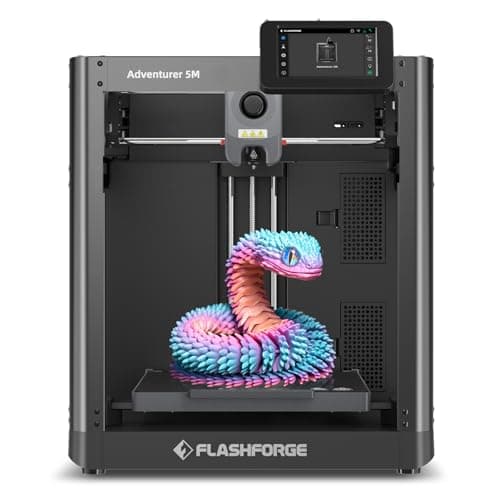
A CoreXY frame, a 280 C direct-drive hot end and a nozzle you swap in three seconds, at the price most brands charge for a bed-slinger. Read FlashForge's own spec table before you believe the 600 mm/s on the box - that number is the travel speed, not the print speed.
#ad Price as of September 21, 2026, from Amazon. Prices change. How we make money.
What it actually is
An open-frame CoreXY printer. CoreXY means the print head moves in both X and Y while the bed only moves down, so there is no heavy bed swinging back and forth - the layout fast printers use.
What the manufacturer states
| Figure | Value | Source |
|---|---|---|
| Build volume | 220 x 220 x 220 mm | FlashForge Adventurer 5M specification table |
| Speed | Max travel speed 600 mm/s (FlashForge's spec table states this as TRAVEL speed) | FlashForge Adventurer 5M specification table |
| Acceleration | Max 20,000 mm/s2 | FlashForge Adventurer 5M specification table |
| Extruder | Direct drive, quantity 1 | FlashForge Adventurer 5M specification table |
| Max extruder temperature | 280 C | FlashForge Adventurer 5M specification table |
| Platform temperature | 100 C | FlashForge Adventurer 5M specification table |
| Build plate | Flexible removable PEI steel plate | FlashForge Adventurer 5M specification table |
| Nozzle diameters | 0.25 / 0.4 / 0.6 / 0.8 mm, quick-detach in 3 seconds | FlashForge Adventurer 5M specification table |
| Shell | Open | FlashForge Adventurer 5M specification table |
| Leveling | Automatic Datum Management (ADM) real-time adjustment and auto-leveling | FlashForge Adventurer 5M specification table |
| Display | 4.3-inch touchscreen | FlashForge Adventurer 5M specification table |
| Connectivity | Wi-Fi, Ethernet, USB | FlashForge Adventurer 5M specification table |
| Supported filament | PLA and PETG recommended on the 0.4 mm nozzle; TPU, PLA-CF and PETG-CF on the 0.6 mm nozzle | FlashForge Adventurer 5M specification table |
| Machine size | 363 x 376 x 413 mm excluding the screen and spool holder | FlashForge Adventurer 5M specification table |
| Power | AC 100-120 / 200-240 V, 50/60 Hz, 350 W | FlashForge Adventurer 5M specification table |
| Assembly | 95 percent pre-assembled; only the display and filament holder fit on | FlashForge Adventurer 5M specification table |
| Warranty | 1-year limited on the printer, 3 months on extruder parts | FlashForge Adventurer 5M specification table |
| Noise and air filtration | Both rows are left blank on FlashForge's published spec table | FlashForge Adventurer 5M specification table |
Read from FlashForge, Adventurer 5M product page and specification table on 2026-09-21. Where a manufacturer does not publish a figure, there is no row for it here.
What is good about it
- A CoreXY frame at a bed-slinger price, which is unusual under $300
- 280 C direct-drive hot end - hotter than most machines in this bracket
- Quick-detach nozzles in four diameters, changed without tools
- Flexible PEI plate and a filament run-out sensor, both of which prevent common first-print failures
- 95 percent pre-assembled, so the box-to-first-print path is short
What is not
- The headline 600 mm/s is the TRAVEL speed on FlashForge's own spec table, not a print speed - the machine does not lay plastic that fast
- Open frame, so ABS and ASA will warp; FlashForge's enclosure is a separate purchase and its own FAQ recommends PLA and PETG
- FlashForge leaves both the noise and the air-filtration rows blank on its spec table, so neither can be checked before buying
- 220 mm cube is the smallest build volume of the machines on this site in its price range
- Single extruder, so no multi-color printing without changing filament by hand
Skip this one if
Skip it if you want to print ABS or ASA. This is an open frame and the enclosure is sold separately, so the all-in price stops being competitive. Buy something already enclosed instead.
What we cannot tell you
We have not printed on this machine. How loud it actually is, what print speed it sustains on real geometry, and how well the quick-detach nozzle seals after repeated swaps are all things the spec table does not answer - and FlashForge publishes no noise figure at all.
How it scored for a beginner
- Setup out of the box9.0
- Auto-calibration8.5
- First-layer forgiveness8.0
- Parts and filament availability8.0
- Running cost8.5
- Published data7.0
Beginner fit 8.3 / 10. That is our editorial read of how well this suits someone buying their first printer, taken off the published specifications — not a test result, and not a verdict on absolute quality. It is deliberately not marked up as a rating in this page’s structured data. How we pick.
How these were picked
We have not printed on these machines and we do not pretend to have. What we did was read each manufacturer’s own specification page, take their stated build volume, temperatures and speeds, check that every pick genuinely fits the job in this page’s title, confirm it is still being sold, and pull a live price rather than a remembered one. Every figure names the source it came from, so you can check it yourself in about a minute.
How we pick sets out the full method, including what would change a ranking.
Questions people actually ask
+−Is the FlashForge Adventurer 5M really 600 mm/s?
FlashForge’s own specification table lists 600 mm/s as the max travel speed — how fast the head moves when it is not extruding. It is not the speed at which the printer lays plastic. The more meaningful figure is the 20,000 mm/s2 maximum acceleration, which is genuinely high for this price.
+−Can the Adventurer 5M print ABS?
Not well as supplied. FlashForge lists the shell as “Open” and recommends PLA and PETG for best results. ABS and ASA need a chamber that holds heat, and FlashForge sells an enclosure separately. If ABS is the plan, buy a machine that is enclosed from the start.
+−Adventurer 5M or 5M Pro?
The Pro is the enclosed, filtered version of the same machine at a higher price. If you want ABS, ASA or quieter running, that is the one that addresses it — the base 5M does not. We have only verified the specification of the base 5M here.
+−Is the Adventurer 5M good for beginners?
Yes, with the caveat about materials. It arrives 95 percent assembled, levels itself, has a flexible PEI plate and a filament run-out sensor — the features that prevent the most common first-week failures. Just buy it expecting to print PLA and PETG.