Review
Elegoo Centauri Carbon Review
The cheapest way we know to get a box around a printer, which is the single upgrade that decides which plastics you can use and whether the machine can live in a room with people in it.
By Scooter M. · Published · Last reviewed
How this page is funded: the buy links below are affiliate links. If you buy through one we earn a commission, at no extra cost to you. It does not change the order of the picks or a word of what we say about them. Full disclosure.
Printers we claim to have tested: 0. Everyone in this category says they tested twenty machines. We have not tested any, and we would rather say so. What we did instead is on this page: the manufacturer’s own published specification for every pick, cited and dated; the arithmetic on what it costs to run, with the inputs shown; a live price rather than a remembered one; and a plain answer on who should skip each machine.
The short answer
Buy it if you want an enclosure and you do not want to pay enclosure prices. Elegoo publishes a fully enclosed CoreXY machine with 256 mm cubed of space, a 320 °C nozzle, a 110 °C plate and a material list that runs all the way to PC and fiber-reinforced grades. The tradeoff is that none of that helps in your first month, and the company itself recommends running it at half its headline speed.
There is now a second-generation model. The Elegoo Centauri Carbon 2 publishes a hotter 350 °C nozzle and is sold as a Combo with Elegoo’s CANVAS multi-material unit included. Read that review before buying this one.
What this machine is for
There is a specific person this printer answers. They have read our beginner picks, accepted that an open frame is the sensible first machine, and then got stuck on one thought: I can already see myself wanting ABS. Historically the answer was to buy the open-frame machine anyway and replace it later, because an enclosed printer cost roughly twice as much. The Centauri Carbon is the machine that made that answer optional.
Everything below is read from Elegoo’s own published specification sheet on 2026-09-06. We have not printed on it, and we say so on every page that recommends anything.
The specification, and what each figure means for you
256 × 256 × 256 mm, on a 260 × 260 mm plate. The same working envelope as a Bambu Lab A1 or P1S, and comfortably more than the A1 mini. In practice that is most of what a first year prints, plus the things that do not fit inside 180 mm.
320 °C nozzle, 110 °C plate. Both figures are higher than anything else on our shortlist, and the plate is the one that matters. 110 °C is what keeps a large ABS or ASA part stuck down for the several hours it needs. Elegoo qualifies that figure with “at 25 °C ambient,” which is honest of them and worth reading: a cold garage is not the test condition.
PLA, PETG, ABS, ASA, TPU, PET, PC, PA and fiber-reinforced grades. That is a wider list than any open-frame machine can publish, and it is entirely down to the box. It comes with a brass hardened-steel nozzle, which is the part that makes the abrasive fiber-filled materials survivable rather than a consumable expense.
500 mm/s maximum — and 250 mm/s recommended. This is the number the marketing does not lead with and the one we would check first. Elegoo publishes both figures on the same line. Treat the recommended figure as the real one; every printer’s headline speed is a straight-line ceiling that no object with corners in it ever reaches. The acceleration figures follow the same pattern: 10,000 mm/s² by default, 20,000 mm/s² as a maximum.
121-point auto-leveling and full-auto calibration. The setup steps that used to end people’s interest are handled. If you have read our bed leveling and Z-offset page, this is the machine doing both for you.
398 × 404 × 490 mm and 17.5 kg. It is nearly half a meter tall and heavier than any open-frame machine on this site. Measure the shelf, and put it on something that does not bounce — our placement page covers why that matters more on a fast machine.
350 W at 110 V, 55 dB or below. The power figure is the same as a Bambu Lab A1 despite the enclosure, because the plate does most of the drawing. The published sound figure is unusual — most manufacturers do not print one at all — though 55 dB is a number without a test condition attached, so treat it as indicative.
The one thing it does not have
Elegoo’s own sensor table lists a camera, filament run-out detection, power-loss recovery, full-auto calibration and automatic filament unloading as present, and marks clog detection with a dash. It is not there.
That is worth knowing rather than worth panicking about. A clog on a machine without clog detection means a print that keeps moving while nothing comes out, which wastes hours rather than filament. It is also a failure mode you can largely avoid with dry filament and a clean nozzle — see why nozzles clog and how to clear one.
The software situation, which nobody checks before buying
Elegoo publishes ElegooSlicer as the recommended software and lists Orca and Cura as supported, with STL, OBJ, 3MF and STP accepted as input. That matters more than it sounds. A slicer is the program that turns a downloaded model into instructions your specific printer understands, and a machine with a well-maintained profile in a mainstream slicer is a machine you can keep using after the manufacturer moves on.
Practically: everything on the model libraries downloads as STL or 3MF, so anything you find will open. Orca in particular is the slicer a large part of the enthusiast community has settled on, and having a supported profile in it means you are not dependent on one company’s software staying good.
What the sensor list means for your first week
Elegoo publishes a camera, filament run-out detection, power-loss recovery, automatic filament unloading and full-auto calibration. Read in order of how often each one saves you:
Full-auto calibration and 121-point leveling is the one that decides whether week one is enjoyable. It is the difference between a machine that starts printing and a machine you have to earn the right to use.
Filament run-out detection earns its place on the first long print. Without it, a spool that ends at hour six leaves the printer drawing air for the remaining three.
Power-loss recovery matters if you live somewhere with unreliable power, and does nothing otherwise. Nobody should buy a printer for it.
The camera is genuinely useful for checking a long print from another room, and it is not a security camera. Elegoo does not publish a frame rate for it on the specification sheet, so we cannot tell you whether it is a video stream or a slow series of stills.
The heat and the room
Two published figures deserve reading together. The plate is rated to 110 °C at 25 °C ambient, and the machine’s stated operating range is 5 to 40 °C. Elegoo is telling you, in the polite language of a specification sheet, that a cold garage in January is outside the tested conditions and that a plate rated to 110 °C may not reach it there.
That is not a criticism of this printer specifically — every machine has an ambient assumption and most do not publish theirs. It is a reason to think about where the printer lives before you order it, particularly if the answer is an unheated space. The rest of that argument, including vibration and surfaces, is on where to put your 3D printer.
What the enclosure actually buys, and what it costs
Two things. It holds chamber heat, which is what stops ABS and ASA contracting off the plate as they cool. And it contains most of the noise and the smell, which is frequently the real reason people buy one: a printer running overnight in a studio flat is a different proposition inside a box.
What it costs is subtler. For PLA — which is what your first year is, whatever you currently intend — a warm chamber is mildly unhelpful, because PLA prefers to be cooled quickly. Enclosed machines vent for exactly that reason, which is another way of saying the enclosure is switched off for the material you will use most.
Who should skip it
Anyone whose honest answer to “what will you print” is still “I am not sure.” Every advantage this machine holds is aimed at materials a first year does not reach, and a bigger, more capable printer is not an easier one. Buy an A1 mini and spend the difference on filament.
Also skip it if the deciding factor is community support. The Bambu and Creality lines have years of forum answers behind them; a newer platform has fewer, and when something goes wrong at 11pm that gap is real.
What to buy with it
A kilogram of PLA to learn on before you go anywhere near ABS — our PLA picks are three mainstream spools with published tolerances. Then read setting up your first printer before the box arrives. If you are cross-shopping this against the enclosed Bambu, we put them side by side on Centauri Carbon against the P1S.
What we would buy for this
Chosen from the same registry as our roundups, on the manufacturer’s own published figures and a live price.
Elegoo Centauri Carbon
Elegoo · An enclosed printer without an enclosed-printer budget
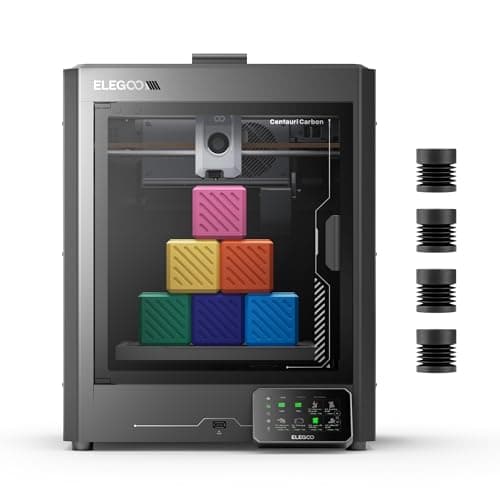
An enclosed CoreXY printer at a price that used to buy an open frame. If the reason you are hesitating about a beginner machine is that you can already see yourself outgrowing it, this is the one that answers that.
#ad Price as of October 22, 2026, from Amazon. Prices change. How we make money.
What it actually is
A boxed CoreXY machine with a steel chassis and aluminum and glass panels. The enclosure holds chamber heat, which is what lets it handle materials that shrink and peel on an open frame.
What the manufacturer states
| Figure | Value | Source |
|---|---|---|
| Build volume | 256 x 256 x 256 mm | Elegoo Centauri Carbon product specifications |
| Motion system | CoreXY | Elegoo Centauri Carbon product specifications |
| Enclosure | Fully enclosed; steel chassis with aluminum and glass shell | Elegoo Centauri Carbon product specifications |
| Maximum speed | 500 mm/s | Elegoo Centauri Carbon product specifications |
| Maximum acceleration | 20,000 mm/s2 (10,000 mm/s2 default) | Elegoo Centauri Carbon product specifications |
| Max nozzle temperature | 320 C | Elegoo Centauri Carbon product specifications |
| Max heated bed temperature | 110 C at 25 C ambient | Elegoo Centauri Carbon product specifications |
| Supported filament | PLA, PETG, ABS, ASA, TPU, PET, PC, PA and carbon or glass fiber reinforced grades | Elegoo Centauri Carbon product specifications |
| Bed leveling | 121-point auto-leveling; full-auto calibration | Elegoo Centauri Carbon product specifications |
| Print accuracy | +/- 0.1 mm | Elegoo Centauri Carbon product specifications |
| Machine size and weight | 398 x 404 x 490 mm, 17.5 kg | Elegoo Centauri Carbon product specifications |
| Rated power | 350 W at 110 V | Elegoo Centauri Carbon product specifications |
| Operating sound | 55 dB or below | Elegoo Centauri Carbon product specifications |
Read from Elegoo, Centauri Carbon product page on 2026-09-06. Where a manufacturer does not publish a figure, there is no row for it here.
What is good about it
- Fully enclosed at a price that competes with open-frame machines
- 20,000 mm/s2 rated acceleration, matching the enclosed Bambu
- 256 mm cubed — the same working envelope as an A1 or a P1S
- The enclosure contains noise and smell, which decides whether a printer can live in a bedroom
What is not
- A newer platform than the Bambu and Creality lines, so there is less community troubleshooting behind it
- An enclosure adds a heat-soak wait to PLA prints in a warm room
- Larger and heavier than any open-frame machine here
- Nothing about the enclosure makes the first print easier — it makes later prints possible
Skip this one if
Skip it if PLA is all you will ever print and your printer lives in a spare room. You are paying for a box you will not use. The enclosure earns its money on ABS, ASA and a shared living space, not on PLA in a garage.
What we cannot tell you
We have not printed on this machine. Chamber temperature in practice, panel fit and finish, and long-term CoreXY belt tension are not published numbers.
How it scored for a beginner
- Setup out of the box8.5
- Auto-calibration8.5
- First-layer forgiveness8.5
- Parts and filament availability7.5
- Running cost8.0
- Help when it goes wrong7.5
Beginner fit 8.3 / 10. That is our editorial read of how well this suits someone buying their first printer, taken off the published specifications — not a test result, and not a verdict on absolute quality. It is deliberately not marked up as a rating in this page’s structured data. How we pick.
How these were picked
We have not printed on these machines and we do not pretend to have. What we did was read each manufacturer’s own specification page, take their stated build volume, temperatures and speeds, check that every pick genuinely fits the job in this page’s title, confirm it is still being sold, and pull a live price rather than a remembered one. Every figure names the source it came from, so you can check it yourself in about a minute.
How we pick sets out the full method, including what would change a ranking.
Questions people actually ask
+−Is the Elegoo Centauri Carbon good for beginners?
It is capable of being a first printer — Elegoo publishes 121-point auto-leveling and full-auto calibration, so the hard setup steps are handled. It is not the easiest first printer, because everything it adds over an open-frame machine is aimed at materials a beginner should not start with.
+−Can the Centauri Carbon print ABS and carbon fiber filament?
Elegoo lists PLA, PETG, ABS, ASA, TPU, PET, PC, PA and carbon or glass fiber reinforced filaments as supported, and ships it with a brass hardened-steel nozzle, which is the part abrasive filaments wear out. The enclosure and the 110 °C plate are what make the warping materials realistic.
+−How fast is the Centauri Carbon really?
Elegoo publishes 500 mm/s as the maximum and 250 mm/s as the recommended speed, on the same line of its own specification sheet. The recommended figure is the useful one. Rated speed is a straight-line ceiling and no real object reaches it.
+−Does it detect a clogged nozzle?
No. Elegoo’s sensor table lists a camera, filament run-out detection, power-loss recovery and automatic filament unloading, and marks clog detection as absent. Keep filament dry and the nozzle clean and it is rarely an issue.