Head to head
PETG vs ABS
This comparison is usually decided by your printer rather than by the plastic. One of these runs on an open frame and one does not, and no setting closes that gap.
By Scooter M. · Published · Last reviewed
How this page is funded: the buy links below are affiliate links. If you buy through one we earn a commission, at no extra cost to you. It does not change the order of the picks or a word of what we say about them. Full disclosure.
Printers we claim to have tested: 0. Everyone in this category says they tested twenty machines. We have not tested any, and we would rather say so. What we did instead is on this page: the manufacturer’s own published specification for every pick, cited and dated; the arithmetic on what it costs to run, with the inputs shown; a live price rather than a remembered one; and a plain answer on who should skip each machine.
The short answer
If your printer is open-frame, print PETG. The decision is already made. ABS needs a 90-100 °C bed and a warm, enclosed chamber, and without one it contracts as it cools and lifts off the plate. If you do have an enclosure, choose ABS only when you need real heat resistance or a part you can sand and solvent-weld — and accept that Polymaker publishes 30-50 mm/s for it against up to 300 mm/s for PETG.
People arrive at this comparison expecting a materials-science answer. The honest answer is mostly a hardware one, so we will deal with that first and then compare the plastics for the readers it still applies to.
The enclosure question, settled first
ABS shrinks measurably as it cools. On a tall part, the lower layers have already cooled and contracted while the upper ones are still going down hot, and the corners pull themselves off the plate. A warm chamber slows that cooling so the whole part contracts together.
That is why every manufacturer of an open-frame machine says the same thing. Bambu Lab rates ABS as not recommended on the A series. Creality publishes the Ender-3 V3 SE’s extruder as working with PLA, PETG and TPU — ABS is not on the list. This is not conservatism; it is physics the manufacturer cannot design around on an open frame.
PETG, by contrast, is rated on effectively every current beginner machine. Bambu Lab lists it as ideal for the A1 series and the P1S, Elegoo lists it for the Centauri Carbon, and Creality lists it for the Ender-3 V3 SE. If you own any of the machines in our beginner picks, PETG is inside its published envelope today.
The published numbers
Read from each manufacturer's own product page on 2026-09-13.
| Overture High Speed PETG | Polymaker PolyLite ABS | |
|---|---|---|
| Nozzle temperature | 230 - 260 C | 245 - 265 C |
| Bed temperature | 65 - 70 C | 90 - 100 C |
| Printing speed | Up to 300 mm/s | 30 - 50 mm/s |
| Enclosure | Not required | Required in practice |
| Drying | 60 C for 5 hours | 70 C for 6 hours |
| Smell while printing | Mild | Noticeable |
| UV stability outdoors | Reasonable | Poor - goes chalky |
The speed row is the one people underestimate. A part that takes four hours in PETG is a very different proposition in ABS at a published 30-50 mm/s. That is not a rounding difference; it changes whether you start the print before bed or before a weekend.
The bed row is the one that decides whether you can print it at all. A 90-100 °C bed is above what several beginner machines publish: Bambu Lab rates the A1 mini and A2L at 80 °C maximum. Even with an enclosure, a machine that cannot reach the published bed range is a machine that cannot run the material properly.
What each one is genuinely for
PETG: brackets and mounts that carry weight, anything that lives in a car or outdoors, enclosures for electronics that get warm, and anything that will be dropped on a hard floor. It bends where PLA snaps and it tolerates heat that would soften PLA. It is the correct second material for almost everybody, and our PETG picks cover which spools to buy.
ABS: parts that must survive genuine heat, and parts you intend to finish. ABS sands well, and it can be bonded and smoothed with solvent in a way PETG resists. That finishing behavior is the quiet reason prop makers and modelers still reach for it long after PETG became easier.
The things nobody mentions until you have bought a spool
PETG sticks harder than you want. On a smooth plate it can bond firmly enough to damage the surface when you remove the part. Use a textured plate, or raise the Z-offset slightly so the first layer is laid down rather than pressed in.
PETG strings. Fine hairs between towers are the PETG signature, and they are mostly a moisture problem. Polymaker states on its own page that wet PETG strings. The stringing page works through the fixes in order.
ABS smells. Noticeably, for hours. This is why enclosed machines fit activated carbon filters — Bambu Lab says explicitly that the P1S filter exists because filaments like ABS emit odors during printing. Printing ABS in a bedroom with no filtration is a decision, not an oversight.
ABS is not outdoor plastic. Leave an ABS part in sunlight and it goes chalky and brittle. If the part lives outside, you do not want ABS — you want its UV-stable sibling, which is the subject of ABS against ASA.
How we would decide
Answer two questions in order. Is my printer enclosed? If no, print PETG; there is nothing further to discuss. Does this part need to survive real heat, or be sanded and solvent-bonded? If no, print PETG anyway — it is faster, easier and rated for more machines. Only a yes to both makes ABS the right spool.
If you are shopping for the enclosure rather than the plastic, the machines that make ABS realistic are on the best enclosed 3D printers.
What we would buy for this
Chosen from the same registry as our roundups, on the manufacturer’s own published figures and a live price.
Overture High Speed PETG
Overture · Parts that have to survive heat or flexing
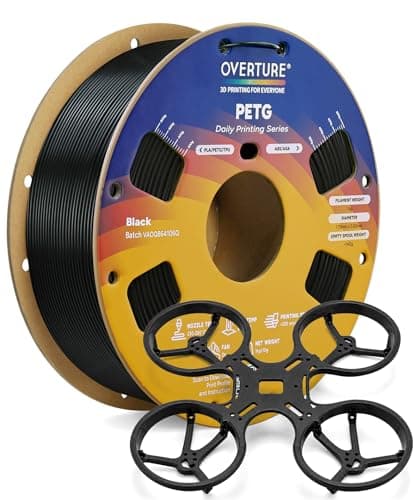
The second spool, not the first. PETG is what you move to when a part has to survive a hot car, a bit of flex or the outdoors — and it is fussier about stringing and bed adhesion than PLA in exchange.
#ad Price as of September 14, 2026, from Amazon. Prices change. How we make money.
What it actually is
PETG is a tougher, slightly flexible plastic that tolerates heat far better than PLA. It prints hotter, sticks harder to the plate, and strings more. The same material family as a drinks bottle.
What the manufacturer states
| Figure | Value | Source |
|---|---|---|
| Diameter | 1.75 mm | Overture published product specification |
| Dimensional accuracy | +/- 0.02 mm | Overture published product specification |
| Recommended nozzle temperature | 230 - 260 C | Overture published product specification |
| Recommended printing speed | 30 - 300 mm/s | Overture published product specification |
Read from Overture, High Speed PETG filament product page on 2026-09-01. Where a manufacturer does not publish a figure, there is no row for it here.
What is good about it
- Handles heat that would soften a PLA part into uselessness
- Tougher and less brittle than PLA, so it survives being dropped
- +/- 0.02 mm published tolerance, the same as Overture's PLA
- A 30 - 300 mm/s published speed range that fits current fast machines
What is not
- Strings between features far more readily than PLA
- 230 - 260 C means your printer's hot end has to be rated for it — the A1 mini's 300 C ceiling is fine, some older machines are not
- It can stick to a smooth PEI plate hard enough to damage the surface
- Absorbs moisture from the air faster than PLA, so an open spool goes off
Skip this one if
Skip it as a first spool. Learn what a good first layer looks like in PLA before you add a material that sticks too well and strings between everything. PETG is a solution to a problem you have not had yet.
What we cannot tell you
We have not printed this filament. How much stringing you get at a given retraction setting, and whether it damages a specific plate, depend on the machine and we have not tested either.
How it scored for a beginner
- Ease for a beginner6.5
- Published tolerance9.5
- Availability9.0
- Value per kilogram8.0
Beginner fit 7.9 / 10. That is our editorial read of how well this suits someone buying their first printer, taken off the published specifications — not a test result, and not a verdict on absolute quality. It is deliberately not marked up as a rating in this page’s structured data. How we pick.
Polymaker PolyLite ABS
Polymaker · Parts that must survive heat, on a printer with an enclosure
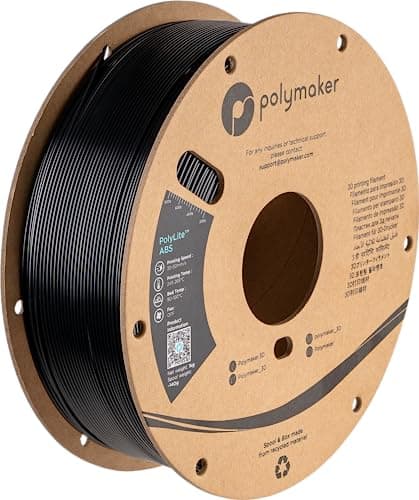
The classic engineering plastic, and the one that most punishes an open-frame printer. Polymaker publishes a 245-265 C nozzle and a 90-100 C bed, and a printing speed range of 30-50 mm/s, which tells you plainly that this is not a material you rush.
#ad Price as of September 14, 2026, from Amazon. Prices change. How we make money.
What it actually is
A 1 kg spool of 1.75 mm ABS. ABS is tough and heat-resistant and it contracts measurably as it cools, which is why it lifts off an unheated, unenclosed plate and why it is an enclosure-only material in practice.
What the manufacturer states
| Figure | Value | Source |
|---|---|---|
| Printing temperature | 245 - 265 C | Polymaker PolyLite ABS published print settings |
| Bed temperature | 90 - 100 C | Polymaker PolyLite ABS published print settings |
| Printing speed | 30 - 50 mm/s | Polymaker PolyLite ABS published print settings |
| Drying | 70 C for 6 hours | Polymaker PolyLite ABS published print settings |
| Spool size | 1 kg, 1.75 mm | Polymaker PolyLite ABS published print settings |
Read from Polymaker, PolyLite ABS product page and print settings on 2026-09-13. Where a manufacturer does not publish a figure, there is no row for it here.
What is good about it
- Genuinely heat-resistant in a way no PLA is, which is the whole reason to move up to it
- Tough and machinable - it can be sanded, drilled and glued with solvent in ways PLA resists
- Polymaker publishes the full profile including the bed range, so there is no guessing at 90-100 C
- Cheaper per kilogram than ASA, its outdoor-rated sibling
What is not
- The published 30-50 mm/s speed range is a fraction of what a modern machine can do - ABS parts take much longer
- It needs a 90-100 C bed and an enclosure. On an open frame it will lift, and no setting fixes that
- It emits a noticeable smell while printing, which is why enclosed machines fit carbon filters
- Not UV stable - leave an ABS part outdoors and it goes chalky and brittle
Skip this one if
Skip it entirely if your printer is open-frame. Bambu Lab rates ABS as not recommended on the A series and Creality does not list it for the Ender-3 V3 SE's extruder. Buying it for an open machine is buying a spool you cannot use.
What we cannot tell you
We have not printed this filament. How strong the smell really is in a room with the door shut, and how much warping survives a properly heated chamber, are things only a unit and a spool can answer.
How it scored for a beginner
- Ease for a beginner4.0
- Published data9.0
- Toughness8.5
- Heat resistance9.0
- Value8.5
Beginner fit 7.6 / 10. That is our editorial read of how well this suits someone buying their first printer, taken off the published specifications — not a test result, and not a verdict on absolute quality. It is deliberately not marked up as a rating in this page’s structured data. How we pick.
How these were picked
We have not printed on these machines and we do not pretend to have. What we did was read each manufacturer’s own specification page, take their stated build volume, temperatures and speeds, check that every pick genuinely fits the job in this page’s title, confirm it is still being sold, and pull a live price rather than a remembered one. Every figure names the source it came from, so you can check it yourself in about a minute.
How we pick sets out the full method, including what would change a ranking.
Questions people actually ask
+−Can I print ABS without an enclosure?
Not reliably. ABS contracts as it cools and lifts off the plate without a warm chamber to slow that down. Bambu Lab rates ABS as not recommended on its open-frame A series, and Creality does not list it for the Ender-3 V3 SE’s extruder.
+−Is PETG stronger than ABS?
They fail differently rather than one being simply stronger. PETG is tougher against impact and holds up outdoors; ABS handles higher temperatures and finishes better with sanding and solvent. For most household parts PETG is the more useful of the two.
+−Which prints faster, PETG or ABS?
PETG, by a wide margin on published figures. Overture publishes up to 300 mm/s for its High Speed PETG; Polymaker publishes 30-50 mm/s for its ABS. Expect an ABS print to take several times longer than the same part in PETG.
+−Does ABS really smell that bad?
It is noticeable enough that enclosed printers fit carbon filters for it. Bambu Lab states the P1S filter exists because filaments such as ABS emit odors while printing. Ventilate, or use a machine with filtration, or print something else.