Head to head
ABS vs ASA
Two closely related engineering plastics with one decisive difference. If the finished part will ever see direct sunlight, that difference is the entire comparison.
By Scooter M. · Published · Last reviewed
How this page is funded: the buy links below are affiliate links. If you buy through one we earn a commission, at no extra cost to you. It does not change the order of the picks or a word of what we say about them. Full disclosure.
Printers we claim to have tested: 0. Everyone in this category says they tested twenty machines. We have not tested any, and we would rather say so. What we did instead is on this page: the manufacturer’s own published specification for every pick, cited and dated; the arithmetic on what it costs to run, with the inputs shown; a live price rather than a remembered one; and a plain answer on who should skip each machine.
The short answer
Outdoors, print ASA. Indoors, print ABS and keep the difference. Polymaker rates its ASA UV and weather resistant; its ABS is not. ASA also publishes a faster and more forgiving envelope — up to 200 mm/s against 30-50 mm/s, and a 75-95 °C bed against 90-100 °C. Both still need an enclosure.
These two materials are close relatives. ASA was developed as an answer to the one thing ABS is genuinely bad at: ultraviolet light. Everything else about them — the toughness, the heat resistance, the smell, the warping behavior, the way they sand and solvent-bond — is broadly similar, which is why the comparison comes down to a single question about where the part lives.
The one difference that decides it
ABS degrades in sunlight. The surface chalks, the color fades and the plastic gradually becomes brittle. A bracket on a fence, a mount on a car, a housing for a garden sensor — all of these fail this way, and they fail slowly enough that you only notice when the part snaps.
ASA replaces the component responsible for that degradation. Polymaker publishes it as UV and weather resistant on its own product page. That is a manufacturer claim rather than something we have tested over a year on a windowsill, and we are repeating it as their claim, but it is the established reason the material exists.
The published numbers
Read from Polymaker's own product pages on 2026-09-13, so both columns come from one manufacturer and are directly comparable.
| Polymaker ASA | Polymaker PolyLite ABS | |
|---|---|---|
| Nozzle temperature | 240 - 260 C | 245 - 265 C |
| Bed temperature | 75 - 95 C | 90 - 100 C |
| Printing speed | Up to 200 mm/s | 30 - 50 mm/s |
| Drying | 70 C for 6 hours | 70 C for 6 hours |
| UV and weather resistance | Rated by the manufacturer | Not rated |
| Enclosure | Required in practice | Required in practice |
Two rows are more interesting than the UV one, because they contradict the usual assumption that ASA is simply the harder material to print.
The speed range. Polymaker publishes up to 200 mm/s for ASA and 30-50 mm/s for its ABS. On these figures ASA is several times faster, which is the opposite of the folklore.
The bed range. 75-95 °C for ASA against 90-100 °C for ABS. The lower floor matters: it widens the set of machines that can actually hold the published range rather than sitting at their ceiling for an eight-hour print.
What both of them still demand
An enclosure. ASA warps like ABS. Being UV-stable does not make it open-frame friendly, and a machine that cannot hold chamber heat will lift the corners of either material. If you are shopping for that, the machines are on the best enclosed 3D printers.
Ventilation or filtration. Both emit a noticeable smell for the length of the print. Bambu Lab fits an activated carbon filter to the P1S specifically because filaments like ABS emit odors while printing, and the same applies to ASA.
Dry filament. Polymaker publishes 70 °C for 6 hours for both. These are not materials that forgive a spool that has sat open in a humid room — storage and drying covers what that actually requires.
Patience with the first layer. Both want a clean, warm plate and no draft. If your first layer is the problem rather than the material, start at prints not sticking to the bed.
The cost question
ASA sits above ABS per kilogram, and both sit above PETG. We do not print the numbers here because they move; the live price is inside each button on this page. What is worth saying is that the premium buys exactly one property. If the part never sees the sun, you are paying for ultraviolet resistance you will never test.
The reverse mistake is more expensive, though. Printing an outdoor bracket in ABS to save a few dollars means printing it twice, and the second time you will still buy the ASA.
Our answer
Ask where the finished part will physically be a year from now. On a shelf, a desk or inside a machine: ABS, or more likely PETG. On a fence, a roof, a dashboard or a boat: ASA, and do not talk yourself out of it.
What we would buy for this
Chosen from the same registry as our roundups, on the manufacturer’s own published figures and a live price.
Polymaker ASA
Polymaker · Parts that live outdoors
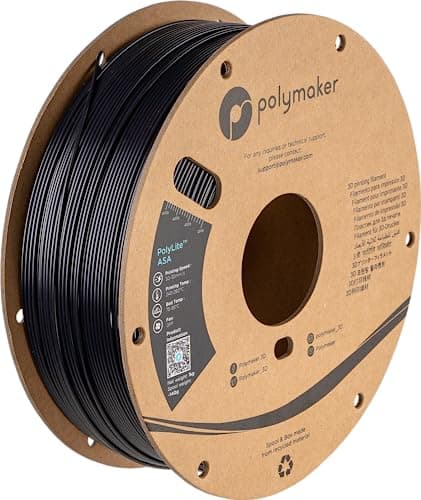
ABS that survives sunlight. Polymaker publishes a 240-260 C nozzle, a 75-95 C bed and speeds up to 200 mm/s - a wider and faster envelope than its own ABS - and rates it UV and weather resistant, which is the single reason to choose it.
#ad Price as of September 14, 2026, from Amazon. Prices change. How we make money.
What it actually is
A 1 kg spool of 1.75 mm ASA. Chemically it is a close relative of ABS with the weak link swapped out: the component that degrades in ultraviolet light is replaced, so the part does not go chalky in the sun.
What the manufacturer states
| Figure | Value | Source |
|---|---|---|
| Printing temperature | 240 - 260 C | Polymaker ASA published print settings |
| Bed temperature | 75 - 95 C | Polymaker ASA published print settings |
| Printing speed | Up to 200 mm/s | Polymaker ASA published print settings |
| Drying | 70 C for 6 hours | Polymaker ASA published print settings |
| Spool size | 1 kg, 1.75 mm | Polymaker ASA published print settings |
Read from Polymaker, ASA product page and print settings on 2026-09-13. Where a manufacturer does not publish a figure, there is no row for it here.
What is good about it
- UV and weather resistant, per Polymaker's own rating - the one thing ABS cannot do
- A published speed range up to 200 mm/s against 30-50 mm/s for Polymaker's ABS, so it is far less of a wait
- A slightly lower bed range than ABS at 75-95 C, which widens the machines that can run it
- Same solvent-bonding and sanding behavior as ABS for finishing work
What is not
- It still contracts as it cools and still needs an enclosure - being outdoor-rated does not make it open-frame friendly
- The most expensive spool on this site per kilogram
- Emits the same kind of smell as ABS while printing
- Overkill for anything that lives indoors, where PETG does the job for less
Skip this one if
Skip it if the part stays inside. Everything you pay extra for here is ultraviolet resistance, and a shelf in a living room does not test it. Skip it too if your printer is open-frame, for the same reason as ABS.
What we cannot tell you
We have not printed this filament, and we have not left a printed part on a windowsill for a year. The UV claim is Polymaker's, published on their own page, and we are repeating it rather than confirming it.
How it scored for a beginner
- Ease for a beginner4.5
- Published data9.0
- Toughness8.5
- Heat resistance9.0
- Value7.0
Beginner fit 7.9 / 10. That is our editorial read of how well this suits someone buying their first printer, taken off the published specifications — not a test result, and not a verdict on absolute quality. It is deliberately not marked up as a rating in this page’s structured data. How we pick.
Polymaker PolyLite ABS
Polymaker · Parts that must survive heat, on a printer with an enclosure
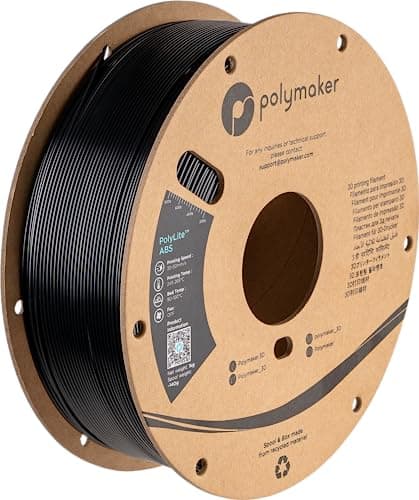
The classic engineering plastic, and the one that most punishes an open-frame printer. Polymaker publishes a 245-265 C nozzle and a 90-100 C bed, and a printing speed range of 30-50 mm/s, which tells you plainly that this is not a material you rush.
#ad Price as of September 14, 2026, from Amazon. Prices change. How we make money.
What it actually is
A 1 kg spool of 1.75 mm ABS. ABS is tough and heat-resistant and it contracts measurably as it cools, which is why it lifts off an unheated, unenclosed plate and why it is an enclosure-only material in practice.
What the manufacturer states
| Figure | Value | Source |
|---|---|---|
| Printing temperature | 245 - 265 C | Polymaker PolyLite ABS published print settings |
| Bed temperature | 90 - 100 C | Polymaker PolyLite ABS published print settings |
| Printing speed | 30 - 50 mm/s | Polymaker PolyLite ABS published print settings |
| Drying | 70 C for 6 hours | Polymaker PolyLite ABS published print settings |
| Spool size | 1 kg, 1.75 mm | Polymaker PolyLite ABS published print settings |
Read from Polymaker, PolyLite ABS product page and print settings on 2026-09-13. Where a manufacturer does not publish a figure, there is no row for it here.
What is good about it
- Genuinely heat-resistant in a way no PLA is, which is the whole reason to move up to it
- Tough and machinable - it can be sanded, drilled and glued with solvent in ways PLA resists
- Polymaker publishes the full profile including the bed range, so there is no guessing at 90-100 C
- Cheaper per kilogram than ASA, its outdoor-rated sibling
What is not
- The published 30-50 mm/s speed range is a fraction of what a modern machine can do - ABS parts take much longer
- It needs a 90-100 C bed and an enclosure. On an open frame it will lift, and no setting fixes that
- It emits a noticeable smell while printing, which is why enclosed machines fit carbon filters
- Not UV stable - leave an ABS part outdoors and it goes chalky and brittle
Skip this one if
Skip it entirely if your printer is open-frame. Bambu Lab rates ABS as not recommended on the A series and Creality does not list it for the Ender-3 V3 SE's extruder. Buying it for an open machine is buying a spool you cannot use.
What we cannot tell you
We have not printed this filament. How strong the smell really is in a room with the door shut, and how much warping survives a properly heated chamber, are things only a unit and a spool can answer.
How it scored for a beginner
- Ease for a beginner4.0
- Published data9.0
- Toughness8.5
- Heat resistance9.0
- Value8.5
Beginner fit 7.6 / 10. That is our editorial read of how well this suits someone buying their first printer, taken off the published specifications — not a test result, and not a verdict on absolute quality. It is deliberately not marked up as a rating in this page’s structured data. How we pick.
How these were picked
We have not printed on these machines and we do not pretend to have. What we did was read each manufacturer’s own specification page, take their stated build volume, temperatures and speeds, check that every pick genuinely fits the job in this page’s title, confirm it is still being sold, and pull a live price rather than a remembered one. Every figure names the source it came from, so you can check it yourself in about a minute.
How we pick sets out the full method, including what would change a ranking.
Questions people actually ask
+−Is ASA just UV-resistant ABS?
That is the practical summary. They are close chemical relatives with similar toughness and heat resistance; ASA replaces the component that degrades under ultraviolet light, which is why Polymaker rates it UV and weather resistant and does not rate ABS that way.
+−Is ASA harder to print than ABS?
Not on Polymaker’s published figures. Its ASA lists a 75-95 °C bed and speeds up to 200 mm/s, against 90-100 °C and 30-50 mm/s for its ABS. Both still warp and both still need an enclosure.
+−Can I print ASA on an open-frame printer?
No more than you can print ABS on one. Both contract as they cool and need a warm chamber to stop the corners lifting. UV resistance changes what happens to the finished part outdoors, not how it behaves while printing.
+−Do ABS and ASA smell while printing?
Both do, noticeably, for the length of the print. Use a machine with an activated carbon filter or a well-ventilated space. Bambu Lab fits a filter to the P1S for exactly this reason.