Roundup
The Best PETG Filament
PETG is what you buy when a part has to survive heat, sunlight or being dropped. It is also fussier than PLA in three specific ways, and knowing them in advance is most of the battle.
By Scooter M. · Published · Last reviewed
How this page is funded: the buy links below are affiliate links. If you buy through one we earn a commission, at no extra cost to you. It does not change the order of the picks or a word of what we say about them. Full disclosure.
Printers we claim to have tested: 0. Everyone in this category says they tested twenty machines. We have not tested any, and we would rather say so. What we did instead is on this page: the manufacturer’s own published specification for every pick, cited and dated; the arithmetic on what it costs to run, with the inputs shown; a live price rather than a remembered one; and a plain answer on who should skip each machine.
The short answer
Buy Overture High Speed PETG, and only after you have finished at least one spool of PLA. PETG is tougher than PLA and survives heat that would soften it. It is also stickier on the plate, stringier in the air and far more sensitive to moisture, and none of those three things are worth learning at the same time as the printer.
Everything below is read from each manufacturer’s own published page. We have not printed any of these spools and we do not claim to have. What we can do is show you which company publishes real numbers and which publishes adjectives.
What PETG is actually for
PLA is stiff, prints beautifully and gives up at around 60 °C, which is roughly the temperature of a car dashboard on a warm day. PETG is the next material along: less stiff, considerably tougher, and rated by Polymaker at approximately 70 °C heat deflection. It bends where PLA snaps.
That makes it the right answer for a specific, short list of things. Brackets and mounts that carry weight. Anything that lives outdoors or in a car. Parts that will be dropped, stood on, or screwed into. Enclosures for electronics that get warm. If your printing is decorative and lives on a shelf indoors, PETG is a downgrade in appearance and an upgrade in nothing you will notice.
The full material map, including where ABS and TPU sit relative to both, is on filament types and what they are for, and the direct head-to-head is on PLA against PETG.
How we picked
Four criteria, in this order.
1. Does the manufacturer publish numbers? A spool listing that says “premium quality, no clogging” and gives no temperature range is a spool we cannot assess. Every pick here has a published nozzle and bed range at minimum, and the top two publish considerably more.
2. Is the temperature range achievable on a beginner machine? PETG wants roughly 230-260 °C. A printer with a 250 °C ceiling is working near its limit at the top of that range, and a wider published range gives you somewhere to move.
3. Is the moisture behavior stated honestly? PETG is hygroscopic; wet PETG strings, pops and prints badly. We ranked up the manufacturers who say so on their own page rather than leaving you to discover it.
4. Is it a 1 kg, 1.75 mm spool you can actually buy? Every pick was listed in stock on the manufacturer’s own store on 2026-09-06. We do not feature filament that is discontinued or clearing out.
The three ways PETG differs from PLA
It sticks harder. This sounds like good news and is the most common way a first PETG print goes wrong: it can bond to a smooth PEI plate hard enough to take a chunk out of it. The standard advice, and ours, is to run PETG on a textured plate, or to raise the Z-offset very slightly so the first layer is squashed less. Our bed adhesion page has a PETG-specific section.
It strings. Fine hairs between parts of the model are the PETG signature, and they are mostly a moisture and retraction problem rather than a filament-quality problem. Polymaker states this explicitly on its own product page: keep the filament dry to prevent excessive stringing. The full fix list is on how to stop your prints stringing.
It wants less cooling. PLA likes a fan at full blast. PETG bonds better between layers with the fan turned down — Polymaker publishes 20 to 60 percent, Overture says the cooling fan should be turned on without giving a percentage. Too much cooling on PETG produces a part that looks fine and splits along the layer lines when you load it.
Published figures, read from each manufacturer's own page on 2026-09-06.
| Spool | Nozzle | Bed | Drying | Notable published data |
|---|---|---|---|---|
| Overture High Speed PETG | 230 - 260 C | 65 - 70 C | 60 C for 5 h | Toughness 15.7 kJ/m2, layer adhesion 45.7 MPa, elongation 9.3 percent |
| Polymaker PETG | 240 - 260 C | 60 - 70 C | 60 C for 6 h | Approximately 70 C HDT; full retraction profile published |
| Bambu Lab PETG Basic | Not published on the product page | Not published on the product page | Dry before use, per Bambu Lab | 1.75 mm +/- 0.03 mm; UL GREENGUARD 2904 certified |
Where a cell says “not published,” that is literal. Bambu Lab does not print a temperature range on the PETG Basic product page, and we would rather show you the gap than fill it with a number from somewhere else. On a Bambu printer the machine reads the spool tag and applies its own profile, which is arguably why the company does not bother.
What we would actually print in PETG
A short and specific list is more useful than a paragraph about material properties, so here is ours.
Wall hooks, brackets and anything that carries weight. PETG bends under load and recovers; PLA holds until it does not, then snaps without warning. For a bracket holding something you care about, that failure mode difference is the whole argument.
Anything that lives in a car. A phone mount or a cup insert in PLA will deform on a hot day. This is the single most common “my print melted” story and it is entirely predictable from the published heat deflection figures.
Anything outdoors. PETG resists moisture and sunlight better than PLA, which slowly becomes brittle in UV.
Enclosures for electronics that get warm. A Raspberry Pi case, a router mount, anything sitting on top of a warm appliance.
Things that get dropped. Tool holders, garage organizers, anything that will hit a concrete floor at some point.
What we would not print in PETG: display models, miniatures, anything where the surface finish is the point, and anything with fine detail. PLA is better at all of those and easier at every step.
The three mistakes people make on a first PETG spool
Printing it like PLA. The most common one. PLA profiles run the part cooling fan at or near full, and PETG bonds between layers considerably worse when it is cooled that hard. Polymaker publishes 20 to 60 percent for its own PETG. A part printed with a PLA fan setting looks perfectly good and splits along a layer line the first time you load it, which is the worst kind of failure because you only find out when it matters.
Squashing the first layer onto a smooth plate. PETG sticks harder than PLA, and a first layer pressed firmly into a smooth PEI surface can bond well enough to pull a piece of the coating off when you remove the part. Use a textured plate, or raise the Z-offset slightly so the first layer is laid down rather than pressed in.
Going straight to full speed. PETG needs a moment longer in the melt zone than PLA does. A machine rated at 500 mm/s running a fast profile with a fresh PETG spool is the recipe for under-extrusion that looks like a clogged nozzle and is not — the ordered diagnosis for that is on the clogged nozzle page. Print the first PETG spool at a moderate speed and raise it once you have a part you trust.
Which printers are rated for PETG
Almost every current beginner machine, which is worth stating plainly because people assume PETG needs something special. It does not; it needs a nozzle that comfortably reaches about 250 °C and a heated bed.
Bambu Lab rates the A1 and A1 mini as ideal for PETG, alongside PLA, TPU and PVA. It rates the enclosed P1S as ideal for PETG as well. Creality publishes the Ender-3 V3 SE’s Sprite extruder as working with PLA, PETG and flexible TPU. Elegoo lists PETG among the supported materials on the Centauri Carbon.
In other words, if you bought anything from our beginner picks, PETG is inside its published envelope. The machine-specific filament pages go further: filament for a Bambu A1 and filament for an Ender-3 V3.
Reading a PETG listing without being misled
Three words recur on PETG spools and only one of them means much.
“High Speed” or “HF.” A formulation tuned to flow faster, so it can keep up with a machine printing quickly. Real, and only relevant if you actually print fast. On a 250 mm/s machine it changes nothing you would notice.
“CF” or “carbon fiber.” Chopped fiber mixed into the plastic for stiffness and a matte finish. It is abrasive, and it wears out a standard brass nozzle. Do not buy it for a first printer unless the machine ships with a hardened nozzle, and check the manufacturer’s own guidance first — Bambu Lab, for instance, says fiber-reinforced filament is not recommended on the P1S without an extruder and hot end upgrade.
“Silk,” “matte,” “translucent.” Cosmetic variants. They print at the same temperatures and behave slightly differently in ways nobody publishes. Fine to buy; not a reason to choose one brand over another.
Do not skip the drying question
Every one of these three manufacturers tells you, on its own page, to dry PETG or keep it dry. Overture publishes 60 °C for 5 hours and warns that over-drying makes filament brittle. Polymaker publishes 60 °C for 6 hours and says it only applies if the spool has absorbed moisture. Bambu Lab lists “dry out before use” in its cautions.
That consistency is the point. With PLA, a dryer is a month-three purchase. With PETG it moves up the list, and a sealed box with desiccant does most of the same job for less if you are only storing rather than actively drying. The full argument, and what a dryer actually fixes, is on filament storage and drying.
What this costs in practice
PETG generally sits above mainstream PLA per kilogram and below the engineering materials. We do not print prices in the text because they move constantly; the live figure sits inside every buy button on this page. What is worth knowing is that the cost per print is dominated by how many grams the object weighs, not by the headline spool price — the arithmetic is on what filament actually costs per print, and a 1 kg spool typically covers twenty to thirty desk-sized objects either way.
One genuine extra cost is worth budgeting for. Every manufacturer here tells you to keep PETG dry, and on an open-frame printer in an ordinary room that means either a sealed box with desiccant or a dryer. It is not a large sum next to the printer, and it is the difference between a second spool that prints like the first one and a second spool that strings.
Quick picks
Ranked on how well each one fits the job in this page's title, read off the manufacturer's own published specifications. Tap any row for the full write-up, including who should skip it.
| # | Product | Best for | Beginner fit | Price |
|---|---|---|---|---|
| 1 | 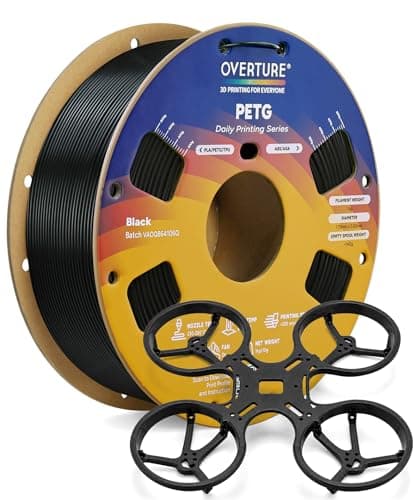 Overture High Speed PETGOverture Overture High Speed PETGOverture | Best overall | 7.9 | $14.69 - Check price on Amazon |
| 2 | 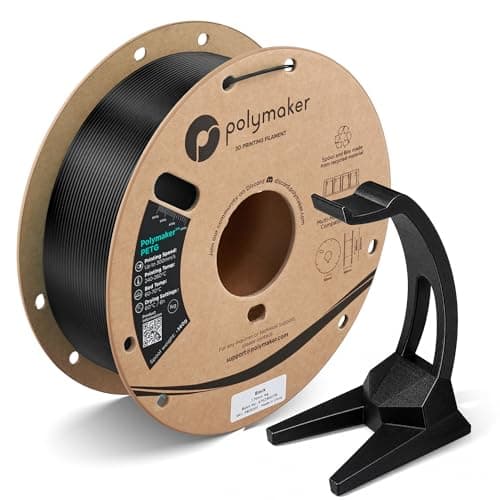 Polymaker PETGPolymaker Polymaker PETGPolymaker | Best documented | 8.6 | $15.19 - Check price on Amazon |
| 3 | 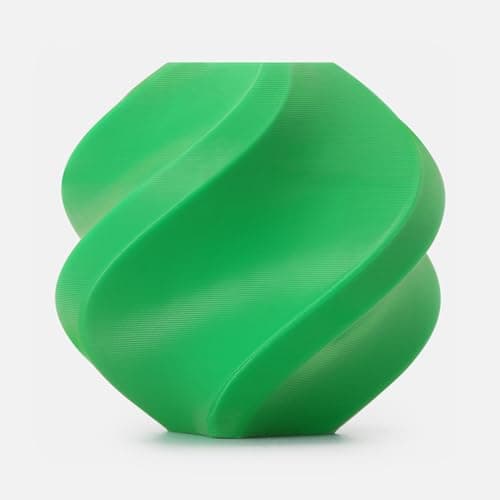 Bambu Lab PETG BasicBambu Lab Bambu Lab PETG BasicBambu Lab | Best on a Bambu printer | 8.4 | $33.11 - Check price on Amazon |
#1 · Best overall
Overture High Speed PETG
Overture · Parts that have to survive heat or flexing
The second spool, not the first. PETG is what you move to when a part has to survive a hot car, a bit of flex or the outdoors — and it is fussier about stringing and bed adhesion than PLA in exchange.
#ad Price as of October 21, 2026, from Amazon. Prices change. How we make money.
What it actually is
PETG is a tougher, slightly flexible plastic that tolerates heat far better than PLA. It prints hotter, sticks harder to the plate, and strings more. The same material family as a drinks bottle.
Does it fit this page?
Overture publishes what almost nobody else does for a consumer spool: measured toughness, layer adhesion and elongation figures alongside the print temperatures. A 230-260 C nozzle range is the widest here, which gives a printer with a lower ceiling somewhere to work.
What the manufacturer states
| Figure | Value | Source |
|---|---|---|
| Diameter | 1.75 mm | Overture published product specification |
| Dimensional accuracy | +/- 0.02 mm | Overture published product specification |
| Recommended nozzle temperature | 230 - 260 C | Overture published product specification |
| Recommended printing speed | 30 - 300 mm/s | Overture published product specification |
Read from Overture, High Speed PETG filament product page on 2026-09-01. Where a manufacturer does not publish a figure, there is no row for it here.
What is good about it
- Handles heat that would soften a PLA part into uselessness
- Tougher and less brittle than PLA, so it survives being dropped
- +/- 0.02 mm published tolerance, the same as Overture's PLA
- A 30 - 300 mm/s published speed range that fits current fast machines
What is not
- Strings between features far more readily than PLA
- 230 - 260 C means your printer's hot end has to be rated for it — the A1 mini's 300 C ceiling is fine, some older machines are not
- It can stick to a smooth PEI plate hard enough to damage the surface
- Absorbs moisture from the air faster than PLA, so an open spool goes off
Skip this one if
Skip it as a first spool. Learn what a good first layer looks like in PLA before you add a material that sticks too well and strings between everything. PETG is a solution to a problem you have not had yet.
What we cannot tell you
We have not printed this filament. How much stringing you get at a given retraction setting, and whether it damages a specific plate, depend on the machine and we have not tested either.
How it scored for a beginner
- Ease for a beginner6.5
- Published tolerance9.5
- Availability9.0
- Value per kilogram8.0
Beginner fit 7.9 / 10. That is our editorial read of how well this suits someone buying their first printer, taken off the published specifications — not a test result, and not a verdict on absolute quality. It is deliberately not marked up as a rating in this page’s structured data. How we pick.
#2 · Best documented
Polymaker PETG
Polymaker · Functional parts that have to survive heat or a fall
The PETG for somebody who wants a published number for everything. Polymaker states a 240-260 C nozzle range, a 60-70 C bed, roughly 70 C heat deflection and speeds up to 300 mm/s, and it says plainly on its own product page that the material is very hygroscopic and will string if it is wet.
#ad Price as of October 21, 2026, from Amazon. Prices change. How we make money.
What it actually is
A 1 kg spool of 1.75 mm PETG. PETG is the tougher, more heat-resistant step up from PLA: it bends rather than snaps, it survives a hot car, and it is fussier about moisture in exchange.
Does it fit this page?
Polymaker publishes the complete profile - temperature, fan percentage, and separate retraction distances and speeds for direct-drive and indirect-drive extruders - plus roughly 70 C heat deflection. If you want to dial a new material in properly, this is the spool that hands you the settings.
What the manufacturer states
| Figure | Value | Source |
|---|---|---|
| Printing temperature | 240 - 260 C | Polymaker PETG published print settings |
| Bed temperature | 60 - 70 C | Polymaker PETG published print settings |
| Printing speed | Up to 300 mm/s | Polymaker PETG published print settings |
| Part cooling fan | 20 - 60 percent | Polymaker PETG published print settings |
| Heat deflection | Approximately 70 C HDT | Polymaker PETG published print settings |
| Drying | 60 C for 6 hours, only if the spool has absorbed moisture | Polymaker PETG published print settings |
| Spool size | 1 kg, 1.75 mm | Polymaker PETG published print settings |
Read from Polymaker, PETG product page and print settings on 2026-09-06. Where a manufacturer does not publish a figure, there is no row for it here.
What is good about it
- Polymaker publishes the full print profile — temperatures, fan percentage and separate retraction figures for direct-drive and indirect-drive extruders
- Roughly 70 C heat deflection, which is the specification that lets a PETG part live in a car in summer
- Polymaker states it is less brittle and more impact-resistant than PLA, which is the reason to move up from PLA at all
- Ships in a resealable vacuum barrier bag, so the spool starts dry
What is not
- Polymaker says on its own page that the material is very hygroscopic — a wet spool strings badly and prints poorly
- 240-260 C is hotter than PLA, so a printer with a 250 C ceiling is working at its limit
- More expensive per kilogram than the mainstream PLA on this site
- PETG is stickier on the plate than PLA, which makes first prints harder to remove, not harder to start
Skip this one if
Skip it if your printing is decorative and lives indoors. PLA is easier, cheaper, prints cooler and looks better. PETG is a materials upgrade bought for a reason, and 'I saw it recommended' is not one.
What we cannot tell you
We have not printed this filament. Real spool-to-spool consistency, how much stringing survives a correct dry, and how the color matches the swatch are all things that need a printer and a spool.
How it scored for a beginner
- Ease for a beginner7.5
- Published data9.5
- Toughness9.0
- Heat resistance9.0
- Value8.0
Beginner fit 8.6 / 10. That is our editorial read of how well this suits someone buying their first printer, taken off the published specifications — not a test result, and not a verdict on absolute quality. It is deliberately not marked up as a rating in this page’s structured data. How we pick.
#3 · Best on a Bambu printer
Bambu Lab PETG Basic
Bambu Lab · PETG on a Bambu printer, with the profile handled for you
The PETG to buy if you own a Bambu machine and want the printer to set its own profile. Bambu Lab publishes a 1.75 mm +/- 0.03 mm diameter, states it works with every AMS, and certifies it to UL GREENGUARD 2904 for indoor emissions. It also says, in its own cautions, to dry it before use.
#ad Price as of October 21, 2026, from Amazon. Prices change. How we make money.
What it actually is
Bambu Lab's own-brand 1 kg PETG spool. The spool carries a tag the printer reads, so the machine loads the material profile rather than asking you to pick one — the same trick as their PLA Basic.
Does it fit this page?
The spool tag makes a Bambu machine load the material profile itself, which removes the single setting a beginner is most likely to get wrong on a first PETG print. On any other printer that advantage is worth nothing, which is exactly why it is third and not first.
What the manufacturer states
| Figure | Value | Source |
|---|---|---|
| Diameter | 1.75 mm +/- 0.03 mm | Bambu Lab PETG Basic product page |
| Spool size | 1 kg | Bambu Lab PETG Basic product page |
| AMS compatibility | All AMS series | Bambu Lab PETG Basic product page |
| Indoor emissions | Certified to UL GREENGUARD 2904 | Bambu Lab PETG Basic product page |
| Handling | Dry out before use, per Bambu Lab's stated cautions | Bambu Lab PETG Basic product page |
| Format | Sold with a spool or as a refill for a reusable spool | Bambu Lab PETG Basic product page |
Read from Bambu Lab, PETG Basic product page on 2026-09-06. Where a manufacturer does not publish a figure, there is no row for it here.
What is good about it
- The spool tag makes a Bambu printer load the right profile, which removes the one setting a beginner is most likely to get wrong on a new material
- +/- 0.03 mm published diameter tolerance, in line with the mainstream spools on this site
- Certified to UL GREENGUARD 2904 for indoor emissions — a published certification rather than a marketing adjective
- Refill format exists, so the plastic spool does not have to be bought twice
What is not
- The profile advantage is worth nothing on a printer that is not a Bambu
- Bambu Lab does not publish a nozzle or bed temperature range on the product page itself, so we cannot quote one here
- Priced above the generic PETG spools it competes with
- Bambu Lab's own cautions say to dry it before use, which means a dryer or a sealed box is part of the real cost
Skip this one if
Skip it if you do not own a Bambu machine. Everything that makes this spool worth the premium is the tag the printer reads, and on any other printer you are paying for a feature the machine cannot use.
What we cannot tell you
We have not printed this filament. Whether the automatic profile is actually well tuned, and how much stringing remains after Bambu Lab's own recommended dry, need a machine and a spool to answer.
How it scored for a beginner
- Ease for a beginner9.0
- Published data7.5
- Toughness8.5
- Heat resistance8.5
- Value7.5
Beginner fit 8.4 / 10. That is our editorial read of how well this suits someone buying their first printer, taken off the published specifications — not a test result, and not a verdict on absolute quality. It is deliberately not marked up as a rating in this page’s structured data. How we pick.
How these were picked
We have not printed on these machines and we do not pretend to have. What we did was read each manufacturer’s own specification page, take their stated build volume, temperatures and speeds, check that every pick genuinely fits the job in this page’s title, confirm it is still being sold, and pull a live price rather than a remembered one. Every figure names the source it came from, so you can check it yourself in about a minute.
How we pick sets out the full method, including what would change a ranking.
Questions people actually ask
+−Is PETG better than PLA?
Tougher and more heat-resistant, not better. PLA is stiffer, prints more accurately, looks better and is far easier to get right. PETG earns its place on parts that carry load, live outdoors, or sit somewhere warm. For everything else PLA is the correct answer.
+−What temperature should I print PETG at?
Use the range on the spool you bought. Overture publishes 230-260 °C at the nozzle with a 65-70 °C bed; Polymaker publishes 240-260 °C with a 60-70 °C bed. Start in the middle of the published range and adjust from there rather than copying a number from a video.
+−Why does my PETG string so much?
Usually moisture. PETG absorbs water from the air, and wet filament strings, pops and prints with a rough surface. Polymaker says so on its own product page. Dry the spool at 60 °C, then look at retraction settings and temperature. The stringing page works through the fixes in order.
+−Do I need a different build plate for PETG?
Not strictly, but a textured plate is safer. PETG can bond to a smooth PEI surface hard enough to damage it. Textured PEI, or a slightly higher Z-offset so the first layer is squashed less, is the usual answer.
+−Can any 3D printer use PETG?
Most current beginner machines can. Bambu Lab rates the A series ideal for PETG and Creality publishes the Ender-3 V3 SE’s extruder as working with PLA, PETG and TPU. What matters is a nozzle that reaches roughly 250 °C and a heated bed.