Start here
Is a 3D Printer Worth It?
The most-hedged question in this category, answered in the first sixty words and then argued properly — including the case against, which most guides leave out entirely.
By Scooter M. · Published · Last reviewed
How this page is funded: the buy links below are affiliate links. If you buy through one we earn a commission, at no extra cost to you. It does not change the order of the picks or a word of what we say about them. Full disclosure.
Printers we claim to have tested: 0. Everyone in this category says they tested twenty machines. We have not tested any, and we would rather say so. What we did instead is on this page: the manufacturer’s own published specification for every pick, cited and dated; the arithmetic on what it costs to run, with the inputs shown; a live price rather than a remembered one; and a plain answer on who should skip each machine.
The short answer
Yes, if you want a hobby that occasionally produces something useful. No, if you want one specific object made once. A printer earns its keep through repeated small wins — a replacement knob, a bracket that fits your shelf, an organizer nobody sells. For a single object, a printing service is cheaper and better.
The case for
It makes things that cannot be bought
This is the real argument and it is stronger than it sounds. Nobody sells a bracket for your specific shelf, a knob for a fifteen-year-old dishwasher, a divider sized to your drawer, or an adapter between two particular things that do not fit.
The moment you print the first of those, the machine stops being a novelty. It is not competing with a shop — it is doing something shops cannot do at all.
The setup problem has genuinely been solved
The reputation this hobby carries is largely from an earlier era: hours of leveling with a sheet of paper, a Z-offset discovered by trial and error, and a first month spent tuning rather than printing. That reputation is out of date.
Current beginner machines publish automatic bed leveling, automatic Z-offset and automatic flow calibration. Bambu Lab states the A1 series probes the bed with the nozzle for absolute Z-offset and levels with no manual adjustment; Creality publishes CR Touch leveling with a strain-sensor Z-offset even on its cheapest current machine. Setup is reported at roughly fifteen minutes on the auto-calibrating machines.
The running cost is trivially small
People worry about this more than any other aspect and it is the least worrying part. Bambu Lab publishes a 150 W maximum for the A1 mini. Treating that peak as though it were drawn constantly — a deliberate overestimate, since most of it is consumed heating up — an eight-hour print uses 1.2 kWh.
At the 18.34 cents per kilowatt-hour the US Energy Information Administration reported for residential customers in June 2026, that is about 22 cents. The whole calculation, at several print lengths and machine sizes, is on what your first month costs.
Filament goes further than people expect
A 1 kg spool commonly covers twenty to thirty useful desk-sized objects, because most things people actually print weigh tens of grams. Cost per object is a division you can do in your head, and it is low enough that it stops being a factor in whether to make something — which is a large part of why the hobby is enjoyable.
The case against
Almost no guide publishes this section, which is why it is here.
It is a hobby, not an appliance
This is the single most important sentence on the page. A 3D printer is not a device you press a button on and receive an object from. It has a learning curve, it has failure modes, and it asks for attention. The curve is much shallower than it used to be and it is still a curve.
If what you want is an object, you want a printing service. If what you want is the capability to make objects, you want a printer. Those are different desires and only one of them is satisfied by buying a machine.
The third-month problem
The enthusiasm curve is real and predictable. Week one is exciting. Month one is productive. Month three is when it either becomes a tool you reach for or an object gathering dust on a shelf.
What decides it is whether you have a supply of problems for it to solve. People with an existing hobby — tabletop gaming, photography, gardening, cycling, model making — almost always keep printing, because the problems keep arriving. People who bought the printer as the hobby itself have a harder time.
Prints fail, and it is normal
A couple of failures in the first fortnight is ordinary and is not evidence you bought the wrong machine. But it is a real, recurring cost in time and filament, and if a thing not working immediately makes you want to put it in a cupboard, that is worth knowing about yourself before you spend the money.
It takes up space and makes noise
Bambu Lab publishes 347 × 315 × 365 mm for the A1 mini and 465 × 410 × 430 mm for the A1, and both are bed-slingers whose plates travel beyond the frame in use. They want a solid surface, not a shelf that flexes. And the sound is rhythmic and mechanical rather than a steady hum, which is easier to notice and harder to tune out.
Who should not buy one
If you recognize yourself here, the honest answer is no.
| If this is you | Do this instead |
|---|---|
| You want one specific object made once | Use a 3D printing service. Cheaper and better finished |
| You want it to pay for itself quickly | It will not. It saves money slowly, on things you could not buy at all |
| You have no space that is solid, dry and out of a draft | Solve the space first. Placement causes more failures than settings do |
| You have no patience for a thing not working | Genuinely reconsider. Failures are part of it, especially early |
| You want to print in metal | That is industrial equipment. Not a desktop machine at any price |
| You want food-safe kitchen items | Layer lines are hard to clean and PLA softens in a dishwasher |
| Somebody else wants you to have one | Wait until you want one. That is the whole third-month problem |
Is it worth it for kids?
It depends on one thing, and it is not age: whether the child has asked for one specifically and repeatedly, or whether it is an adult’s idea of what they ought to be interested in. The first is a strong signal; the second is a weak one.
The machine choice then depends on whether an adult will be involved anyway. The kids page works through both questions and the safety facts.
Is it worth it for tabletop miniatures?
If you play regularly and want a lot of figures, yes — and the machine you want is a resin printer rather than a filament one, because resin resolves detail that a 0.4 mm nozzle physically cannot. Print time depends on height rather than how many models are on the plate, so a whole squad costs the same as one figure.
The catch is the routine: gloves, ventilation, an alcohol wash and a UV cure on every print. Filament against resin covers that trade honestly.
Is a printer the right tool at all?
Sometimes the honest answer is a different machine. If your projects need to be wood or aluminum, that is a CNC router. If they are essentially flat — signs, panels, engraved things — that is a laser cutter, and it will do the work in minutes where a printer takes hours.
If the answer is yes
Start at the beginner printer picks — one machine per situation with the tradeoff named. Then order a spool of PLA with it, because the coil in the box is a sample, and read the setup guide before the box arrives. The two decisions that matter most, where to put it and running the calibration before your first print, both happen in the first hour.
What we would buy for this
Chosen from the same registry as our roundups, on the manufacturer’s own published figures and a live price.
Bambu Lab A1 mini
Bambu Lab · A genuine first printer
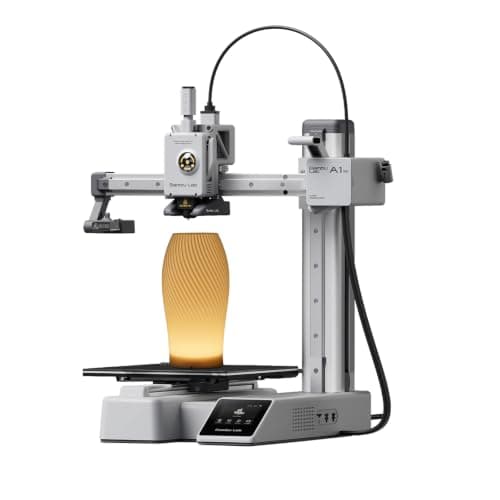
The one to get if you have never done this before. It calibrates itself before every print — bed mesh, Z-offset, flow, resonance — so the part of 3D printing that used to defeat beginners is a step you never see. The build volume is the price you pay.
#ad Price as of October 19, 2026, from Amazon. Prices change. How we make money.
What it actually is
A small open-frame filament printer. Filament is a 1.75 mm plastic string on a spool; the machine melts it and draws your object one layer at a time. Open-frame means there is no box around it, which is fine for PLA and a limitation for materials that warp.
What the manufacturer states
| Figure | Value | Source |
|---|---|---|
| Build volume | 180 x 180 x 180 mm | Bambu Lab A1 mini technical specifications |
| Max hot end temperature | 300 C | Bambu Lab A1 mini technical specifications |
| Max build plate temperature | 80 C | Bambu Lab A1 mini technical specifications |
| Max toolhead speed | 500 mm/s | Bambu Lab A1 mini technical specifications |
| Max toolhead acceleration | 10,000 mm/s2 | Bambu Lab A1 mini technical specifications |
| Filaments rated ideal | PLA, PETG, TPU, PVA | Bambu Lab A1 mini technical specifications |
| Filaments not recommended | ABS, ASA, PC, PA, PET, carbon/glass fiber reinforced | Bambu Lab A1 mini technical specifications |
| Machine dimensions | 347 x 315 x 365 mm | Bambu Lab A1 mini technical specifications |
| Net weight | 5.5 kg | Bambu Lab A1 mini technical specifications |
| Max power | 150 W | Bambu Lab A1 mini technical specifications |
Read from Bambu Lab, A1 mini technical specifications on 2026-09-01. Where a manufacturer does not publish a figure, there is no row for it here.
What is good about it
- Full auto-calibration on every print, per Bambu Lab's own specification — no paper-under-the-nozzle ritual
- Rated ideal for PLA, PETG, TPU and PVA, which covers everything a beginner should print in year one
- 150 W maximum power draw is the lowest of any printer on this site, so running cost is trivial
- 5.5 kg and 347 mm wide — it fits on a desk without rearranging the room
What is not
- 180 mm cubed is genuinely small. A full-size helmet or a large cosplay prop will not fit
- Bambu Lab rates ABS, ASA, PC and fiber-reinforced filaments as not recommended on this machine
- The multi-color AMS lite is a separate purchase, so the headline price is not the multi-color price
- Bambu Lab's own Amazon store lists this machine bundled with an LED lamp kit rather than on its own, so the price on our button is for that bundle. The bare printer is sold direct on Bambu Lab's store
- Open frame, so it is at the mercy of a draft from a window or an air conditioning vent
Skip this one if
Skip it if you already know the thing you want to print is bigger than a shoebox, or if you specifically want ABS or a carbon-fiber-filled filament. Bambu Lab itself lists those materials as not recommended here, and buying a machine you intend to use outside its rated envelope is how a first printer becomes a frustrating one.
What we cannot tell you
We have not printed on this machine. Long-term reliability, real-world noise in a quiet room, and how the textured plate holds up after a year are all things we cannot honestly report without owning one.
How it scored for a beginner
- Setup out of the box9.5
- Auto-calibration10.0
- First-layer forgiveness9.5
- Parts and filament availability9.0
- Running cost10.0
- Help when it goes wrong9.0
Beginner fit 9.2 / 10. That is our editorial read of how well this suits someone buying their first printer, taken off the published specifications — not a test result, and not a verdict on absolute quality. It is deliberately not marked up as a rating in this page’s structured data. How we pick.
Creality Ender-3 V3 SE
Creality · The smallest sensible amount of money
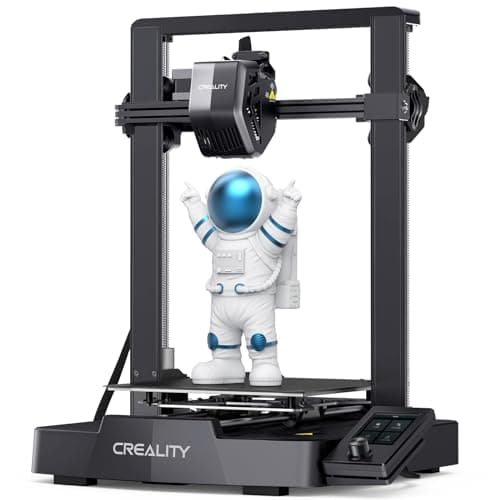
The cheap way in, and a genuinely modern one: auto bed leveling with CR Touch, automatic Z-offset from a strain sensor, and a direct-drive extruder. You will still learn more about your printer than an A1 owner does. Whether that is a feature or a cost is the whole decision.
#ad Price as of October 19, 2026, from Amazon. Prices change. How we make money.
What it actually is
An open-frame bed-slinger — the plate moves back and forth under a head that moves side to side and up. It is the classic hobby-printer layout, and this generation added the automatic setup steps the older Enders famously lacked.
What the manufacturer states
| Figure | Value | Source |
|---|---|---|
| Build volume | 220 x 220 x 250 mm | Creality Ender-3 V3 SE product specifications |
| Maximum print speed | 250 mm/s | Creality Ender-3 V3 SE product specifications |
| Typical print speed | 180 mm/s | Creality Ender-3 V3 SE product specifications |
| Acceleration | 2,500 mm/s2 | Creality Ender-3 V3 SE product specifications |
| Leveling | CR Touch auto leveling with strain-sensor Z-offset | Creality Ender-3 V3 SE product specifications |
| Extruder | Sprite direct extruder | Creality Ender-3 V3 SE product specifications |
| Filament diameter | 1.75 mm | Creality Ender-3 V3 SE product specifications |
Read from Creality, Ender-3 V3 SE product page on 2026-09-01. Where a manufacturer does not publish a figure, there is no row for it here.
What is good about it
- 220 x 220 x 250 mm is larger in every axis than the A1 mini
- Automatic bed leveling and Z-offset, which is the thing older Enders did not have
- The largest parts and community ecozystem of any machine here, by a distance
- Some assembly is required, and you will understand your printer better for it
What is not
- 250 mm/s maximum and 2,500 mm/s2 acceleration — a fraction of the A1's rated figures
- Not fully assembled out of the box, so first-print day is longer
- No filament run-out safety net of the kind Bambu specifies on the A1 series
- More of the tuning is yours to do, which is the trade for the price
Skip this one if
Skip it if the reason you are buying a printer is that you want to print things, not to own a printer. This machine is excellent value and it will ask more of you than an A1 mini will. If your patience for troubleshooting is low, spend the difference.
What we cannot tell you
We have not printed on this machine. How often the auto leveling needs re-running, the quality of the bundled build surface after a hundred prints, and assembly time for someone who has never built one are all outside what the specification tells you.
How it scored for a beginner
- Setup out of the box7.0
- Auto-calibration8.0
- First-layer forgiveness7.5
- Parts and filament availability10.0
- Running cost9.0
- Help when it goes wrong10.0
Beginner fit 8.0 / 10. That is our editorial read of how well this suits someone buying their first printer, taken off the published specifications — not a test result, and not a verdict on absolute quality. It is deliberately not marked up as a rating in this page’s structured data. How we pick.
How these were picked
We have not printed on these machines and we do not pretend to have. What we did was read each manufacturer’s own specification page, take their stated build volume, temperatures and speeds, check that every pick genuinely fits the job in this page’s title, confirm it is still being sold, and pull a live price rather than a remembered one. Every figure names the source it came from, so you can check it yourself in about a minute.
How we pick sets out the full method, including what would change a ranking.
Questions people actually ask
+−Is a 3D printer worth the money?
If you want a hobby that occasionally produces something useful, yes. If you want one specific object made once, no — a printing service is cheaper and better finished. The value comes from repeated small wins on things that cannot be bought at all.
+−Will a 3D printer pay for itself?
Slowly, and not in the way people mean. It rarely beats buying mass- produced items on price. Where it wins is on objects that do not exist to buy — a bracket for your specific shelf, a knob for an old appliance, an organizer sized to your drawer.
+−How much does it cost to run a 3D printer?
Very little. Taking a 150 W published maximum as though it were drawn constantly, an eight-hour print uses 1.2 kWh — about 22 cents at the 18.34 cents per kilowatt-hour the EIA reported for US residential customers in June 2026. Real consumption is lower.
+−Is a 3D printer hard to use in 2026?
Much less than its reputation suggests. Current beginner machines publish automatic bed leveling, Z-offset and flow calibration, and setup is reported at roughly fifteen minutes on the auto-calibrating models. There is still a learning curve; it is just far shorter than it was.
+−Is a 3D printer worth it for kids?
If the child has asked for one specifically and repeatedly, yes. If it is an adult’s idea of a good hobby for them, be more cautious — month three is where interest either sticks or does not, and that is not something you can buy your way past.
+−Is a 3D printer worth it for D&D minis?
If you play regularly and want a lot of figures, yes — but the machine is a resin printer, not a filament one, and it comes with gloves, ventilation, an alcohol wash and a UV cure on every print. For a handful of figures, buying them is cheaper and far less work.