Guide
Filament Storage and Drying
This is the failure most beginners misdiagnose. Filament pulls water out of ordinary room air, and water in the nozzle turns to steam. Here is how to recognize it and what actually fixes it.
By Scooter M. · Published · Last reviewed
How this page is funded: the buy links below are affiliate links. If you buy through one we earn a commission, at no extra cost to you. It does not change the order of the picks or a word of what we say about them. Full disclosure.
Printers we claim to have tested: 0. Everyone in this category says they tested twenty machines. We have not tested any, and we would rather say so. What we did instead is on this page: the manufacturer’s own published specification for every pick, cited and dated; the arithmetic on what it costs to run, with the inputs shown; a live price rather than a remembered one; and a plain answer on who should skip each machine.
The short answer
If a spool that used to print well starts popping and stringing, it is wet. Filament absorbs water from ordinary room air, and that water turns to steam in a 200 °C nozzle. The fix is heat and time — a filament dryer, or a sealed box with fresh desiccant for storage. You do not need either on day one.
How to tell
Wet filament has a specific set of symptoms and once you know them it is unmistakable.
- Popping or crackling from the nozzle. That is water boiling. It is the single clearest sign and it is audible from across the room.
- A rough, foamy or pitted surface where the print used to be smooth — steam bubbles disrupting the extrusion.
- Stringing that has got worse over time on the same model with the same settings.
- Weak layer bonding. The part comes apart along layer lines more easily than an identical print did a month ago.
- Visible steam at the nozzle in a badly affected spool.
The diagnostic that settles it: print the same model from a fresh, sealed spool. If the problem disappears, it was moisture and not your machine.
Which filaments care, and how much
All of them absorb water; they differ in how fast and how much it matters.
- PLA is the most forgiving. It takes weeks of open exposure in a normal room before it misbehaves noticeably.
- PETG is noticeably thirstier. An open spool in a humid room can be a problem within days, which is one of the reasons PETG has a reputation for stringing.
- TPU, nylon and PVA are the extreme end. Nylon in particular commonly wants drying before every print, and PVA dissolves in water by design, so leaving it in humid air is exactly as bad as it sounds.
Storage: the cheap version that works
You do not need equipment to store filament well. The requirement is simply airtight plus a desiccant.
- Keep the vacuum bag your spool came in. Reputable manufacturers vacuum-seal spools with a desiccant pack — Overture and HATCHBOX both publish this. That bag is a perfectly good storage container.
- Airtight box plus desiccant for the rest. A cereal container or a sealed plastic tub with silica gel packs works. This is where most people land and it is genuinely sufficient for PLA.
- Refresh the desiccant. Silica gel saturates. Color-indicating packs tell you when; plain ones you replace or bake dry periodically.
- Do not store filament in a garage or a basement. Temperature swings and humidity are exactly the wrong combination, and it is where people put things they are not using.
When a dryer is worth buying
A dryer does what a sealed box cannot: it removes moisture that has already been absorbed, using heat over several hours. A box only stops more getting in.
You do not need one on day one. Your first spool arrives sealed and dry, and a dryer solves a problem you will not have for weeks. That is why it is not on our starter kit list.
Buy one when a spool that used to print well starts popping, or when you move to PETG, TPU or nylon, or if you live somewhere genuinely humid. The feature worth paying for is capacity: a unit that holds several spools and lets you print directly from it means your filament is dry while it prints, rather than being dried and then left out to reabsorb.
The SUNLU FilaDryer S4 publishes a four-spool capacity, a 35–70 °C range that covers PLA at the low end and nylon at the high end, and support for 1.75, 2.85 and 3.0 mm filament. Those are the specifications that matter for this job.
The oven question
People do dry filament in a kitchen oven. It can work and it has two real problems: most domestic ovens are poorly calibrated at the low temperatures involved, and PLA softens not far above the temperature you would be drying it at. An oven that overshoots turns a spool into a fused block. If you try it, use the lowest setting your oven has and watch it. A purpose-built dryer holds a lower, steadier temperature precisely because that is the whole design problem.
If you have reached the point of buying one, the three boxes we would choose between - compared on published temperature range, humidity readout and capacity - are on the best filament dryers.
What we would buy for this
Chosen from the same registry as our roundups, on the manufacturer’s own published figures and a live price.
SUNLU FilaDryer S4
SUNLU · Filament that has been open more than a few weeks
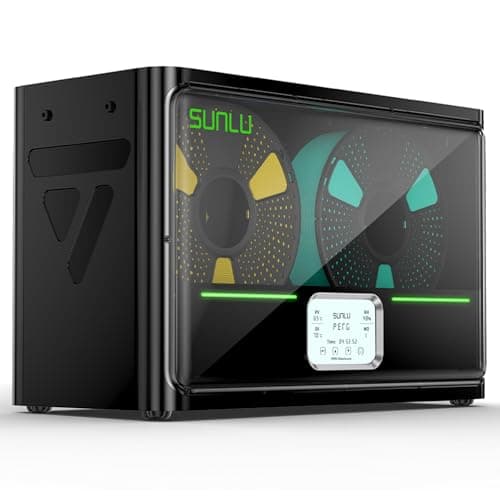
The accessory that fixes a failure most beginners misdiagnose. Filament absorbs water from the air; wet filament pops, strings and prints badly, and no amount of leveling fixes it. Four spools at once and you can print straight out of the box.
#ad Price as of October 19, 2026, from Amazon. Prices change. How we make money.
What it actually is
A heated box that drives moisture out of filament and then keeps it dry while you print from it. Plastics like PETG and nylon pull water out of ordinary room air within days, and water in the filament turns to steam in the nozzle.
What the manufacturer states
| Figure | Value | Source |
|---|---|---|
| Capacity | 4 x 1 kg spools | SUNLU FilaDryer S4 published specification |
| Temperature range | 35 - 70 C | SUNLU FilaDryer S4 published specification |
| Heater | 350 W PTC heater | SUNLU FilaDryer S4 published specification |
| Filament diameters supported | 1.75 mm, 2.85 mm, 3.0 mm | SUNLU FilaDryer S4 published specification |
Read from SUNLU, FilaDryer S4 product page on 2026-09-01. Where a manufacturer does not publish a figure, there is no row for it here.
What is good about it
- Four spools at once, which is the difference between drying filament and having dry filament
- 35 - 70 C covers PLA at the low end and nylon at the high end
- You can feed the printer directly from the box, so filament stays dry mid-print
- Fixes a whole class of print failures that look like machine problems
What is not
- A 350 W heater is more power than most printers here draw
- It is a large box that needs somewhere to live next to the printer
- Nothing about it helps on a fresh, sealed, dry spool
- Sealed boxes with desiccant do most of the same job for less money if you are only storing
Skip this one if
Skip it on day one. Your first spool arrives vacuum sealed and dry, and a dryer solves a problem you will not have for weeks. Buy it when a spool that used to print well starts popping and stringing.
What we cannot tell you
We have not used this dryer. How long a spool actually stays dry in a humid room, and how accurate the displayed temperature is, need measurement we have not done.
How it scored for a beginner
- Ease for a beginner9.0
- Fixes a real failure9.5
- Availability8.5
- Value7.5
Beginner fit 8.5 / 10. That is our editorial read of how well this suits someone buying their first printer, taken off the published specifications — not a test result, and not a verdict on absolute quality. It is deliberately not marked up as a rating in this page’s structured data. How we pick.
Overture PLA
Overture · Your first spool, and your tenth
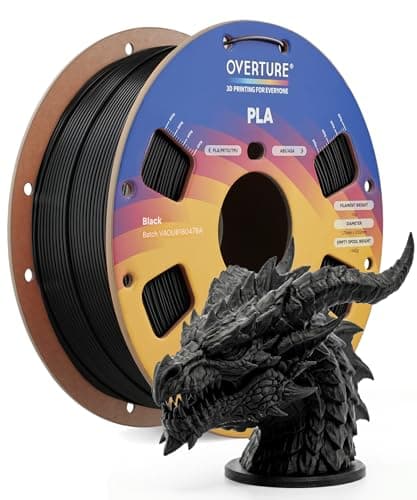
The default answer to 'what filament should I buy'. A tight published diameter tolerance, a conventional temperature range every printer profile already expects, and it is sold everywhere. Nothing about it is exciting, which is the point.
#ad Price as of October 19, 2026, from Amazon. Prices change. How we make money.
What it actually is
PLA is the plastic beginners should print. It is stiff, it needs no enclosure, it barely smells, and it sticks to a plate at low temperatures. This is a mainstream 1 kg spool of it.
What the manufacturer states
| Figure | Value | Source |
|---|---|---|
| Diameter | 1.75 mm | Overture published product specification |
| Dimensional accuracy | +/- 0.02 mm | Overture published product specification |
| Spool weight | 1 kg (2.2 lb) | Overture published product specification |
| Recommended nozzle temperature | 190 - 220 C | Overture published product specification |
| Recommended bed temperature | 25 - 60 C | Overture published product specification |
| Packaging | Dried before packing and vacuum sealed | Overture published product specification |
Read from Overture, PLA filament product page on 2026-09-01. Where a manufacturer does not publish a figure, there is no row for it here.
What is good about it
- +/- 0.02 mm published tolerance, which is as tight as mainstream PLA is quoted
- 190 - 220 C is squarely inside every stock PLA profile you will meet
- A 25 - 60 C bed range means it will stick even on an unheated or barely warm plate
- Vacuum sealed with desiccant, so a spool bought in advance is still dry when it arrives
What is not
- PLA softens in a hot car or a sunny window — this is a property of the material, not the brand
- Not the cheapest per kilogram once you start printing seriously
- Color consistency between batches of any budget filament is a real thing
- No filament is a fix for a machine that is not leveled
Skip this one if
Skip it if the part you are making will live outdoors or in a car. That is a PETG job, not a PLA one, and no PLA brand changes that.
What we cannot tell you
We have not printed this filament. Batch-to-batch color consistency and how it behaves after a year in a cupboard are things only repeated use reveals.
How it scored for a beginner
- Ease for a beginner9.5
- Published tolerance9.5
- Availability9.5
- Value per kilogram8.0
Beginner fit 9.0 / 10. That is our editorial read of how well this suits someone buying their first printer, taken off the published specifications — not a test result, and not a verdict on absolute quality. It is deliberately not marked up as a rating in this page’s structured data. How we pick.
How these were picked
We have not printed on these machines and we do not pretend to have. What we did was read each manufacturer’s own specification page, take their stated build volume, temperatures and speeds, check that every pick genuinely fits the job in this page’s title, confirm it is still being sold, and pull a live price rather than a remembered one. Every figure names the source it came from, so you can check it yourself in about a minute.
How we pick sets out the full method, including what would change a ranking.
Questions people actually ask
+−How do I know if my filament is wet?
Listen for popping or crackling at the nozzle — that is water boiling. Look for a rough or pitted surface where the print used to be smooth, stringing that has got worse over time, and layers that separate more easily than they used to. Printing the same model from a fresh sealed spool settles it.
+−Do I need a filament dryer?
Not on day one — a new spool arrives sealed and dry. Buy one when a spool that used to print well starts misbehaving, when you move to PETG, TPU or nylon, or if you live somewhere humid. Until then a sealed box with desiccant does the storage job.
+−How should I store 3D printer filament?
Airtight with a desiccant. The vacuum bag it came in is ideal; a sealed tub with silica gel is the usual homemade version. Refresh the desiccant periodically, and keep spools out of garages and basements where humidity and temperature swing.
+−Can I dry filament in the oven?
People do, and there are two real risks: most domestic ovens are badly calibrated at these low temperatures, and PLA softens not far above the drying temperature. An oven that overshoots fuses the spool into a block. Use the lowest setting and watch it, or use a purpose-built dryer that holds a steady low temperature.