Review
Bambu Lab A1 Review
Same automatic calibration, a build volume nearly three times larger by volume, and the bed temperature that quietly matters more than the size does.
By Scooter M. · Published · Last reviewed
How this page is funded: the buy links below are affiliate links. If you buy through one we earn a commission, at no extra cost to you. It does not change the order of the picks or a word of what we say about them. Full disclosure.
Printers we claim to have tested: 0. Everyone in this category says they tested twenty machines. We have not tested any, and we would rather say so. What we did instead is on this page: the manufacturer’s own published specification for every pick, cited and dated; the arithmetic on what it costs to run, with the inputs shown; a live price rather than a remembered one; and a plain answer on who should skip each machine.
The short answer
Buy it instead of the mini if you can name something you want to print that will not fit in 180 mm cubed. You get 256 mm cubed, a 100 °C plate rather than 80 °C, and identical automatic calibration. You pay in desk space — 465 mm wide and 8.3 kg — and in power, at a published 350 W against 150 W.
The bed temperature is the underrated part
Everyone compares these two machines on build volume, and the volume difference is real: 256 mm cubed is close to three times 180 mm cubed by volume, not the 40% the linear numbers suggest.
But the specification that changes what you can reliably finish is the plate. Bambu Lab publishes 100 °C maximum on the A1 against 80 °C on the mini. PETG on a large footprint wants a hot plate to stay stuck for the whole print, and a large part that lifts at hour four is a large part wasted. If your reason for wanting the bigger machine is bigger parts, the hotter plate is the half of the upgrade that makes those parts finish.
What is identical
Almost everything else, and this is a genuine virtue. Same 300 °C hot end, same rated 500 mm/s and 10,000 mm/s², same filament-ideal list of PLA, PETG, TPU and PVA, same not-recommended list, same automatic bed leveling and Z-offset probing, same four-color AMS lite as a separate purchase.
Which means nothing about the first month gets harder as the machine gets larger. That is not true of every step up in this category, and it is the main reason we recommend the A1 as a first printer at all rather than only as a second one.
What it costs you
Space. 465 × 410 × 430 mm, and it is a bed-slinger, which means the plate travels back and forth beyond the frame’s footprint in use. Measure the surface before you buy, and make sure it is solid — a bed-slinger on a wobbly table produces visible ripples on the side of tall prints.
Power. A published 350 W maximum at 110 V against the mini’s 150 W. In absolute terms this is still small — the arithmetic is on the setup cost page — but it is more than double.
Weight. 8.3 kg against 5.5 kg. Relevant only if the printer is going to move around, which is a reason in itself to give it a permanent home.
Who should skip it
Anybody who has not measured their desk, and anybody who cannot name something they want to print that is larger than 180 mm cubed. Wanting headroom in the abstract is how people end up with a machine twice the size they needed, printing keychains. The mini is the cheaper mistake and the smaller one.
Also skip it if you want ABS or ASA. The A1 is still an open frame and Bambu Lab’s not-recommended list is the same. For those materials you want an enclosure — see the A1 against the P1S.
A1 against A1 mini, on the manufacturer's own published figures, read 2026-09-01.
| Figure | A1 | A1 mini |
|---|---|---|
| Build volume | 256 x 256 x 256 mm | 180 x 180 x 180 mm |
| Max build plate temperature | 100 C | 80 C |
| Max hot end temperature | 300 C | 300 C |
| Max speed / acceleration | 500 mm/s / 10,000 mm/s2 | 500 mm/s / 10,000 mm/s2 |
| Dimensions | 465 x 410 x 430 mm | 347 x 315 x 365 mm |
| Net weight | 8.3 kg | 5.5 kg |
| Max power | 350 W at 110 V | 150 W |
What we would buy for this
Chosen from the same registry as our roundups, on the manufacturer’s own published figures and a live price.
Bambu Lab A1
Bambu Lab · A first printer you will not outgrow
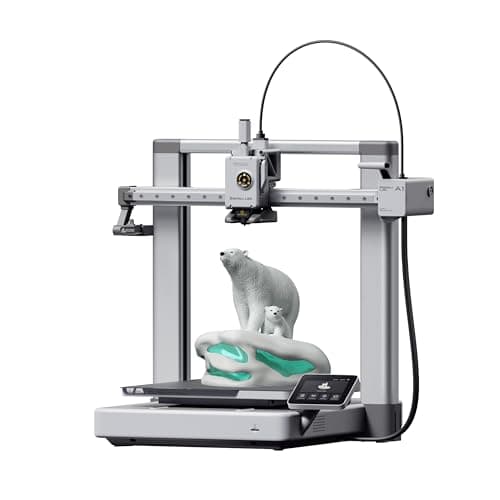
The A1 mini's larger sibling, and the better buy the moment you have a specific large thing in mind. Same self-calibration, 256 mm cubed instead of 180, and a 100 C bed rather than 80 C — which is the spec that actually widens what you can print.
#ad Price as of October 19, 2026, from Amazon. Prices change. How we make money.
What it actually is
The full-size version of the A1: same open-frame layout, same automatic calibration, a bigger bed and a hotter one. The extra bed temperature matters because materials that shrink as they cool need a warm plate to stay stuck to it.
What the manufacturer states
| Figure | Value | Source |
|---|---|---|
| Build volume | 256 x 256 x 256 mm | Bambu Lab A1 technical specifications |
| Max hot end temperature | 300 C | Bambu Lab A1 technical specifications |
| Max build plate temperature | 100 C | Bambu Lab A1 technical specifications |
| Max toolhead speed | 500 mm/s | Bambu Lab A1 technical specifications |
| Max toolhead acceleration | 10,000 mm/s2 | Bambu Lab A1 technical specifications |
| Filaments rated ideal | PLA, PETG, TPU, PVA | Bambu Lab A1 technical specifications |
| Machine dimensions | 465 x 410 x 430 mm | Bambu Lab A1 technical specifications |
| Net weight | 8.3 kg | Bambu Lab A1 technical specifications |
| Max power | 350 W at 110 V | Bambu Lab A1 technical specifications |
Read from Bambu Lab, A1 technical specifications on 2026-09-01. Where a manufacturer does not publish a figure, there is no row for it here.
What is good about it
- 256 mm cubed covers almost everything a first-year printer is asked to make
- 100 C bed rather than the mini's 80 C, which is the difference that makes larger PETG parts stick
- Identical hands-off calibration to the A1 mini, so nothing gets harder as the machine gets bigger
- Bambu Lab publishes a full specification sheet, so every number on this page is checkable in a minute
What is not
- 465 mm wide and 8.3 kg — it needs a dedicated shelf, not a corner of a desk
- 350 W at US voltage against the mini's 150 W, so it costs meaningfully more to run
- Still open-frame, so the material limits are the same as the mini's despite the hotter bed
- Multi-color is again a separate AMS lite purchase
Skip this one if
Skip it if your desk is the only place it can go and you have not measured that desk. It is nearly half a meter wide. If you are unsure whether you will use the extra volume, the mini is the cheaper mistake.
What we cannot tell you
We have not printed on this machine. Noise at full speed, long-term belt and rod wear, and how often the auto-calibration actually needs intervention are all beyond what a specification sheet can tell you.
How it scored for a beginner
- Setup out of the box9.5
- Auto-calibration10.0
- First-layer forgiveness9.5
- Parts and filament availability9.0
- Running cost8.0
- Help when it goes wrong9.0
Beginner fit 9.0 / 10. That is our editorial read of how well this suits someone buying their first printer, taken off the published specifications — not a test result, and not a verdict on absolute quality. It is deliberately not marked up as a rating in this page’s structured data. How we pick.
How these were picked
We have not printed on these machines and we do not pretend to have. What we did was read each manufacturer’s own specification page, take their stated build volume, temperatures and speeds, check that every pick genuinely fits the job in this page’s title, confirm it is still being sold, and pull a live price rather than a remembered one. Every figure names the source it came from, so you can check it yourself in about a minute.
How we pick sets out the full method, including what would change a ranking.
Questions people actually ask
+−Is the Bambu Lab A1 worth it over the A1 mini?
If you can name a specific thing you want to print that will not fit in 180 mm cubed, yes. Otherwise the mini is the same machine in less space for less money. The hidden half of the upgrade is the 100 °C plate against the mini’s 80 °C, which is what keeps large PETG parts stuck down.
+−How much desk space does the A1 need?
Bambu Lab publishes 465 × 410 × 430 mm. Allow more than that in practice: it is a bed-slinger, so the plate travels beyond the frame footprint, and you need clearance to load a spool and reach the front.
+−Can the A1 print ABS?
Bambu Lab rates ABS, ASA, PC, PA and fiber-reinforced filaments as not recommended on the A1, the same as on the mini. It is an open frame. For those materials you want the enclosed P1S or another enclosed machine.