Roundup
Gifts for Someone Who Already 3D Prints
They have opinions about machines and almost none about spare build plates. That gap is where the good presents live, and everything here costs a fraction of a printer.
By Scooter M. · Published · Last reviewed

How this page is funded: the buy links below are affiliate links. If you buy through one we earn a commission, at no extra cost to you. It does not change the order of the picks or a word of what we say about them. Full disclosure.
Printers we claim to have tested: 0. Everyone in this category says they tested twenty machines. We have not tested any, and we would rather say so. What we did instead is on this page: the manufacturer’s own published specification for every pick, cited and dated; the arithmetic on what it costs to run, with the inputs shown; a live price rather than a remembered one; and a plain answer on who should skip each machine.
The short answer
Do not buy a second printer. Somebody who already prints has strong opinions about machines and will have chosen the one they wanted. What they have not bought is the filament dryer they know they need, a spare build plate, or a spool of something they have never tried. Those are the good presents.
Why a printer is the wrong gift here
Two reasons. Anyone who prints regularly has researched machines and has a specific next one in mind, usually for a specific reason — an enclosure, more volume, multi-color. Guessing correctly is unlikely.
And a second printer needs somewhere to live, which is a bigger ask than it sounds. A machine that has to be found space for is a complicated present.
The best presents, ranked
1. A filament dryer
The classic. Everybody who prints knows filament absorbs moisture and that wet filament pops, strings and prints badly. Almost nobody gets round to buying the box, because it never feels urgent until a spool has already gone off.
The feature to look for is capacity plus the ability to print directly from it, which means the filament stays dry during the print rather than being dried and then left out to reabsorb. The SUNLU FilaDryer S4 publishes a four-spool capacity, a 35–70 °C range and support for 1.75, 2.85 and 3.0 mm filament.
2. Filament they would not buy themselves
The thing that actually runs out, and the easiest present to get right. Two directions work:
- A better version of what they use. A spool from a manufacturer that publishes a full technical data sheet, in a color they use constantly.
- Something they have not tried. Silk, matte, glow-in-the-dark, color-changing, wood-filled. All of them are still PLA and print at roughly PLA settings, so it is a new experience with no new problems.
Avoid guessing at exotic engineering filaments — nylon and carbon-fiber-filled materials need specific hardware and are a frustrating present if the machine cannot run them. The filament types guide explains which need what.
3. A spare build plate
Unglamorous and used immediately. A second plate means starting the next print while the last one is still cooling, and a different surface texture is genuinely useful — smooth for glossy bottoms, textured for grip.
The catch is that plates are machine-specific, so you need to know exactly which printer they own. If you do, this is one of the best presents on the list.
4. Storage that actually gets used
Sealed boxes with desiccant for spools, or a proper storage system for finished prints. Both are things people improvise badly for months. Storage and drying covers what good looks like.
5. Finishing and cleanup tools
Small, cheap and genuinely used: flush cutters, a plastic scraper set, a deburring tool for cleaning up edges, sanding sticks. People who print mostly own one bad pair of snips and nothing else.
Present ideas by budget band, without naming prices we cannot stand behind.
| Budget | Best choice | Why |
|---|---|---|
| Small | A spool of something they have not tried | New experience, no new problems |
| Small | Flush cutters and a plastic scraper set | Everybody needs these and nobody buys good ones |
| Medium | Two spools plus finishing tools | Covers the consumable and the annoyance at once |
| Medium | A spare build plate | Only if you know exactly which printer they own |
| Larger | A filament dryer | The thing they know they need and have not bought |
| Larger | A multi-spool color unit | Only if you are certain their machine supports it |
The zero-cost present
Print something for them, badly. Someone who prints will find a slightly wonky object made specifically for them by a person who does not normally do this far more charming than another spool. It also means asking them to teach you, which is a present in itself.
If you have no printer, model libraries are free and full of things designed for this — and printing services will make one for you.
Quick picks
Ranked on how well each one fits the job in this page's title, read off the manufacturer's own published specifications. Tap any row for the full write-up, including who should skip it.
| # | Product | Best for | Beginner fit | Price |
|---|---|---|---|---|
| 1 | 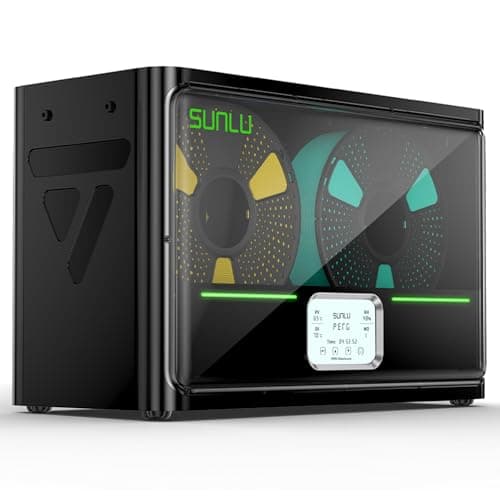 SUNLU FilaDryer S4SUNLU SUNLU FilaDryer S4SUNLU | Best accessory gift | 8.5 | $99.44 - Check price on Amazon |
| 2 | 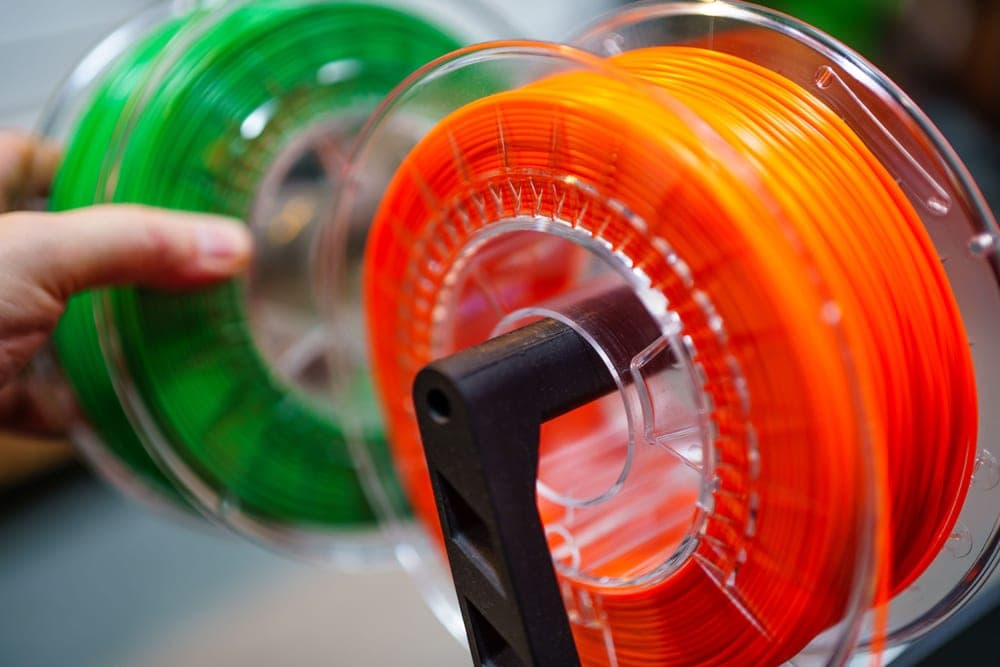 Polymaker PolyLite PLAPolymaker Polymaker PolyLite PLAPolymaker | Best filament gift | 8.7 | Check price on Amazon |
| 3 | 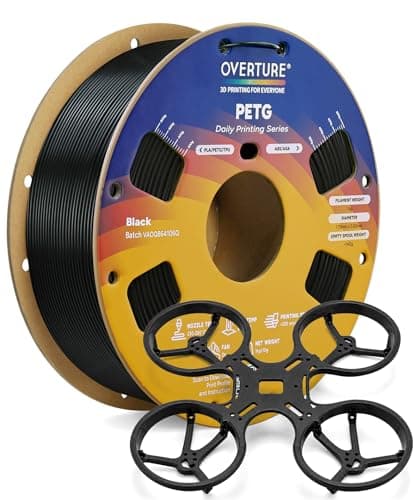 Overture High Speed PETGOverture Overture High Speed PETGOverture | Best 'try something new' gift | 7.9 | $14.69 - Check price on Amazon |
#1 · Best accessory gift
SUNLU FilaDryer S4
SUNLU · Filament that has been open more than a few weeks
The accessory that fixes a failure most beginners misdiagnose. Filament absorbs water from the air; wet filament pops, strings and prints badly, and no amount of leveling fixes it. Four spools at once and you can print straight out of the box.
#ad Price as of October 19, 2026, from Amazon. Prices change. How we make money.
What it actually is
A heated box that drives moisture out of filament and then keeps it dry while you print from it. Plastics like PETG and nylon pull water out of ordinary room air within days, and water in the filament turns to steam in the nozzle.
Does it fit this page?
The classic thing people know they need and never get round to buying. A published four-spool capacity and a 35-70 C range means it covers PLA through nylon, and they can print straight out of it.
What the manufacturer states
| Figure | Value | Source |
|---|---|---|
| Capacity | 4 x 1 kg spools | SUNLU FilaDryer S4 published specification |
| Temperature range | 35 - 70 C | SUNLU FilaDryer S4 published specification |
| Heater | 350 W PTC heater | SUNLU FilaDryer S4 published specification |
| Filament diameters supported | 1.75 mm, 2.85 mm, 3.0 mm | SUNLU FilaDryer S4 published specification |
Read from SUNLU, FilaDryer S4 product page on 2026-09-01. Where a manufacturer does not publish a figure, there is no row for it here.
What is good about it
- Four spools at once, which is the difference between drying filament and having dry filament
- 35 - 70 C covers PLA at the low end and nylon at the high end
- You can feed the printer directly from the box, so filament stays dry mid-print
- Fixes a whole class of print failures that look like machine problems
What is not
- A 350 W heater is more power than most printers here draw
- It is a large box that needs somewhere to live next to the printer
- Nothing about it helps on a fresh, sealed, dry spool
- Sealed boxes with desiccant do most of the same job for less money if you are only storing
Skip this one if
Skip it on day one. Your first spool arrives vacuum sealed and dry, and a dryer solves a problem you will not have for weeks. Buy it when a spool that used to print well starts popping and stringing.
What we cannot tell you
We have not used this dryer. How long a spool actually stays dry in a humid room, and how accurate the displayed temperature is, need measurement we have not done.
How it scored for a beginner
- Ease for a beginner9.0
- Fixes a real failure9.5
- Availability8.5
- Value7.5
Beginner fit 8.5 / 10. That is our editorial read of how well this suits someone buying their first printer, taken off the published specifications — not a test result, and not a verdict on absolute quality. It is deliberately not marked up as a rating in this page’s structured data. How we pick.
#2 · Best filament gift
Polymaker PolyLite PLA
Polymaker · A print you do not want to repeat
The spool to buy when a print matters. Polymaker publishes a proper technical data sheet rather than a marketing bullet list, and a wider 190 - 230 C window gives you room to raise the temperature when a layer is not bonding.
#ad We do not hold a current price for this product, so we do not show one. How we make money.
What it actually is
A mainstream PLA from a manufacturer that publishes full technical data sheets for its materials. Same plastic family as any other PLA; the difference is documentation and consistency rather than chemistry.
Does it fit this page?
Filament is the thing that actually runs out, and a spool from a manufacturer that publishes a full technical data sheet is a step up from whatever they buy on autopilot.
What the manufacturer states
| Figure | Value | Source |
|---|---|---|
| Diameter | 1.75 mm (+/- 0.05 mm) | Polymaker PolyLite PLA technical data sheet |
| Spool weight | 1 kg | Polymaker PolyLite PLA technical data sheet |
| Extrusion temperature | 190 - 230 C | Polymaker PolyLite PLA technical data sheet |
| Bed temperature | 25 - 60 C | Polymaker PolyLite PLA technical data sheet |
| Suggested printing speed | 40 - 60 mm/s | Polymaker PolyLite PLA technical data sheet |
Read from Polymaker, PolyLite PLA technical data sheet on 2026-09-01. Where a manufacturer does not publish a figure, there is no row for it here.
What is good about it
- Polymaker publishes a full technical data sheet, which is rarer in filament than it should be
- 190 - 230 C is a wider usable window than most PLA quotes, which helps with layer bonding
- Consistent enough that a working profile tends to keep working on the next spool
- Widely stocked, so replacing a color mid-project is realistic
What is not
- The published diameter tolerance is +/- 0.05 mm, looser than Overture's quoted +/- 0.02 mm
- Costs more per kilogram than the budget spools
- The suggested 40 - 60 mm/s speed is conservative for a printer rated at 500 mm/s
- Still PLA, with all of PLA's heat limits
Skip this one if
Skip it if you are printing your first Benchy and learning what the buttons do. Buy the cheaper spool, make your mistakes on it, and save this for the print you actually care about.
What we cannot tell you
We have not printed this filament. Real-world spool-to-spool variation and how the published speed range holds up on a fast machine need testing we have not done.
How it scored for a beginner
- Ease for a beginner9.0
- Published tolerance8.0
- Availability9.0
- Value per kilogram7.5
Beginner fit 8.7 / 10. That is our editorial read of how well this suits someone buying their first printer, taken off the published specifications — not a test result, and not a verdict on absolute quality. It is deliberately not marked up as a rating in this page’s structured data. How we pick.
#3 · Best 'try something new' gift
Overture High Speed PETG
Overture · Parts that have to survive heat or flexing
The second spool, not the first. PETG is what you move to when a part has to survive a hot car, a bit of flex or the outdoors — and it is fussier about stringing and bed adhesion than PLA in exchange.
#ad Price as of October 19, 2026, from Amazon. Prices change. How we make money.
What it actually is
PETG is a tougher, slightly flexible plastic that tolerates heat far better than PLA. It prints hotter, sticks harder to the plate, and strings more. The same material family as a drinks bottle.
Does it fit this page?
A material they may not have tried, for parts that live in a car or outdoors. Comes with a genuine reason to use it rather than being another spool of the same thing.
What the manufacturer states
| Figure | Value | Source |
|---|---|---|
| Diameter | 1.75 mm | Overture published product specification |
| Dimensional accuracy | +/- 0.02 mm | Overture published product specification |
| Recommended nozzle temperature | 230 - 260 C | Overture published product specification |
| Recommended printing speed | 30 - 300 mm/s | Overture published product specification |
Read from Overture, High Speed PETG filament product page on 2026-09-01. Where a manufacturer does not publish a figure, there is no row for it here.
What is good about it
- Handles heat that would soften a PLA part into uselessness
- Tougher and less brittle than PLA, so it survives being dropped
- +/- 0.02 mm published tolerance, the same as Overture's PLA
- A 30 - 300 mm/s published speed range that fits current fast machines
What is not
- Strings between features far more readily than PLA
- 230 - 260 C means your printer's hot end has to be rated for it — the A1 mini's 300 C ceiling is fine, some older machines are not
- It can stick to a smooth PEI plate hard enough to damage the surface
- Absorbs moisture from the air faster than PLA, so an open spool goes off
Skip this one if
Skip it as a first spool. Learn what a good first layer looks like in PLA before you add a material that sticks too well and strings between everything. PETG is a solution to a problem you have not had yet.
What we cannot tell you
We have not printed this filament. How much stringing you get at a given retraction setting, and whether it damages a specific plate, depend on the machine and we have not tested either.
How it scored for a beginner
- Ease for a beginner6.5
- Published tolerance9.5
- Availability9.0
- Value per kilogram8.0
Beginner fit 7.9 / 10. That is our editorial read of how well this suits someone buying their first printer, taken off the published specifications — not a test result, and not a verdict on absolute quality. It is deliberately not marked up as a rating in this page’s structured data. How we pick.
How these were picked
We have not printed on these machines and we do not pretend to have. What we did was read each manufacturer’s own specification page, take their stated build volume, temperatures and speeds, check that every pick genuinely fits the job in this page’s title, confirm it is still being sold, and pull a live price rather than a remembered one. Every figure names the source it came from, so you can check it yourself in about a minute.
How we pick sets out the full method, including what would change a ranking.
Questions people actually ask
+−What do you buy someone who already has a 3D printer?
A filament dryer, filament they would not buy themselves, a spare build plate for their specific machine, or a set of decent finishing tools. Not a second printer — they will have a specific one in mind for a specific reason.
+−Is filament a good gift?
One of the best. It is the thing that actually runs out, and silk, matte, glow-in-the-dark and color-changing PLA are all still PLA to print — a new experience with no new problems. Avoid exotic engineering filaments unless you know their machine can run them.
+−Should I buy a build plate as a gift?
Yes, if you know exactly which printer they own — plates are machine-specific. A second plate means starting the next print while the last cools, and a different surface texture is genuinely useful.
+−Are 3D printer upgrade kits good presents?
Usually not. They are model-specific, frequently solve problems the owner does not have, and a present that means an afternoon of disassembly is a chore. If they wanted the upgrade, they would already have it.