Head to head
Elegoo Centauri Carbon vs Bambu Lab P1S
Same shape, same working envelope, same reason to buy either: you want a box around the printer. The published specifications separate them in one direction and everything else separates them in the other.
By Scooter M. · Published · Last reviewed
How this page is funded: the buy links below are affiliate links. If you buy through one we earn a commission, at no extra cost to you. It does not change the order of the picks or a word of what we say about them. Full disclosure.
Printers we claim to have tested: 0. Everyone in this category says they tested twenty machines. We have not tested any, and we would rather say so. What we did instead is on this page: the manufacturer’s own published specification for every pick, cited and dated; the arithmetic on what it costs to run, with the inputs shown; a live price rather than a remembered one; and a plain answer on who should skip each machine.
The short answer
Buy the Centauri Carbon for the specification. Buy the P1S for the ecosystem. Elegoo publishes a hotter nozzle, a hotter plate and a wider material list, including the fiber-filled grades Bambu Lab warns against on the P1S. Bambu Lab gives you an activated carbon filter, AMS multi-color, and several years of other people having already hit your problem and written the answer down.
These two machines exist for the same buyer: somebody who has decided that an enclosure is worth paying for and does not want to spend flagship money on one. They are the same shape, they use the same motion system, and they give you exactly the same 256 mm cubed of space. What follows is where they genuinely diverge.
The published figures, side by side
Read from each manufacturer's own specification table on 2026-09-06.
| Elegoo Centauri Carbon | Bambu Lab P1S | |
|---|---|---|
| Build volume | 256 x 256 x 256 mm | 256 x 256 x 256 mm |
| Motion | CoreXY, enclosed | CoreXY, enclosed |
| Max nozzle temperature | 320 C | 300 C |
| Max plate temperature | 110 C at 25 C ambient | 100 C |
| Max speed | 500 mm/s (250 mm/s recommended) | 500 mm/s |
| Max acceleration | 20,000 mm/s2 (10,000 default) | 20 m/s2 (20,000 mm/s2) |
| Fiber-filled filament | Listed as supported; hardened steel nozzle included | Not recommended without an extruder and hot end upgrade |
| Air filter | Not published | Activated carbon |
| Clog detection | Marked absent on Elegoo's sensor table | Not published |
| Weight | 17.5 kg | 12.95 kg |
| Rated power at 110 V | 350 W | 350 W |
Where Elegoo wins: the materials ceiling
A 320 °C nozzle and a 110 °C plate are the two figures that decide how far up the materials ladder a machine can go, and Elegoo publishes higher numbers on both. More decisively, it lists carbon and glass fiber reinforced filaments as supported and includes a hardened-steel nozzle, while Bambu Lab states in its own comparison text that fiber-reinforced filament is not recommended on the P1S before an extruder and hot end upgrade.
If your reason for wanting an enclosure is a specific engineering material — a bracket in ASA that lives outside, a part in carbon-filled nylon — that difference is the whole comparison and you can stop reading here.
Where Bambu wins: everything that is not a number
The filter. Bambu Lab fits an activated carbon filter and says plainly what it is for: ABS and similar filaments emit odors while printing. Elegoo does not publish a filter on the Centauri Carbon’s sheet. If the printer is going in a bedroom, an office or a studio flat, that is not a minor line item.
Multi-color. The P1S takes Bambu Lab’s AMS, and the Combo bundles ship with one. It is a mature system with a large number of users behind it. We still say do not buy multi-color on day one, but knowing the upgrade path exists is worth something.
The answers. This is the one we would weight highest for a first or second printer. When a print fails at eleven at night, what you want is somebody who has already had that exact failure on that exact machine and written down what fixed it. Bambu Lab has years of that. The Centauri Carbon is a newer platform with less of it.
The speed figures are closer than they look
Both machines publish 500 mm/s. Elegoo also publishes a recommended speed of 250 mm/s on the same line, which is the more useful number and which we would treat as the honest one for both machines. Rated speed is a straight-line ceiling; real geometry with corners in it never reaches it, and the printer spends most of its time accelerating and decelerating rather than cruising.
The same caution applies to acceleration. Elegoo publishes 10,000 mm/s² as its default and 20,000 as its maximum; Bambu Lab publishes 20 m/s², which is the same 20,000 mm/s² written differently. Two identically-shaped machines will produce near-identical objects in PLA, and anyone telling you otherwise is selling something.
How we would decide
Ask which failure would annoy you more. If it is “I bought an enclosed printer and still cannot print the material I wanted,” buy the Centauri Carbon — it publishes the higher ceiling and includes the nozzle for abrasives. If it is “something went wrong and I could not find anyone who had fixed it,” buy the P1S. Both are defensible; only one of them is right for you, and the specification sheet cannot tell you which.
What we would buy for this
Chosen from the same registry as our roundups, on the manufacturer’s own published figures and a live price.
Elegoo Centauri Carbon
Elegoo · An enclosed printer without an enclosed-printer budget
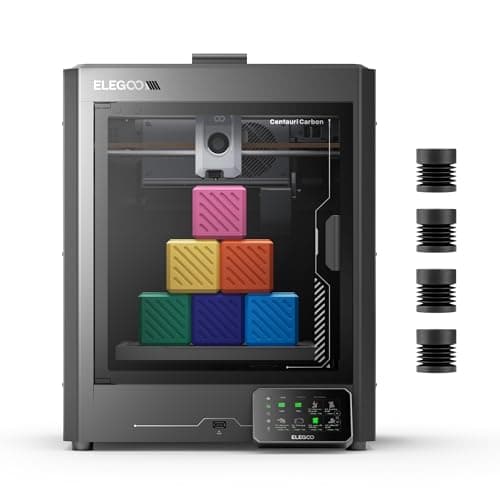
An enclosed CoreXY printer at a price that used to buy an open frame. If the reason you are hesitating about a beginner machine is that you can already see yourself outgrowing it, this is the one that answers that.
#ad Price as of October 21, 2026, from Amazon. Prices change. How we make money.
What it actually is
A boxed CoreXY machine with a steel chassis and aluminum and glass panels. The enclosure holds chamber heat, which is what lets it handle materials that shrink and peel on an open frame.
What the manufacturer states
| Figure | Value | Source |
|---|---|---|
| Build volume | 256 x 256 x 256 mm | Elegoo Centauri Carbon product specifications |
| Motion system | CoreXY | Elegoo Centauri Carbon product specifications |
| Enclosure | Fully enclosed; steel chassis with aluminum and glass shell | Elegoo Centauri Carbon product specifications |
| Maximum speed | 500 mm/s | Elegoo Centauri Carbon product specifications |
| Maximum acceleration | 20,000 mm/s2 (10,000 mm/s2 default) | Elegoo Centauri Carbon product specifications |
| Max nozzle temperature | 320 C | Elegoo Centauri Carbon product specifications |
| Max heated bed temperature | 110 C at 25 C ambient | Elegoo Centauri Carbon product specifications |
| Supported filament | PLA, PETG, ABS, ASA, TPU, PET, PC, PA and carbon or glass fiber reinforced grades | Elegoo Centauri Carbon product specifications |
| Bed leveling | 121-point auto-leveling; full-auto calibration | Elegoo Centauri Carbon product specifications |
| Print accuracy | +/- 0.1 mm | Elegoo Centauri Carbon product specifications |
| Machine size and weight | 398 x 404 x 490 mm, 17.5 kg | Elegoo Centauri Carbon product specifications |
| Rated power | 350 W at 110 V | Elegoo Centauri Carbon product specifications |
| Operating sound | 55 dB or below | Elegoo Centauri Carbon product specifications |
Read from Elegoo, Centauri Carbon product page on 2026-09-06. Where a manufacturer does not publish a figure, there is no row for it here.
What is good about it
- Fully enclosed at a price that competes with open-frame machines
- 20,000 mm/s2 rated acceleration, matching the enclosed Bambu
- 256 mm cubed — the same working envelope as an A1 or a P1S
- The enclosure contains noise and smell, which decides whether a printer can live in a bedroom
What is not
- A newer platform than the Bambu and Creality lines, so there is less community troubleshooting behind it
- An enclosure adds a heat-soak wait to PLA prints in a warm room
- Larger and heavier than any open-frame machine here
- Nothing about the enclosure makes the first print easier — it makes later prints possible
Skip this one if
Skip it if PLA is all you will ever print and your printer lives in a spare room. You are paying for a box you will not use. The enclosure earns its money on ABS, ASA and a shared living space, not on PLA in a garage.
What we cannot tell you
We have not printed on this machine. Chamber temperature in practice, panel fit and finish, and long-term CoreXY belt tension are not published numbers.
How it scored for a beginner
- Setup out of the box8.5
- Auto-calibration8.5
- First-layer forgiveness8.5
- Parts and filament availability7.5
- Running cost8.0
- Help when it goes wrong7.5
Beginner fit 8.3 / 10. That is our editorial read of how well this suits someone buying their first printer, taken off the published specifications — not a test result, and not a verdict on absolute quality. It is deliberately not marked up as a rating in this page’s structured data. How we pick.
Bambu Lab P1S
Bambu Lab · A first printer for someone who already knows they want ABS or ASA
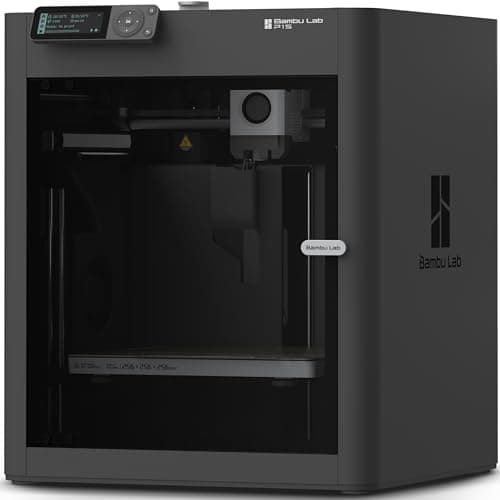
An enclosed CoreXY machine, which is a different class of thing from an A1: the bed stays still and the box holds heat, so the materials the A1 refuses become possible. It is more printer than a first-timer needs, and the right answer if you already know you want ABS.
#ad Price as of October 21, 2026, from Amazon. Prices change. How we make money.
What it actually is
A boxed printer using CoreXY motion — the print head moves in two axes while the bed only goes up and down. Keeping the bed still lets it move faster, and the enclosure keeps the chamber warm so plastics that shrink as they cool do not peel off the plate.
What the manufacturer states
| Figure | Value | Source |
|---|---|---|
| Build volume | 256 x 256 x 256 mm | Bambu Lab P1S technical specifications |
| Enclosure | Enclosed, plastic and glass | Bambu Lab P1S technical specifications |
| Max hot end temperature | 300 C | Bambu Lab P1S technical specifications |
| Max build plate temperature | 100 C | Bambu Lab P1S technical specifications |
| Max speed | 500 mm/s | Bambu Lab P1S technical specifications |
| Max acceleration | 20,000 mm/s2 | Bambu Lab P1S technical specifications |
| Nozzle | All-metal hot end, 0.4 mm included; 0.2, 0.6 and 0.8 mm optional | Bambu Lab P1S technical specifications |
| Filaments rated ideal | PLA, PETG, TPU, PVA, PET, ABS, ASA | Bambu Lab P1S technical specifications |
| Filaments rated capable | PA, PC | Bambu Lab P1S technical specifications |
| Air filter | Activated carbon | Bambu Lab P1S technical specifications |
| Physical dimensions | 389 x 389 x 458 mm | Bambu Lab P1S technical specifications |
| Net weight | 12.95 kg | Bambu Lab P1S technical specifications |
| Max power | 350 W at 110 V | Bambu Lab P1S technical specifications |
Read from Bambu Lab, P1S product page and specification table on 2026-09-06. Where a manufacturer does not publish a figure, there is no row for it here.
What is good about it
- Enclosed, so ABS and ASA are on the menu rather than off it
- CoreXY at 20,000 mm/s2 acceleration — twice the A1's rated figure
- Same 256 mm cubed volume as the A1 in a smaller footprint, because the bed does not travel
- The enclosure also contains most of the noise and the smell, which matters if it lives in a room you sit in
What is not
- Noticeably more expensive than an A1 for a beginner who will print PLA for a year
- The enclosure makes routine maintenance fiddlier than an open frame
- Nothing about it is easier to learn on than an A1 mini — it is just more capable
- Multi-color is again a separate AMS purchase
Skip this one if
Skip it if your honest answer to 'what will you print' is 'I am not sure yet'. Everything the P1S adds over an A1 is aimed at materials a beginner should not start with. Buy it when a specific project demands ABS, not before.
What we cannot tell you
We have not printed on this machine. Chamber temperature in a cold room, real ABS warping behavior and long-term fan noise are not on any specification sheet.
How it scored for a beginner
- Setup out of the box8.5
- Auto-calibration9.5
- First-layer forgiveness9.0
- Parts and filament availability9.0
- Running cost7.0
- Help when it goes wrong9.0
Beginner fit 8.4 / 10. That is our editorial read of how well this suits someone buying their first printer, taken off the published specifications — not a test result, and not a verdict on absolute quality. It is deliberately not marked up as a rating in this page’s structured data. How we pick.
How these were picked
We have not printed on these machines and we do not pretend to have. What we did was read each manufacturer’s own specification page, take their stated build volume, temperatures and speeds, check that every pick genuinely fits the job in this page’s title, confirm it is still being sold, and pull a live price rather than a remembered one. Every figure names the source it came from, so you can check it yourself in about a minute.
How we pick sets out the full method, including what would change a ranking.
Questions people actually ask
+−Which is better for ABS, the Centauri Carbon or the P1S?
Both are rated for it. Elegoo publishes the higher plate temperature — 110 °C against 100 °C — which helps on larger parts, while Bambu Lab fits an activated carbon filter, which matters if the printer shares a room with you. Materials ceiling versus air quality is the honest way to frame it.
+−Can either printer handle carbon fiber filament?
Elegoo lists fiber-reinforced filaments as supported and includes a brass hardened-steel nozzle. Bambu Lab states that fiber-reinforced filament is not recommended on the P1S before an extruder and hot end upgrade is done. That is a clear split, in Elegoo’s favor, from the manufacturers’ own words.
+−Is the Centauri Carbon a real alternative to a Bambu?
On published specification, comfortably. On everything around the machine — the size of the user base, the volume of troubleshooting written down, the maturity of the multi-color system — Bambu Lab is still ahead. Which of those you weight higher depends on how you like to solve problems.