Roundup
The Best Glow in the Dark Filament
Glow filament is the most fun a beginner can have with a spool, and the only decorative filament that can quietly ruin your nozzle. One manufacturer here says so outright. The other two say nothing at all.
By Scooter M. · Published · Last reviewed
How this page is funded: the buy links below are affiliate links. If you buy through one we earn a commission, at no extra cost to you. It does not change the order of the picks or a word of what we say about them. Full disclosure.
Printers we claim to have tested: 0. Everyone in this category says they tested twenty machines. We have not tested any, and we would rather say so. What we did instead is on this page: the manufacturer’s own published specification for every pick, cited and dated; the arithmetic on what it costs to run, with the inputs shown; a live price rather than a remembered one; and a plain answer on who should skip each machine.
The short answer
Buy Overture Glow PLA, and fit a hardened steel nozzle before you print it. Overture publishes the tightest tolerance, the only real mechanical data here, and the lowest price. The nozzle advice does not come from Overture — it comes from Elegoo, which is the only one of these three brands that publishes a hardened steel nozzle as a requirement for its glow PLA. The pigment that makes all of them glow is the same class of hard mineral.
We have not printed any of these spools. Everything below is what each manufacturer publishes — and as with ABS, the interesting part is where they disagree, or where two of them simply stay quiet about something the third treats as a requirement.
How glow filament actually works
It is ordinary PLA with a photoluminescent pigment mixed in. The pigment absorbs light, holds some of that energy, and releases it slowly as a visible glow once the lights go out. It is not powered, it does not contain anything radioactive, and it does not glow forever — it charges, then discharges.
Three consequences follow, and they explain almost everything about living with this filament:
It needs charging. A print that has sat in a dark drawer will not glow. It needs a few minutes under bright light first, and the brighter the source, the better the result.
The glow fades. It is brightest in the first minutes and tails off from there. None of these three manufacturers publishes a brightness figure or a duration, so we cannot tell you how long any of them lasts — and neither can anyone else without measuring it.
The pigment is a mineral, not a dye. This is the part that matters for your printer, and it gets its own section below.
How we judged these
Four criteria, set before we looked at any spool. Note that “how bright is the glow” is deliberately not one of them, because no manufacturer publishes it and we have not measured it.
1. Does it tell you what the pigment does to your nozzle? The one piece of information that can cost a reader real money. Only one of these three publishes it.
2. Is there a pigment loading figure? The closest thing to a brightness specification available. One brand publishes it.
3. Are the print settings complete? Nozzle, bed, speed, drying, tolerance.
4. Is there any mechanical data? Glow prints are decorative, but a spool that publishes toughness and elongation is telling you something about manufacturing control.
The nozzle problem, which only one brand mentions
What that means practically: a hardened steel nozzle is a few dollars and takes minutes to fit, and most machines on this site list one as an option. Fit it, print the glow spool, and swap back if you prefer brass for everyday PLA. A worn nozzle shows up as inconsistent extrusion and poor surfaces, and it is easy to spend a week blaming settings for it — our nozzle troubleshooting guide covers how that presents.
This is also the clearest example on this site of why we rank on published data. Two of these brands sell the same category of product and simply do not mention the requirement. That silence is information.
What each brand publishes
Manufacturer-published figures only. Blank rows mean the manufacturer publishes nothing for that line.
| Overture Glow PLA | Elegoo Glow PLA | SUNLU Glow PLA | |
|---|---|---|---|
| Nozzle material | Not published | Hardened steel, 0.4 mm+ | Not published |
| Pigment loading | Not published | Not published | 10 percent |
| Nozzle temperature | 190 - 220 C | 190 - 230 C | 200 - 240 C |
| Bed temperature | 25 - 60 C | 35 - 65 C | 50 - 60 C, with glue |
| Printing speed | 40 - 60 mm/s | Under 250 mm/s | 50-100 mm/s at 200-210 C; 100-200 mm/s at 210-240 C |
| Diameter tolerance | +/- 0.02 mm | Not published | +/- 0.03 mm |
| Drying | 50 C for 7 hours | Not published | 50 C |
| Mechanical data | Toughness, layer adhesion, elongation | None published | Density, 54 C Vicat |
| Green available | No | Yes | Yes |
The speed row is worth a second look. Overture publishes 40-60 mm/s. Elegoo publishes a ceiling under 250 mm/s. That is the same pattern we found on ABS — a spread of roughly four times between two manufacturers describing the same kind of material, with neither publishing its test conditions. SUNLU splits the difference in the most useful way available, by tying temperature to speed rather than giving one flat range.
And the glue row. SUNLU publishes its bed temperature “with glue”; Elegoo states plainly that build plate glue is not required. On a modern textured PEI plate we would try it without adhesive first, as we would with any bed adhesion question.
The picks
1. Overture Glow PLA — best overall
Overture publishes more about how this filament behaves than either rival: a +/- 0.02 mm tolerance held by a CCD measuring system with self-adaptive controls, toughness at 2.9 kJ/m2, layer adhesion at 39.4 MPa, elongation at 5.6 percent, a conservative 40-60 mm/s, drying at 50 C for seven hours, and a one-year shelf life on unopened spools. Downloadable safety and technical data sheets are offered as well, which is unusual in this category. It is also the cheapest of the three. That combination is why it ranks first, and it is consistent with why Overture leads our brand comparison.
The honest downsides. It publishes no nozzle material guidance at all — the single most important omission on this page, and the reason the answer block sends you to fit a hardened steel nozzle anyway. It publishes no pigment loading, so its brightness cannot be compared with SUNLU’s stated figure. There is no green in the glow PLA line — orange, yellow, blue and red only, where the other two brands both lead with green. Its 40-60 mm/s is slow against Elegoo’s published ceiling. And it lists stiffness as “N/A”, an odd gap in an otherwise complete table.
2. Elegoo Glow in the Dark PLA — best documented requirement
One line puts this spool on the page: hardened steel nozzle, 0.4 mm or larger, published as a recommendation rather than buried. Elegoo also confirms that no enclosure and no glue are needed, which means it prints on every machine in our beginner roundup, and publishes a 20-45 C chamber range and a 20 percent RH storage limit. Temperatures are 190-230 C at the nozzle and 35-65 C at the bed, with a ceiling under 250 mm/s. It comes in green.
The honest downsides. It is the most expensive of the three per kilogram. It publishes no diameter tolerance, which both rivals do. It publishes no mechanical data at all — nothing to set against Overture’s toughness and elongation figures. It publishes no pigment loading, so the brightness question is as open as it is for Overture. And the 250 mm/s ceiling sits awkwardly far from Overture’s 40-60 mm/s with no test conditions given for either.
3. SUNLU Glow in the Dark PLA — most glow pigment published
SUNLU is the only brand here that says how much pigment is in the spool: 10 percent photoluminescent loading. That is the closest thing to a brightness specification anyone in this category offers, and it deserves credit. It also publishes temperature bands tied to print speed, which is more practical than a single range, plus density at 1.23 g/cm3 and a Vicat softening temperature of 54 C. Spools arrive pre-dried and vacuum sealed, and it is cheaper than the Elegoo green.
The honest downsides. The 10 percent figure cuts both ways: it is the highest published mineral loading here and SUNLU still publishes no nozzle material guidance, which is a real inconsistency. Its +/- 0.03 mm tolerance is the loosest of the three. It publishes its bed temperature “with glue”, implying an adhesive that Elegoo says is unnecessary. The 54 C Vicat point is a blunt reminder that this is still PLA and a glow print left on a car dashboard will deform. And there is no mechanical data to compare.
How to make a glow print actually glow
More prints disappoint because of how they were designed than because of which spool was used.
Print it thick. Glow comes from the volume of pigment in the part, so a thin single-wall shell holds very little. More perimeters and higher infill genuinely produce a brighter object.
Charge it under a bright light. Room lighting gives a weak result. Direct sunlight or a strong lamp for a few minutes gives a much better one.
Do not expect a lamp. This is a soft afterglow in a dark room, not illumination. Judge it with the lights genuinely off and your eyes adjusted.
Slow the first layer and keep the spool dry. Glow PLA is still PLA and behaves like it — our storage and drying guide applies unchanged.
What it is good for
Light switch plates and door handles, so you can find them at night. Keyring tags. Star and constellation wall pieces. Halloween and Christmas decorations. Board game and tabletop pieces. Anything a child will be delighted by, which is most of it — our first prints guide and printed gift ideas both have projects this suits.
What it is not for: anything structural, anything load-bearing, and anything that gets warm. SUNLU’s published 54 C softening point is the honest limit on all of them.
What we cannot tell you
How bright any of these is, and how long the glow lasts. Nobody publishes a brightness measurement or a decay time, we have no way to measure one, and we are not going to rank three spools on a property we cannot verify. SUNLU’s 10 percent pigment figure is the only published number in the category that bears on it, which is why that pick is awarded for exactly that and nothing more.
We also cannot tell you how quickly any of them wears a brass nozzle. What we can tell you is that one manufacturer of the three says to use hardened steel, and the other two say nothing.
The short version
Overture for the best published print data at the lowest price. Elegoo if you want the brand that is straight with you about the nozzle, and you want green. SUNLU if the pigment loading figure is what you care about. Whichever you buy, fit a hardened steel nozzle first — and treat it as a decorative filament, because that is what all three of them are.
Quick picks
Ranked on how well each one fits the job in this page's title, read off the manufacturer's own published specifications. Tap any row for the full write-up, including who should skip it.
| # | Product | Best for | Beginner fit | Price |
|---|---|---|---|---|
| 1 | 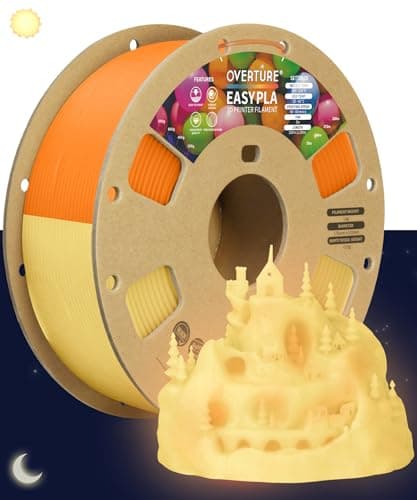 Overture Glow PLAOverture Overture Glow PLAOverture | Best overall | 7.8 | $17.99 - Check price on Amazon |
| 2 | 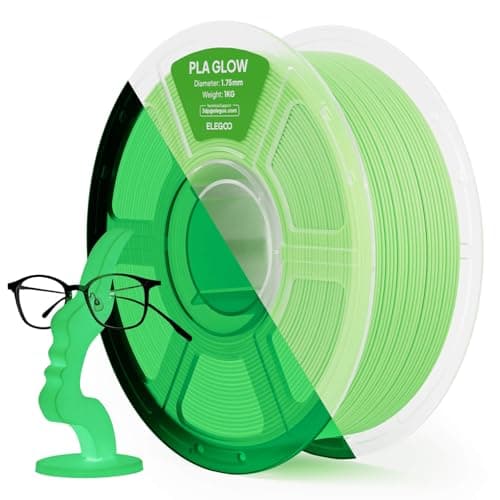 Elegoo Glow in the Dark PLAElegoo Elegoo Glow in the Dark PLAElegoo | Best documented requirement | 8.0 | $24.99 - Check price on Amazon |
| 3 | 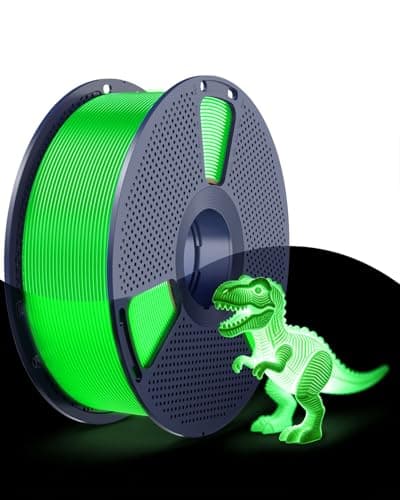 SUNLU Glow in the Dark PLASUNLU SUNLU Glow in the Dark PLASUNLU | Most glow pigment published | 7.6 | $19.99 - Check price on Amazon |
#1 · Best overall
Overture Glow PLA
Overture · A first glow spool, on published print data
The only glow spool of the three that publishes real mechanical data - toughness, layer adhesion and elongation - alongside a +/- 0.02 mm tolerance, and it is the cheapest. The gap is nozzle guidance: Overture publishes none, where Elegoo says its glow PLA needs a hardened steel nozzle.
#ad Price as of September 26, 2026, from Amazon. Prices change. How we make money.
What it actually is
A 1 kg spool of 1.75 mm PLA loaded with a photoluminescent pigment. It charges under light and then emits it back in the dark for a while. Mechanically it is still PLA, so it prints like PLA and it is as weak as PLA in heat.
Does it fit this page?
The cheapest of the three and the only one publishing real mechanical data - 2.9 kJ/m2 toughness, 39.4 MPa layer adhesion, 5.6 percent elongation - alongside a +/- 0.02 mm tolerance with the measuring method named. Published at 190-220 C, a 25-60 C bed and a deliberately conservative 40-60 mm/s, with drying at 50 C for 7 hours. The catch: Overture publishes no nozzle guidance at all, and no green in this line.
What the manufacturer states
| Figure | Value | Source |
|---|---|---|
| Dimensional accuracy | 1.75 mm, +/- 0.02 mm, held with a CCD diameter measuring system and self-adaptive manufacturing controls | Overture Glow PLA published print data |
| Nozzle temperature | 190 - 220 C | Overture Glow PLA published print data |
| Bed temperature | 25 - 60 C | Overture Glow PLA published print data |
| Printing speed | 40 - 60 mm/s | Overture Glow PLA published print data |
| Cooling fan | Turned on | Overture Glow PLA published print data |
| Drying | 50 C for 7 hours | Overture Glow PLA published print data |
| Toughness | 2.9 +/- 0.4 kJ/m2 | Overture Glow PLA published print data |
| Layer adhesion | 39.4 +/- 0.7 MPa | Overture Glow PLA published print data |
| Elongation | 5.6 +/- 0.3 percent | Overture Glow PLA published print data |
| Stiffness | Published as N/A | Overture Glow PLA published print data |
| Shelf life | 1 year unopened, with proper storage | Overture Glow PLA published print data |
| Nozzle material guidance | Not published on the manufacturer's page | Overture Glow PLA published print data |
| Pigment loading | Not published on the manufacturer's page | Overture Glow PLA published print data |
Read from Overture, Glow PLA product page and published print data on 2026-09-26. Where a manufacturer does not publish a figure, there is no row for it here.
What is good about it
- The tightest published diameter tolerance of the three glow spools at +/- 0.02 mm, with the measuring method named
- The only one publishing mechanical figures - toughness, layer adhesion and elongation - rather than just temperatures
- A conservative published speed of 40-60 mm/s, which is the right starting point for an unfamiliar filament
- Publishes a drying procedure and offers downloadable SDS and technical data sheets
- The cheapest of the three per kilogram
What is not
- Publishes no nozzle material guidance at all. Elegoo states its own glow PLA needs a hardened steel nozzle, and the pigment that makes any of these glow is a hard mineral - this is the gap that matters most
- No green in the glow PLA line - Overture offers orange, yellow, blue and red, and green is the color the other two brands lead with
- Publishes no pigment loading, so how brightly it glows cannot be compared against a spool that does publish one
- 40-60 mm/s is slow next to Elegoo's published 250 mm/s ceiling
- Publishes stiffness as N/A, which is an odd gap in an otherwise complete mechanical table
Skip this one if
Skip it if you only own a brass nozzle and are not willing to replace it. Overture does not warn you about nozzle wear, but the pigment is the same class of hard mineral additive that makes Elegoo require hardened steel for its equivalent spool.
What we cannot tell you
We have not printed this spool. How bright the glow actually is, how long it holds after charging, and how quickly it wears a brass nozzle are all unmeasured here - and Overture publishes no pigment loading or nozzle guidance to reason from.
How it scored for a beginner
- Ease for a beginner8.0
- Published data8.5
- Glow data published3.0
- Strength5.0
- Value9.0
Beginner fit 7.8 / 10. That is our editorial read of how well this suits someone buying their first printer, taken off the published specifications — not a test result, and not a verdict on absolute quality. It is deliberately not marked up as a rating in this page’s structured data. How we pick.
#2 · Best documented requirement
Elegoo Glow in the Dark PLA
Elegoo · Knowing what the pigment does to your nozzle before you buy
The only one of the three that tells you the filament will chew a brass nozzle: Elegoo publishes a hardened steel nozzle as a requirement. It also confirms no enclosure and no glue are needed, and it comes in green, the standard photoluminescent color.
#ad Price as of September 26, 2026, from Amazon. Prices change. How we make money.
What it actually is
A 1 kg spool of 1.75 mm glow-in-the-dark PLA in green. The useful part is the parameter table: Elegoo publishes the nozzle material, the chamber range and the humidity limit, which the other two glow spools on this site do not.
Does it fit this page?
The only spool here that publishes the thing that actually costs you money: a hardened steel nozzle, 0.4 mm or larger. It also states that neither an enclosure nor build plate glue is needed, and publishes a 20-45 C chamber range and a 20 percent RH storage limit. Green, 190-230 C, 35-65 C bed, under 250 mm/s. It is the most expensive of the three and publishes no tolerance.
What the manufacturer states
| Figure | Value | Source |
|---|---|---|
| Recommended nozzle | Hardened steel nozzle, 0.4 mm or larger | Elegoo Glow PLA printing parameter table |
| Enclosed printing | Not required | Elegoo Glow PLA printing parameter table |
| Build plate glue | Not required | Elegoo Glow PLA printing parameter table |
| Nozzle temperature | 190 - 230 C | Elegoo Glow PLA printing parameter table |
| Bed temperature | 35 - 65 C, depending on the printer and build plate type | Elegoo Glow PLA printing parameter table |
| Chamber temperature | 20 - 45 C | Elegoo Glow PLA printing parameter table |
| Printing speed | Under 250 mm/s | Elegoo Glow PLA printing parameter table |
| Printing and storage humidity | 20 percent RH or below, sealed with desiccant | Elegoo Glow PLA printing parameter table |
| Diameter tolerance | Not published on the manufacturer's page | Elegoo Glow PLA printing parameter table |
| Pigment loading | Not published on the manufacturer's page | Elegoo Glow PLA printing parameter table |
Read from Elegoo, Glow PLA product page and printing parameter table on 2026-09-26. Where a manufacturer does not publish a figure, there is no row for it here.
What is good about it
- The only glow spool here that publishes a nozzle material requirement - hardened steel, 0.4 mm or larger. That single line is worth more than any other figure on this page
- States plainly that neither an enclosure nor build plate glue is needed, so it prints on any machine on this site
- Publishes a chamber range and a storage humidity limit, which almost no filament page does
- Green, the standard photoluminescent color and the one all three brands here offer
- The widest published nozzle temperature range of the three at 190-230 C
What is not
- The most expensive of the three per kilogram
- Publishes no diameter tolerance, which Overture and SUNLU both do
- Publishes no mechanical data at all - no toughness, no elongation, nothing to compare against Overture's table
- Publishes no pigment loading, so brightness cannot be compared with SUNLU's stated figure
- The 250 mm/s ceiling is more than four times Overture's published range for the same kind of filament, with no test conditions given for either
Skip this one if
Skip it if you are not prepared to fit a hardened steel nozzle. Elegoo is being straight with you about the requirement, and ignoring it means wearing out the nozzle you have.
What we cannot tell you
We have not printed this spool. How bright the glow is, how long it lasts after charging, and how much faster it wears a brass nozzle than a hardened one are all things we have not measured.
How it scored for a beginner
- Ease for a beginner8.5
- Published data8.0
- Glow data published4.0
- Strength5.0
- Value7.0
Beginner fit 8.0 / 10. That is our editorial read of how well this suits someone buying their first printer, taken off the published specifications — not a test result, and not a verdict on absolute quality. It is deliberately not marked up as a rating in this page’s structured data. How we pick.
#3 · Most glow pigment published
SUNLU Glow in the Dark PLA
SUNLU · Comparing glow brightness on a published number rather than a photo
The only spool here that says how much glow pigment is actually in it - 10 percent - which is the one figure that should predict brightness. It also publishes temperatures tied to print speed, which is more practical than a flat range. Then it asks for glue on the bed, where Elegoo says none is needed.
#ad Price as of September 26, 2026, from Amazon. Prices change. How we make money.
What it actually is
A 1 kg spool of 1.75 mm glow-in-the-dark PLA, green, with a stated 10 percent photoluminescent pigment loading. Pigment is what glows; it is also a hard mineral, which is why the loading figure cuts both ways.
Does it fit this page?
The only brand that quantifies what makes it glow: 10 percent photoluminescent pigment. It also publishes temperatures against print speed rather than as one flat range - 200-210 C at 50-100 mm/s, 210-240 C at 100-200 mm/s - plus density and a 54 C Vicat softening point. Then it publishes its bed temperature 'with glue', where Elegoo says glue is not required.
What the manufacturer states
| Figure | Value | Source |
|---|---|---|
| Photoluminescent pigment | 10 percent | SUNLU Glow in the Dark PLA recommended settings |
| Diameter | 1.75 mm +/- 0.03 mm | SUNLU Glow in the Dark PLA recommended settings |
| Printing temperature by speed | 200-210 C at 50-100 mm/s; 210-240 C at 100-200 mm/s | SUNLU Glow in the Dark PLA recommended settings |
| Nozzle temperature | 200 - 240 C | SUNLU Glow in the Dark PLA recommended settings |
| Bed temperature | 50 - 60 C, stated with glue | SUNLU Glow in the Dark PLA recommended settings |
| Drying | 50 C | SUNLU Glow in the Dark PLA recommended settings |
| Density | 1.23 g/cm3 | SUNLU Glow in the Dark PLA recommended settings |
| Vicat softening temperature | 54 C | SUNLU Glow in the Dark PLA recommended settings |
| Packaging | Pre-dried and vacuum sealed | SUNLU Glow in the Dark PLA recommended settings |
| Nozzle material guidance | Not published on the manufacturer's page | SUNLU Glow in the Dark PLA recommended settings |
Read from SUNLU, Glow in the Dark PLA product page and recommended printing settings on 2026-09-26. Where a manufacturer does not publish a figure, there is no row for it here.
What is good about it
- The only one of the three publishing a pigment loading figure at 10 percent, which is the closest thing to a brightness specification anyone offers
- Temperatures published against print speed rather than as one flat range, which is genuinely more useful
- Publishes density and a Vicat softening temperature, so you can reason about where the part will survive
- Pre-dried and vacuum sealed, so the spool arrives ready
- Green, and cheaper per kilogram than the Elegoo green
What is not
- Publishes no nozzle material guidance despite stating the highest pigment loading here. A 10 percent mineral load is exactly why Elegoo requires hardened steel for its equivalent spool
- The loosest published tolerance of the three at +/- 0.03 mm against Overture's +/- 0.02 mm
- Publishes its bed temperature 'with glue', implying an adhesive where Elegoo states glue is not required
- A 54 C Vicat softening temperature is a plain reminder that this is still PLA and will deform in a parked car
- No mechanical data published - nothing to compare against Overture's toughness and elongation figures
Skip this one if
Skip it if the part has to be strong or live anywhere warm. A 54 C softening point and no published mechanical data make this a decorative filament, which is what glow filament is for.
What we cannot tell you
We have not printed this spool. Whether 10 percent pigment actually produces a visibly brighter glow than the others, how long it holds a charge, and how fast it wears a brass nozzle are all unmeasured here.
How it scored for a beginner
- Ease for a beginner8.0
- Published data8.0
- Glow data published9.0
- Strength4.5
- Value8.5
Beginner fit 7.6 / 10. That is our editorial read of how well this suits someone buying their first printer, taken off the published specifications — not a test result, and not a verdict on absolute quality. It is deliberately not marked up as a rating in this page’s structured data. How we pick.
How these were picked
We have not printed on these machines and we do not pretend to have. What we did was read each manufacturer’s own specification page, take their stated build volume, temperatures and speeds, check that every pick genuinely fits the job in this page’s title, confirm it is still being sold, and pull a live price rather than a remembered one. Every figure names the source it came from, so you can check it yourself in about a minute.
How we pick sets out the full method, including what would change a ranking.
Questions people actually ask
+−Does glow in the dark filament damage your nozzle?
Elegoo publishes a hardened steel nozzle, 0.4 mm or larger, as its recommendation for glow PLA, and SUNLU states its own pigment loading at 10 percent. The pigment is a hard mineral rather than a dye, so a soft brass nozzle wears faster than it would on plain PLA. Overture and SUNLU publish no nozzle guidance at all. Fit hardened steel regardless of brand.
+−How long does glow in the dark filament glow for?
None of the three manufacturers publishes a brightness figure or a decay time, and we have not measured one, so we cannot give you a number. What is consistent is the behavior: brightest in the first minutes after charging, then fading. It needs a few minutes under a bright light to charge properly.
+−Which color glows best?
We cannot rank colors honestly, because no manufacturer here publishes a brightness figure for any of them. Green is the standard photoluminescent color and the one both Elegoo and SUNLU lead with; Overture’s glow PLA line has no green at all, offering orange, yellow, blue and red.
+−Do you need a special printer for glow filament?
No. Elegoo states that neither an enclosure nor build plate glue is needed, and all three print in ordinary PLA temperature ranges, so any machine on this site handles them. The only hardware consideration is the nozzle.
+−Why does my glow print look dim?
Usually the part is too thin or was not charged brightly enough. The glow comes from the volume of pigment in the object, so thin single-wall prints hold very little. Add perimeters and infill, then charge it under direct sunlight or a strong lamp rather than room lighting.