Review
Bambu Lab A2L Review
A 330 mm plate for the price of a small printer is a genuinely tempting proposition. Read the heatbed row before you commit - it is the line that decides what this machine is for.
By Scooter M. · Published · Last reviewed
How this page is funded: the buy links below are affiliate links. If you buy through one we earn a commission, at no extra cost to you. It does not change the order of the picks or a word of what we say about them. Full disclosure.
Printers we claim to have tested: 0. Everyone in this category says they tested twenty machines. We have not tested any, and we would rather say so. What we did instead is on this page: the manufacturer’s own published specification for every pick, cited and dated; the arithmetic on what it costs to run, with the inputs shown; a live price rather than a remembered one; and a plain answer on who should skip each machine.
The short answer
Buy it if you want a big plate and you print PLA, PETG or TPU. The A2L publishes a 330 x 320 x 325 mm build volume — by a distance the largest of any machine on this site — with 500 mm/s, a 300 °C nozzle and Bambu’s usual self-calibration. The catch is one row down the spec sheet: the heatbed maxes out at 80 °C, which puts ABS and ASA out of reach entirely. One more thing to know before you start looking: it is not sold on Amazon.
We have not printed on this machine. Everything below is from Bambu Lab’s own published specification for the A2L, read against what the materials actually require.
The plate is the whole reason to consider it
330 x 320 x 325 mm is a lot of printer. For comparison, the A1 and P1S both give you 256 mm cubed, the Centauri Carbon 2 the same, and the Adventurer 5M only 220 mm cubed. The A2L is roughly a third larger in each horizontal direction than the machines it sits beside on price.
What that actually buys you: helmets and cosplay pieces printed in fewer parts, larger functional brackets in one go, and batches of small items in a single job rather than three. Our cosplay roundup covers why sectioning a big model is the tax a small plate charges.
It is worth being honest that most beginners do not need it. The standing advice on this site is that a 180 mm plate is smaller than you think you want and bigger than most first prints turn out to be. Buy the volume because you have a specific large thing in mind, not on the assumption that bigger is better.
The specification
All figures from Bambu Lab's published A2L specifications.
| Specification | Figure | What it means |
|---|---|---|
| Build volume | 330 x 320 x 325 mm | The largest on this site. The reason to buy it. |
| Max heatbed temperature | 80 C | The reason not to. ABS and ASA need 90-100 C and are therefore out. |
| Max nozzle temperature | 300 C | Plenty for PLA, PETG and TPU. |
| Max toolhead speed | 500 mm/s | Level with the A1 and P1S. |
| Max acceleration | 10 m/s2 | Half the P1S's 20,000 mm/s2 — it is a bed-slinger, not CoreXY. |
| Max hot end flow | 28 mm3/s, measured with Bambu PLA Basic at 220 C on a 150 mm single-wall model | Bambu publishes its test conditions, which almost nobody does. |
| Filaments supported | PLA, PETG, TPU, PVA; PLA-CF and PETG-CF with a hardened steel nozzle | No ABS, no ASA, no PC, no PA. |
| Nozzle | Stainless steel; 0.2, 0.4, 0.6, 0.8 mm supported | Swap to hardened steel for the carbon-filled options. |
| Camera | Low-frame-rate, up to 1080P, timelapse | Higher resolution than the Kobra S1's 480P. |
| Sensors | Filament run-out, tangle detection, odometry, power loss recovery | Tangle detection is genuinely uncommon and prevents a real failure. |
| Screen | 3.5 inch, 240x320 touchscreen | Small but adequate. |
| Net weight | 12.8 kg | Similar to a P1S. |
| Physical dimensions | 544 x 529 x 505 mm | Large. Measure the shelf before buying. |
| Max power | 1000 W at 110 V | High, because a plate that size takes real energy to heat. |
| Working temperature | 15 - 30 C | Not a garage machine in winter. |
The 80 degree heatbed, and what it rules out
Compare that with the P1S at 100 °C and the P2S at 110 °C, both of which Bambu rates for ABS and ASA. The A2L is a large-format PLA and PETG machine, and it is best understood that way rather than as a cheaper big printer that happens to be limited. If you want size and engineering materials, our enclosed printer roundup is the right place to look and the answer costs more.
The thing nobody tells you: it is not on Amazon
Bambu Lab’s Amazon store carries the A1, A1 mini, P1S and P2S and their Combo versions. The A2L is not among them — it is sold through Bambu’s own store. We checked this rather than assumed it, and it is worth knowing before you go looking for a deal.
That is not a mark against the machine. Buying direct from a manufacturer generally gets you the longest warranty terms and access to official refurbished stock; our guide to where to buy a 3D printer works through what each channel changes for warranty, returns and how fast the machine arrives. It does mean that the buy link on this page resolves to an Amazon search rather than a specific listing, and we would rather tell you that than quietly send you somewhere unhelpful.
Where it sits against the alternatives
Against the A1. The A1 is 256 mm cubed with the same 500 mm/s and the same 300 °C nozzle, and Bambu rates it for the same core filaments. The A2L is the A1 scaled up, with a plate limited to 80 °C instead of 100 °C. If you do not need the size, the A1 is the better buy and it is available on Amazon.
Against the P1S. Smaller plate, enclosed, 100 °C bed, 20,000 mm/s2 acceleration and rated for ABS and ASA. A different machine for a different job — the P1S and P2S are for people who care about materials; the A2L is for people who care about size.
Against a cosplay-oriented buy. If large prints are the whole reason you are shopping, weigh the A2L’s plate against the sectioning workflow described in our cosplay roundup. Printing in pieces and bonding them is a real skill, and a bigger plate reduces how often you need it rather than removing the need.
The honest downsides
The 80 °C heatbed. Covered above, and it is the big one. This machine cannot print ABS or ASA.
Half the acceleration of a P1S. 10 m/s2 against 20,000 mm/s2. It is a bed-slinger carrying a large, heavy plate, and that plate has to stop and start. Expect the size to cost you time.
1000 W and a 544 mm footprint. A big plate needs real power to heat and real desk to sit on. Check both before buying.
Not on Amazon, so no marketplace returns window and no price comparison across sellers.
A 15-30 °C working range rules out an unheated garage in winter, which is exactly where people tend to put a large printer. Our placement guide covers why that matters.
No published noise figure, consistent with the rest of Bambu’s range and still a gap.
What we cannot tell you
We have not run this machine. How well a plate that large holds a flat first layer across its whole area, how much the extra mass costs in real print time, and how loud it is are all unmeasured here — and Bambu publishes no noise specification to reason from.
What we would buy for this
Chosen from the same registry as our roundups, on the manufacturer’s own published figures and a live price.
Bambu Lab A2L
Bambu Lab · One large PLA part, printed in one piece
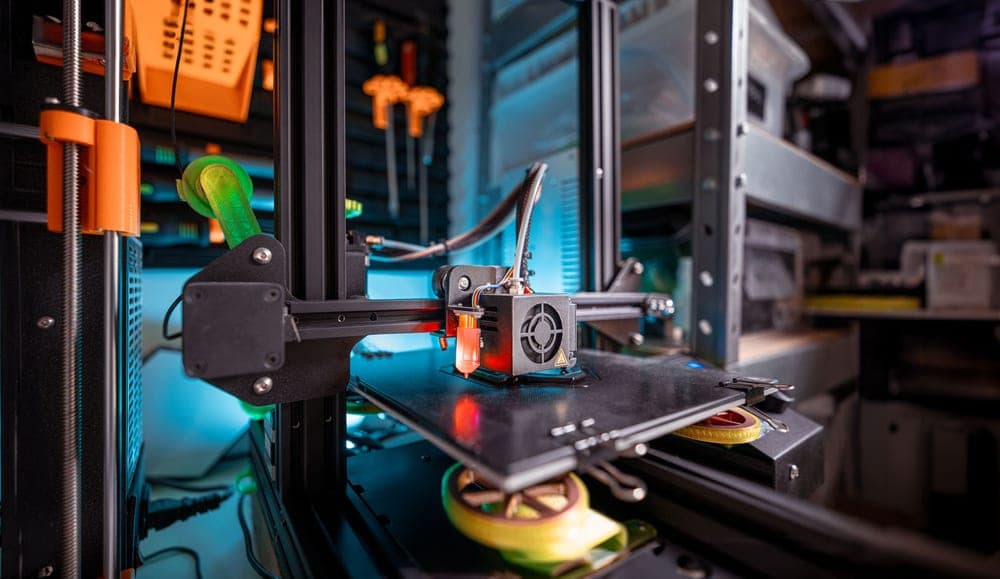
The big open-frame Bambu. 330 x 320 x 325 mm is the largest build volume in the lineup that does not arrive wrapped in a box, and the tradeoff is an 80 C plate — the same ceiling as the little A1 mini, on a machine several times the volume.
#ad We do not hold a current price for this product, so we do not show one. How we make money.
What it actually is
A full-size open-frame printer with a moving bed. It runs the same self-calibrating A-series software and the same PLA-first material list as its smaller siblings; what it adds is floor area, and what it does not add is heat retention.
What the manufacturer states
| Figure | Value | Source |
|---|---|---|
| Build volume | 330 x 320 x 325 mm | Bambu Lab A2L technical specifications |
| Max nozzle temperature | 300 C | Bambu Lab A2L technical specifications |
| Max heatbed temperature | 80 C | Bambu Lab A2L technical specifications |
| Max toolhead speed | 500 mm/s | Bambu Lab A2L technical specifications |
| Max toolhead acceleration | 10 m/s2 | Bambu Lab A2L technical specifications |
| Max hot end flow | 28 mm3/s with Bambu Lab PLA Basic | Bambu Lab A2L technical specifications |
| Filaments supported | PLA, PETG, TPU, PVA; PLA-CF and PETG-CF with a hardened steel nozzle | Bambu Lab A2L technical specifications |
| Nozzle | Stainless steel; 0.2, 0.4, 0.6 and 0.8 mm supported | Bambu Lab A2L technical specifications |
| Physical dimensions | 544 x 529 x 505 mm | Bambu Lab A2L technical specifications |
| Net weight | 12.8 kg | Bambu Lab A2L technical specifications |
| Max power | 1000 W at 110 V | Bambu Lab A2L technical specifications |
| Working temperature | 15 - 30 C | Bambu Lab A2L technical specifications |
Read from Bambu Lab, A2L technical specifications on 2026-09-04. Where a manufacturer does not publish a figure, there is no row for it here.
What is good about it
- 330 x 320 x 325 mm — Bambu Lab's own claim is 105 percent more space than a 256 mm class machine, which is the difference between one helmet and four glued sections
- The same self-calibrating A-series behavior, so the extra size arrives without extra setup
- Bambu Lab states the vibration model is re-tuned as the load on the bed changes, which is the specific thing that goes wrong on tall prints on a moving bed
- Open frame, so it stays a PLA machine — which for a first printer is a feature rather than a limit
What is not
- An 80 C maximum plate temperature, the same as the A1 mini and 20 C below the A1, so large PETG parts are harder here than on the smaller machine
- 544 x 529 mm of desk before the spool and the AMS. Measure the surface first
- 1000 W at 110 V — the price of heating a plate that size
- Bambu Lab rates it for PLA, PETG, TPU and PVA only, so nothing about the extra volume unlocks ABS or ASA
Skip this one if
Skip it unless you can name the large object. Almost every first-year print fits inside 256 mm, and people who buy for a hypothetical helmet spend a year printing brackets on a machine that took half a desk. If your list is ordinary desk-sized objects, buy the A1 and spend the difference on filament.
What we cannot tell you
We have not printed on this machine. Whether an open frame that size holds a first layer across the full plate in a room with a draft, and how loud a bed that big is at speed, are things only a unit in a room can answer.
How it scored for a beginner
- Setup out of the box9.0
- Auto-calibration9.5
- First-layer forgiveness8.5
- Parts and filament availability9.0
- Running cost6.5
- Help when it goes wrong8.5
Beginner fit 8.2 / 10. That is our editorial read of how well this suits someone buying their first printer, taken off the published specifications — not a test result, and not a verdict on absolute quality. It is deliberately not marked up as a rating in this page’s structured data. How we pick.
How these were picked
We have not printed on these machines and we do not pretend to have. What we did was read each manufacturer’s own specification page, take their stated build volume, temperatures and speeds, check that every pick genuinely fits the job in this page’s title, confirm it is still being sold, and pull a live price rather than a remembered one. Every figure names the source it came from, so you can check it yourself in about a minute.
How we pick sets out the full method, including what would change a ranking.
Questions people actually ask
+−Can the Bambu A2L print ABS?
No. Bambu publishes a maximum heatbed temperature of 80 °C, and ABS needs roughly 90-100 °C. Bambu’s own supported filament list for the A2L is PLA, PETG, TPU and PVA, plus PLA-CF and PETG-CF with a hardened steel nozzle. ABS and ASA are not on it.
+−How big is the Bambu A2L build volume?
330 x 320 x 325 mm, which is the largest of any printer covered on this site — roughly a third larger in each horizontal direction than the 256 mm cubed of the A1, P1S and Centauri Carbon 2.
+−Is the Bambu A2L sold on Amazon?
No. Bambu Lab’s Amazon store carries the A1, A1 mini, P1S and P2S and their Combos; the A2L is sold through Bambu’s own store. Buying direct usually means the longest warranty terms, which our where to buy guide covers.
+−A2L or A1?
Buy the A1 unless you have a specific large print in mind. The A1 is 256 mm cubed with the same speed and nozzle temperature, a hotter 100 °C plate, and it is available on Amazon. The A2L trades bed temperature and acceleration for size.