Review
Elegoo Mars 5 Ultra Review
For 28 mm tabletop figures, resin wins outright and no filament settings close the gap. The price is a workflow involving gloves, alcohol, a curing step and a disposal obligation.
By Scooter M. · Published · Last reviewed

How this page is funded: the buy links below are affiliate links. If you buy through one we earn a commission, at no extra cost to you. It does not change the order of the picks or a word of what we say about them. Full disclosure.
Printers we claim to have tested: 0. Everyone in this category says they tested twenty machines. We have not tested any, and we would rather say so. What we did instead is on this page: the manufacturer’s own published specification for every pick, cited and dated; the arithmetic on what it costs to run, with the inputs shown; a live price rather than a remembered one; and a plain answer on who should skip each machine.
The short answer
Buy it only if miniatures are the actual reason you want a 3D printer. Elegoo publishes a 7-inch monochrome LCD at 8520 x 4320 with an 18 micron XY resolution, a 153.36 x 77.76 x 165 mm build volume and up to 150 mm/h. On fine detail it beats every filament machine on this site and nothing you change in a slicer closes that gap. What it costs you is not money — it is gloves, an alcohol wash, a UV curing step, ventilation and a waste-disposal obligation on every single print.
We have not printed on this machine. Everything below is from Elegoo’s published specification for the Mars 5 series, plus an honest account of what resin printing involves — which is the part that actually decides whether you should buy one.
Why resin wins on miniatures
A filament printer builds by pushing melted plastic through a nozzle, so the finest feature it can produce is limited by the nozzle’s diameter — typically 0.4 mm, or 0.2 mm if you fit a smaller one. A resin printer cures a whole layer at once by shining an image onto liquid resin, so its resolution is set by the pixel size of the screen.
Elegoo publishes 18 x 18 microns for this machine. That is 0.018 mm against a filament printer’s 0.2 mm at best. The practical difference shows up exactly where miniatures live: faces, chainmail, fabric folds, lettering, thin weapons. Our FDM versus resin comparison works through the trade in full, and our filament for miniatures page is honest that no spool closes the gap.
The specification
All figures from Elegoo's published Mars 5 series specification.
| Specification | Figure | What it means |
|---|---|---|
| Build volume | 153.36 x 77.76 x 165 mm | Small. Fine for figures and squads; not for anything large. |
| Screen | 7 inch monochrome LCD, 8520 x 4320 | Elegoo describes this as 9K. Monochrome screens cure faster and last longer than color ones. |
| XY resolution | 18 x 18 microns | The number that matters. Roughly a tenth of what a fine filament nozzle manages. |
| Maximum print speed | 150 mm/h | Measured in height per hour rather than nozzle speed, because a whole layer cures at once. |
| Release technology | Tilt release | Elegoo states this peels models from the film faster, which is where the speed claim comes from. |
| Light source | COB with 92 percent light uniformity | Uniformity matters: uneven light means parts cure differently across the plate. |
| Sensor | Smart mechanical sensor | Elegoo's stated failure-detection feature. |
| Machine dimensions | 260 x 268 x 451.5 mm | A small footprint — smaller than most filament printers. |
| Weight | 8.8 kg | Easy to move. |
The routine nobody puts on the box
That is the single most important thing to understand before buying, and it is why this site recommends resin only when the answer to “what will you print” is already “miniatures”. If you want to make brackets, organizers, toys and replacement parts, a filament printer is not a compromise — it is the right tool, and our beginner roundup is the page you want.
There is also a running cost. Resin is sold by the bottle, isopropyl alcohol is a consumable, and the FEP release film and the LCD are both wear items. Our cost guide covers how these add up differently from filament.
Who it suits
Tabletop gamers and painters. The clearest case. 28 mm figures with faces, and a build volume that comfortably holds a squad.
People who already paint models. If you own brushes and a spray booth, the resin workflow will feel familiar rather than alarming, and the ventilation question is probably already solved.
Anyone who has printed miniatures on filament and been disappointed. This is the upgrade that actually fixes it. Our miniatures roundup places it against the filament options.
Who should not buy it
Anyone buying a first 3D printer for general use. The build volume is small, the materials are brittle compared with PLA, and the routine is real work. A filament printer is the right first machine for almost everybody.
Anyone printing functional parts. Resin parts are typically more brittle than PLA or PETG. For brackets, clips and anything load-bearing, see our PETG roundup.
Anyone without somewhere to ventilate and somewhere to wash parts. A bedroom is the wrong room. Our placement guide applies with more force here than to a filament machine.
Households with small children or pets that cannot be kept away from liquid resin and alcohol.
The honest downsides
The workflow, above all. Gloves, wash, cure, dispose, every time.
A 153 x 78 x 165 mm build volume is small even by resin standards and tiny next to any filament printer on this site.
Consumables and wear parts. Resin, alcohol, release film and eventually the LCD itself.
Brittleness. Standard resin parts snap where PLA would bend. Fine for a display figure, poor for anything that gets handled hard.
Elegoo publishes no noise figure, and the machine wants ventilation running alongside it.
Speed is measured in height, not area. 150 mm/h sounds fast and means the plate rises that far in an hour regardless of how many models are on it — which is genuinely an advantage for a full plate and misleading if you read it as a filament speed.
What we cannot tell you
We have not run this machine. How accurate the 18 micron figure feels on a real face, how long the release film lasts, how well the mechanical sensor catches a failure, and how strong the smell is in a small room are all unmeasured here — and Elegoo publishes no noise or emissions data to reason from. If you have a specific health concern about resin, that is a question for a doctor rather than a 3D printing site.
What we would buy for this
Chosen from the same registry as our roundups, on the manufacturer’s own published figures and a live price.
Elegoo Mars 5 Ultra
Elegoo · Tabletop miniatures and nothing else
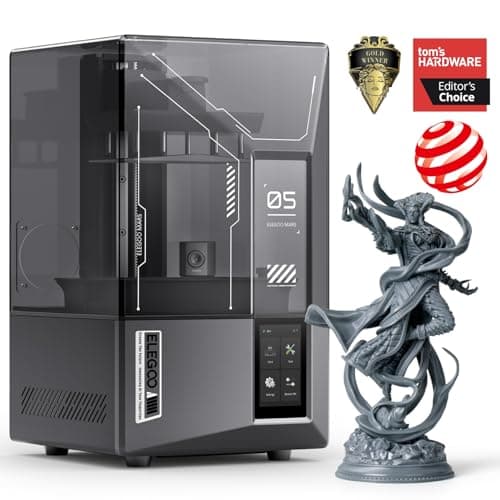
The right machine if and only if your answer to 'what will you print' is 'miniatures'. Resin detail is in a different league to filament, and so is the mess, the smell and the safety routine. It is a specialist tool, not a first printer.
#ad Price as of September 27, 2026, from Amazon. Prices change. How we make money.
What it actually is
A resin printer. Instead of melting plastic string, it cures liquid resin with UV light, one thin layer at a time, which is how it resolves detail a nozzle physically cannot. Finished prints must be washed in alcohol and cured under UV before they are safe to handle bare-handed.
What the manufacturer states
| Figure | Value | Source |
|---|---|---|
| Build volume | 153.36 x 77.76 x 165 mm | Elegoo Mars 5 Ultra product specifications |
| Screen | 7 inch monochrome LCD, 8520 x 4320 | Elegoo Mars 5 Ultra product specifications |
| XY resolution | 18 x 18 microns | Elegoo Mars 5 Ultra product specifications |
| Maximum print speed | 150 mm/h | Elegoo Mars 5 Ultra product specifications |
| Machine dimensions | 260 x 268 x 451.5 mm | Elegoo Mars 5 Ultra product specifications |
| Weight | 8.8 kg | Elegoo Mars 5 Ultra product specifications |
Read from Elegoo, Mars 5 series product page on 2026-09-01. Where a manufacturer does not publish a figure, there is no row for it here.
What is good about it
- 18 micron XY resolution — detail no 0.4 mm nozzle can approach
- 153 x 78 x 165 mm is enough for a whole squad of 28 mm miniatures at once
- Print time depends on height, not on how many models are on the plate
- Automatic leveling, so the setup step is not the hard part
What is not
- Uncured resin is an irritant. Gloves, ventilation and a washing routine are not optional
- Every print needs washing in alcohol and curing under UV before you can handle it
- Resin parts are more brittle than PLA ones — this is not the tool for functional brackets
- The consumables and the disposal are both more expensive and more annoying than filament
Skip this one if
Skip it if you are choosing your first printer and you are not already certain you want miniatures. Every source we read on beginner printing says start with filament, and the reason is not print quality — it is that resin adds a chemical-handling routine to a hobby you have not learned yet.
What we cannot tell you
We have not printed on this machine. Smell in a small room, how long an FEP film lasts, and how much resin a beginner wastes learning supports are all owner knowledge.
How it scored for a beginner
- Setup out of the box8.0
- Auto-calibration8.5
- First-layer forgiveness6.0
- Parts and filament availability7.0
- Running cost5.0
- Help when it goes wrong7.0
Beginner fit 6.5 / 10. That is our editorial read of how well this suits someone buying their first printer, taken off the published specifications — not a test result, and not a verdict on absolute quality. It is deliberately not marked up as a rating in this page’s structured data. How we pick.
How these were picked
We have not printed on these machines and we do not pretend to have. What we did was read each manufacturer’s own specification page, take their stated build volume, temperatures and speeds, check that every pick genuinely fits the job in this page’s title, confirm it is still being sold, and pull a live price rather than a remembered one. Every figure names the source it came from, so you can check it yourself in about a minute.
How we pick sets out the full method, including what would change a ranking.
Questions people actually ask
+−Is the Elegoo Mars 5 Ultra good for beginners?
Only if miniatures are specifically why you want a printer. It is a capable, well-specified machine, but resin printing adds gloves, an isopropyl alcohol wash, a UV curing step, ventilation and a waste disposal obligation to every print. For a general first printer, a filament machine is the better choice.
+−How much better is resin than filament for miniatures?
Substantially, and it is not close. Elegoo publishes an 18 micron XY resolution for this machine; a filament printer is limited by its nozzle, typically 0.4 mm or 0.2 mm at best. That difference is visible exactly where miniatures live — faces, chainmail, thin weapons and lettering.
+−What do you need to buy alongside a resin printer?
Nitrile gloves, isopropyl alcohol for washing, a UV curing source, and a way to dispose of contaminated alcohol and resin properly. Somewhere ventilated to run it is not optional either. Spare FEP release film is a wear item worth having.
+−Can you print functional parts on a resin printer?
You can, but standard resin parts are more brittle than PLA or PETG and tend to snap rather than bend. For brackets, clips and anything load-bearing, a filament printer with PETG is the better tool.