Review
Elegoo Saturn 4 Ultra 16K Review
The finest published resolution of any machine in our registry, on a plate big enough for a whole squad of miniatures at once. Still a resin printer, which means gloves, alcohol and a routine before you own anything.
By Scooter M. · Published · Last reviewed

How this page is funded: the buy links below are affiliate links. If you buy through one we earn a commission, at no extra cost to you. It does not change the order of the picks or a word of what we say about them. Full disclosure.
Printers we claim to have tested: 0. Everyone in this category says they tested twenty machines. We have not tested any, and we would rather say so. What we did instead is on this page: the manufacturer’s own published specification for every pick, cited and dated; the arithmetic on what it costs to run, with the inputs shown; a live price rather than a remembered one; and a plain answer on who should skip each machine.
The short answer
Buy the Elegoo Saturn 4 Ultra 16K if miniatures are already a habit and you want to print a whole squad at once. Elegoo publishes a 14 × 19 micron pixel across a 211 × 118 mm plate — the finest figure of any machine we have researched. If you want one or two miniatures rather than a shelf of them, the Mars 5 Ultra prints the same detail class for less money and less bench space.
This is not a first printer and we will not pretend otherwise. Resin adds a chemical-handling routine to a hobby you have not learned yet, which is the argument we make at length on FDM vs resin. If you are choosing your first machine, start there.
Who this machine is for, in one line each
- Best for: somebody printing tabletop miniatures in batches, who has already decided resin is worth the routine.
- Also good for: anybody who has outgrown a Mars-class plate and is tired of running three jobs to get one unit painted.
- Skip it if: this is your first printer, if you want functional parts rather than models, or if your prints are wide rather than many — 118 mm in the short axis is narrow.
What Elegoo publishes
Elegoo's own published figures for the Saturn 4 Ultra 16K, read from its product page on 2026-10-18. Blank rows are specifications Elegoo does not publish there.
| Specification | Published figure |
|---|---|
| Build volume | 211.68 x 118.37 x 220 mm |
| Screen | 10-inch monochrome LCD, 15120 x 6230 |
| XY resolution | 14 x 19 microns |
| Max print speed | 150 mm/h, stated as 5.5 s per layer at general settings |
| Resin tank | Intelligent heating, held at 30 C |
| Peeling | Tilt release; Elegoo states 2x faster than the Saturn 3 Ultra |
| Leveling | Automatic, no manual adjustment |
| Monitoring | AI camera with chamber light, empty-plate and warp detection, time-lapse |
| Alarms | Residue detection, resin shortage, resin level, leveling failure |
| Thermal protection | Pauses and alerts above 80 C LED temperature |
| Power interruption | Power-loss recovery |
| Machine dimensions, weight, rated power | Not published on the product page |
What 14 microns buys, in terms you can picture
A filament printer draws with a nozzle. The standard nozzle is 0.4 mm — 400 microns — so the finest detail it can resolve in the horizontal plane is roughly the width of that extrusion. A resin printer has no nozzle; it projects an image, and the smallest feature is one pixel. Here that pixel is 14 microns on one axis and 19 on the other.
That is why a resin miniature has chainmail and a filament one has suggestions of chainmail. It is not a close call and no slicer setting closes it. Our miniatures roundup goes through the comparison properly, and filament for miniatures covers how far you can push an FDM machine if you would rather not deal with resin at all.
The plate is the actual reason to choose this over a Mars
Resin print time depends on height, not on how many models are on the plate — every layer cures the whole cross-section at once. So a bigger plate is not a bigger-object feature, it is a more-objects-per-job feature, and it changes the economics of a hobby.
Elegoo's published figures. Saturn 4 Ultra 16K read 2026-10-18; Mars 5 Ultra read 2026-09-01.
| Saturn 4 Ultra 16K | Elegoo Mars 5 Ultra | |
|---|---|---|
| Build volume | 211.68 x 118.37 x 220 mm | 153.36 x 77.76 x 165 mm |
| Plate area | About 25,050 mm2 | About 11,925 mm2 |
| Screen | 10 inch, 15120 x 6230 | 7 inch, 8520 x 4320 |
| XY resolution | 14 x 19 microns | 18 x 18 microns |
| Max speed | 150 mm/h | 150 mm/h |
| Heated resin tank | Yes, 30 C | Not published |
| Machine dimensions | Not published | 260 x 268 x 451.5 mm |
| Weight | Not published | 8.8 kg |
Roughly 2.1 times the plate area at the same published top speed. If you paint a unit at a time, that is the difference between one job and three.
The heated tank is a real addition, not a feature list entry
Elegoo publishes intelligent tank heating that holds the resin at 30 °C. Cold resin is thicker, and thick resin is the published cause of the two failures that annoy resin owners most: bubbles trapped between layers, and layer separation partway up a tall print. Holding the tank at a set temperature removes the variable that a cold garage introduces. The Mars 5 Ultra does not publish a tank heater.
The routine, stated honestly, because it is the real cost
Uncured resin is an irritant. Owning this machine means owning a routine, every single time:
- Nitrile gloves on before the lid comes off, every time.
- Ventilation. Not “a window somewhere” — airflow where the machine is.
- Washing each finished print in isopropyl alcohol, then curing it under UV before it is safe to handle bare-handed.
- Disposing of used alcohol and resin properly, which is not down the sink.
None of that is hard. All of it is non-negotiable, and all of it is a reason a resin printer is a poor choice for a first machine or for a shared room. If you were considering it for a child, read the kids page first — the answer there is filament, firmly.
Where it loses
118 mm in the short axis. This is a squad plate, not a helmet plate. If you want large single objects, resin is the wrong technology and the cosplay roundup covers what to buy instead.
Elegoo publishes less here than it usually does. No machine dimensions, no weight, no rated power on the product page — all three of which Elegoo does publish for the Mars 5 Ultra. That is a gap, and it is odd given the documentation habit we credited the brand with on Elegoo vs Creality.
Brittleness. Resin parts snap where PLA ones bend. This is a display-model tool. For a bracket or a clip you want filament, and PLA vs PETG covers that choice.
Running cost. Resin, alcohol, replacement FEP film and eventually the LCD itself are all consumables, and the 16K screen is the expensive one. The residue detection exists precisely because that screen is what a failed print destroys.
What we cannot tell you
We have not printed on this machine. Whether 14 microns is visibly better than the Mars 5 Ultra’s 18 at normal 28 mm miniature scale, how much the tilt release actually shortens a tall print in practice, and how long a 16K LCD lasts before it needs replacing are all unmeasured here. Those are exactly the questions that decide whether the step up from a Mars is worth it, and we would rather say so than fill the gap with an opinion dressed as data.
What we would buy for this
Chosen from the same registry as our roundups, on the manufacturer’s own published figures and a live price.
Elegoo Saturn 4 Ultra 16K
Elegoo · Printing a lot of miniatures at once, at the finest detail available to a hobbyist
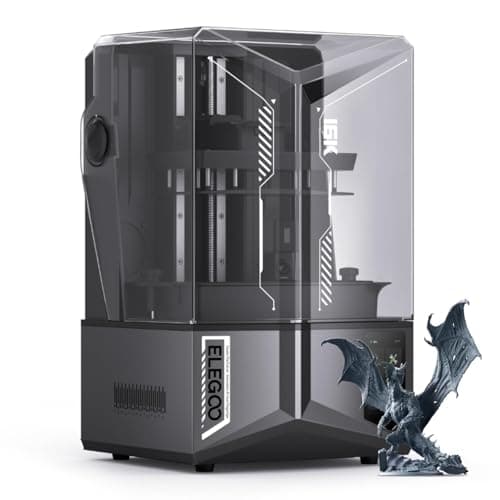
The Mars 5 Ultra's bigger sibling, and the better buy if miniatures are a hobby rather than an experiment. A 14 x 19 micron pixel across a 211 mm plate is a whole squad at a resolution no nozzle approaches. It is still a resin printer, which means gloves, alcohol and a routine before you own anything.
#ad Price as of October 19, 2026, from Amazon. Prices change. How we make money.
What it actually is
A resin printer that cures liquid photopolymer with UV light through a 10-inch 16K LCD, one layer at a time. Nothing melts and no nozzle is involved, which is why it resolves detail a filament printer physically cannot. Every finished print has to be washed in alcohol and cured under UV before it is safe to handle bare-handed.
What the manufacturer states
| Figure | Value | Source |
|---|---|---|
| Build volume | 211.68 x 118.37 x 220 mm | Elegoo Saturn 4 Ultra 16K product page |
| Screen | 10-inch monochrome LCD, 15120 x 6230 | Elegoo Saturn 4 Ultra 16K product page |
| XY resolution | 14 x 19 microns | Elegoo Saturn 4 Ultra 16K product page |
| Maximum print speed | 150 mm/h, which Elegoo states as 5.5 seconds per layer under general parameter settings | Elegoo Saturn 4 Ultra 16K product page |
| Resin tank heating | Intelligent tank heating that holds the resin at 30 C | Elegoo Saturn 4 Ultra 16K product page |
| Peeling | Tilt release, which Elegoo states is twice as fast as the Saturn 3 Ultra | Elegoo Saturn 4 Ultra 16K product page |
| Leveling | Automatic, with no manual adjustment needed | Elegoo Saturn 4 Ultra 16K product page |
| Monitoring | AI camera with a chamber light, empty-plate and warp detection, and time-lapse | Elegoo Saturn 4 Ultra 16K product page |
| Sensors and alarms | Smart mechanical sensor with residue detection, plus resin-shortage, resin-level and leveling-failure alarms | Elegoo Saturn 4 Ultra 16K product page |
| Thermal protection | Pauses the print and alerts when LED temperature exceeds 80 C | Elegoo Saturn 4 Ultra 16K product page |
| Power interruption | Power-loss recovery resumes where it stopped | Elegoo Saturn 4 Ultra 16K product page |
Read from Elegoo, Saturn 4 Ultra 16K product page on 2026-10-18. Where a manufacturer does not publish a figure, there is no row for it here.
What is good about it
- 14 x 19 micron XY pixel, the finest figure published by any machine in our registry
- 211 x 118 mm of plate is roughly 2.1 times the Mars 5 Ultra's footprint, and resin print time depends on height rather than on how many models are on the plate
- Heated resin tank held at 30 C, which is the published fix for the bubbles and layer separation that cold resin causes
- Residue detection genuinely protects the LCD, which is the expensive consumable on a resin printer
- Pauses itself if the LEDs pass 80 C, and resumes after a power cut
What is not
- Uncured resin is an irritant. Gloves, ventilation, alcohol washing and UV curing are a routine, not a precaution
- Elegoo does not publish machine dimensions, weight or rated power on its own product page, where it does publish all three for the Mars 5 Ultra
- Elegoo's own store lists the 16K as sold out, so Amazon is currently the buy path rather than the backup
- Resin parts are more brittle than PLA ones, so this is not the tool for a functional bracket
- 118 mm in the short axis is narrow — it is a squad-of-miniatures plate, not a helmet plate
Skip this one if
Skip it if this is your first printer. Skip it too if you want one or two miniatures rather than a shelf of them: the Mars 5 Ultra prints the same detail class for less money and less bench space, and the only thing you lose is how many fit on the plate at once.
What we cannot tell you
We have not printed on this machine. Whether 14 microns is visibly better than the Mars 5 Ultra's 18 at normal miniature scale, how much the tilt release actually shortens a tall print, and how long the 16K LCD lasts before it needs replacing are all owner questions a specification page cannot settle.
How it scored for a beginner
- Setup out of the box8.0
- Auto-calibration8.5
- First-layer forgiveness6.5
- Parts and filament availability7.5
- Running cost4.5
- Help when it goes wrong7.0
Beginner fit 7.0 / 10. That is our editorial read of how well this suits someone buying their first printer, taken off the published specifications — not a test result, and not a verdict on absolute quality. It is deliberately not marked up as a rating in this page’s structured data. How we pick.
How these were picked
We have not printed on these machines and we do not pretend to have. What we did was read each manufacturer’s own specification page, take their stated build volume, temperatures and speeds, check that every pick genuinely fits the job in this page’s title, confirm it is still being sold, and pull a live price rather than a remembered one. Every figure names the source it came from, so you can check it yourself in about a minute.
How we pick sets out the full method, including what would change a ranking.
Questions people actually ask
+−Is the Saturn 4 Ultra good for beginners?
Not as a first printer. Resin printing adds gloves, ventilation, alcohol washing and UV curing to a hobby you have not learned yet. Start with a filament machine — see FDM vs resin for the full argument. As a first resin printer it is fine: the leveling is automatic and the alarms are good.
+−Saturn 4 Ultra 16K or Mars 5 Ultra?
Mars 5 Ultra unless you print in batches. Elegoo publishes 18 × 18 microns on the Mars against 14 × 19 on the Saturn — close enough that plate size, not resolution, is the real decision. The Saturn gives roughly 2.1 times the plate area and adds a heated resin tank; the Mars costs less, takes less bench space, and Elegoo actually publishes its dimensions and weight. Our Mars 5 Ultra review has the detail.
+−What is the difference between the 12K and 16K Saturn 4 Ultra?
They are separate products with separate listings and separate prices. The figures on this page are the 16K model: a 10-inch 15120 × 6230 LCD at 14 × 19 microns, with a 211.68 × 118.37 × 220 mm build volume. Elegoo publishes a distinct spec page for the 12K version, and the 12K typically sells for less. Check which one a listing is before ordering — the names are nearly identical.
+−Can a resin printer make functional parts?
Badly. Resin parts are more brittle than PLA ones and will snap where a filament part flexes. Resin is a detail technology: miniatures, busts, display models, dental and jewelry patterns. For brackets, clips, organizers and anything that takes a load, use filament — PLA vs PETG covers which.
+−Does the heated resin tank actually matter?
It removes a variable rather than adding a capability. Cold resin is thicker, and thick resin is the published cause of trapped bubbles and layer separation on tall prints. Holding the tank at 30 °C means a cold room stops being a factor. If your printer lives somewhere temperature-stable and warm, it matters less.