Review
Prusa CORE One+ Review
An enclosed CoreXY with an actively controlled chamber, built so that nothing inside it is glued. It is the most repairable printer we have researched and the wrong first printer for almost everyone reading this.
By Scooter M. · Published · Last reviewed
How this page is funded: the buy links below are affiliate links. If you buy through one we earn a commission, at no extra cost to you. It does not change the order of the picks or a word of what we say about them. Full disclosure.
Printers we claim to have tested: 0. Everyone in this category says they tested twenty machines. We have not tested any, and we would rather say so. What we did instead is on this page: the manufacturer’s own published specification for every pick, cited and dated; the arithmetic on what it costs to run, with the inputs shown; a live price rather than a remembered one; and a plain answer on who should skip each machine.
The short answer
Buy the Prusa CORE One+ if you want to own the machine, not just its output. Prusa publishes a 55 °C actively controlled chamber, a 120 °C bed, and a design where nothing is glued and spare parts stay in stock for years. That is what the money buys. It is not a first printer: nothing about it makes month one easier than a Bambu Lab A1 mini at a fraction of the price.
One naming note before the specifications, because it affects what you end up ordering. The machine Prusa currently sells is the CORE One+. Searches and conversations mostly say “CORE One”, and that is the same product line — the plus is the current revision. Everything below is read from Prusa’s own CORE One+ product page.
Who this machine is for, in one line each
- Best for: somebody who expects to keep a printer for a decade and repair it rather than replace it.
- Also good for: ABS, ASA, PC and PA, where a genuinely controlled 55 °C chamber is the difference between working and warping.
- Skip it if: this is your first printer, or if you never intend to open the machine — the repairability is most of what you are paying for.
What Prusa publishes
Prusa Research's own published figures for the CORE One+, read from its product page on 2026-10-18.
| Specification | Published figure |
|---|---|
| Build volume | 250 x 220 x 270 mm (9.8 x 8.6 x 10.6 in) |
| Motion system | Enclosed CoreXY, all-steel structural enclosure |
| Max chamber temperature | 55 C / 131 F, actively controlled |
| Max nozzle temperature | 290 C / 554 F |
| Max heatbed temperature | 120 C / 248 F |
| Nozzle | High-flow Prusa Nozzle brass CHT, 0.4 mm; quick-swap, 0.25 to 0.8 mm available |
| Layer height | 0.05 to 0.30 mm |
| Machine dimensions | 415 x 444 x 555 mm |
| Weight | 22.5 kg |
| Power | 240 W with Power Panic; PLA 90 W, ABS 110 W |
| Materials | PLA, PETG, Flex, PVA, PC, PP, CPE, PVB; advanced: ABS, ASA, HIPS, PA |
| Calibration | Fully automatic first layer via load cell sensor; Input Shaper |
| Multi-material | MMU3 (5 filaments) or INDX (up to 8) |
| Filtration | HEPA optional add-on |
| Camera | Optional in-chamber, 1080p with night vision |
| Serviceability | Nothing glued; spare parts stocked for years after release |
The chamber is the specification, and it is a real one
Most “enclosed” printers in the beginner and mid bands are passively warm boxes: the heat comes from the bed and the walls keep it in. That is useful and it is not the same thing. Prusa publishes an actively controlled chamber to 55 °C with smart ventilation that adjusts itself to the material, so the door stays shut for PLA instead of being propped open.
Why 55 °C matters: warping in ABS and ASA is driven by the temperature difference between the layer being laid down and the layer below it. A controlled chamber shrinks that difference across the whole part rather than only near the bed. Our ABS vs ASA comparison explains which of those two you would actually want, and the enclosure page covers the cheaper route of boxing a machine you already own.
Repairability, stated plainly by the manufacturer
Prusa writes: “Nothing is glued. Everything comes apart with a screwdriver,” and “We keep spare parts in stock for years after release.” It also sells the machine as an assembly kit at a lower price, with a build guide it compares to LEGO Technic.
That is a commitment no other manufacturer in our registry makes in writing, and it is the honest answer to how long a 3D printer lasts: the lifespan of a desktop printer is usually decided by whether parts are still available, not by wear. Creality earns its reputation here through sheer ubiquity — every Ender part is sold by somebody. Prusa earns it by policy.
The flip side is blunt: if you never intend to open the machine, you are paying a premium for an option you will not exercise. That is the single biggest reason this is not a first printer.
The price gap between Prusa and Amazon is large
This is the most practical finding in this review. On 18 October 2026, Prusa’s own store listed the assembled CORE One+ at $1,202.78, in stock, with a one to three business day preparation time, and the assembly kit from $925. The Amazon listing — sold by Amazon.com rather than by Prusa — was $1,549.00. Prusa’s own comparison table on the same site quotes “from $1,299”, which does not match its own listing either.
We are an Amazon affiliate and we will still say it: check Prusa’s store before you buy this one. Our buy button below carries the live Amazon price so you can see the gap for yourself rather than take our word for it. The same logic applies to several machines, which is why where to buy a 3D printer exists as its own page.
The Amazon route also routes warranty and support through Amazon rather than Prusa, which is worth a minute of checking on a machine you intend to keep for a decade.
Where it loses to cheaper machines
Floor area. 250 × 220 mm is less plate than the 256 mm squares it competes with, even though total volume is higher because of the 270 mm Z. If your parts are wide and flat rather than tall, a P1S gives you more usable area for less money.
Nozzle ceiling. 290 °C is lower than the P1S and A1 mini’s 300 °C and well below the K2 Plus’s 350 °C. For PLA, PETG and ABS it is ample; for high-temperature carbon-filled engineering filament it is the constraint.
Nothing included. HEPA filtration, the camera and multi-material are all add-ons. On the machines in our multicolor roundup, multi-material is in the box.
Setup is not the selling point. Prusa publishes fully automatic first-layer calibration via a load cell and Input Shaper compensation, which is genuinely good. It is not better than what a $249 A1 mini does, and that is the comparison a first-time buyer should be making. Our Prusa vs Bambu Lab page takes that argument the whole way.
What we cannot tell you
We have not printed on this machine. Whether the chamber control makes ABS genuinely uneventful, how loud 22.5 kg of steel is in a room, and whether the repairability premium pays back across a decade are owner questions that a specification page cannot answer. We would rather leave those blank than guess at them.
What we are confident about: the published chamber figure is the real differentiator, the repair commitment is in writing, and the price difference between Prusa’s store and Amazon is big enough to be worth your attention before you click anything.
What we would buy for this
Chosen from the same registry as our roundups, on the manufacturer’s own published figures and a live price.
Prusa CORE One+
Prusa Research · Somebody who wants to own the machine, not just its output
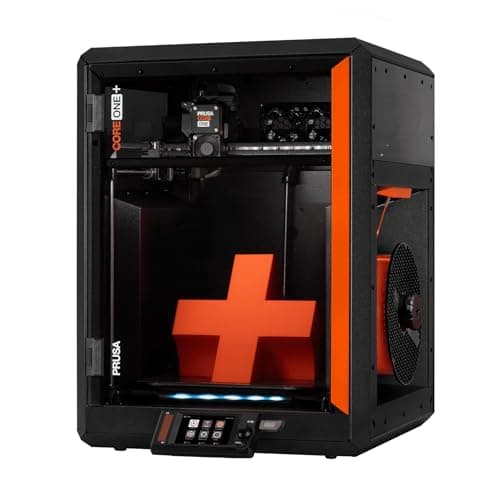
The machine people mean when they say they want something they can fix. Prusa publishes a 250 x 220 x 270 mm enclosed CoreXY with an actively controlled chamber up to 55 C, and says plainly that nothing on it is glued and everything comes apart with a screwdriver.
#ad Price as of October 19, 2026, from Amazon. Prices change. How we make money.
What it actually is
A fully enclosed CoreXY printer with a heated, ventilated chamber, built around an all-steel structural enclosure. It is designed to be disassembled and repaired, with spare parts stocked for years, and it costs several times what a first printer should.
What the manufacturer states
| Figure | Value | Source |
|---|---|---|
| Build volume | 250 x 220 x 270 mm (14.9 liters) | Prusa Research CORE One+ product page |
| Motion and frame | Fully enclosed CoreXY; all-steel structural enclosure | Prusa Research CORE One+ product page |
| Chamber | Actively controlled, heats to 55 C, with smart ventilation | Prusa Research CORE One+ product page |
| Materials | ASA, ABS, PC, PA and other advanced materials, plus standard 1.75 mm filament | Prusa Research CORE One+ product page |
| Vibration control | Input Shaper firmware compensation | Prusa Research CORE One+ product page |
| Serviceability | Nothing glued; disassembles with a screwdriver, spare parts stocked for years | Prusa Research CORE One+ product page |
Read from Prusa Research, CORE One+ product page on 2026-09-13. Where a manufacturer does not publish a figure, there is no row for it here.
What is good about it
- An actively heated chamber to 55 C, which is a genuine step beyond the passively warm boxes in the band below
- Built to be repaired: Prusa states nothing is glued, everything comes apart with a screwdriver, and parts are stocked for years
- Prusa publishes 50 percent less desk space than an MK4S in an enclosure with 30 percent more print volume
- Smart ventilation means the door stays shut for PLA rather than being propped open
What is not
- It costs several times what this site's beginner picks cost, and nothing about it makes a first month easier
- 250 x 220 x 270 mm is less floor area than the 256 mm cubed machines it competes with, even though total volume is higher
- The repairability that justifies the price is worth nothing to somebody who never intends to open the machine
- Sold on Amazon by Amazon rather than by Prusa, so warranty and support routing is worth checking before you order
Skip this one if
Skip it if this is your first printer. Everything you are paying for - the chamber, the steel, the serviceability - is aimed at somebody who already knows what they want to print and expects to keep the machine for a decade. Buy an A1 mini and come back in two years.
What we cannot tell you
We have not printed on this machine. Whether the chamber control makes ABS genuinely uneventful, how loud it is, and whether the repairability premium pays back over years are all owner questions we cannot answer from a specification page.
How it scored for a beginner
- Setup out of the box8.0
- Auto-calibration9.0
- First-layer forgiveness8.5
- Parts and filament availability10.0
- Running cost6.0
- Help when it goes wrong9.5
Beginner fit 7.4 / 10. That is our editorial read of how well this suits someone buying their first printer, taken off the published specifications — not a test result, and not a verdict on absolute quality. It is deliberately not marked up as a rating in this page’s structured data. How we pick.
How these were picked
We have not printed on these machines and we do not pretend to have. What we did was read each manufacturer’s own specification page, take their stated build volume, temperatures and speeds, check that every pick genuinely fits the job in this page’s title, confirm it is still being sold, and pull a live price rather than a remembered one. Every figure names the source it came from, so you can check it yourself in about a minute.
How we pick sets out the full method, including what would change a ranking.
Questions people actually ask
+−Is the Prusa CORE One good for beginners?
No, and Prusa is not really pitching it that way. It costs several times a Bambu Lab A1 mini and nothing you pay extra for — the heated chamber, the steel enclosure, the serviceability — makes a first month easier. Buy an A1 mini, print for a year, and revisit this if you have found a reason to.
+−What is the difference between the CORE One and the CORE One+?
The CORE One+ is the revision Prusa currently sells; the CORE One is the same line. Most search traffic and most conversation still says “CORE One”. If you order from Prusa or from Amazon today, the CORE One+ is what arrives, and the specifications on this page are the CORE One+ figures from Prusa’s own product page.
+−Is the Prusa CORE One cheaper direct from Prusa than on Amazon?
On 18 October 2026 it was, by a wide margin: Prusa’s own store listed the assembled machine at $1,202.78 and the assembly kit from $925, while the Amazon listing was $1,549.00. We earn a commission on Amazon links and we would still check Prusa’s store first on this machine. Prices move, so compare both on the day.
+−What is a heated chamber actually for?
It reduces warping in materials that shrink as they cool — mainly ABS, ASA, PC and PA. Prusa publishes 55 °C, actively controlled, with ventilation that adapts to the material. Most enclosed printers in cheaper bands are passively warm instead, which helps but is not the same thing. If you only plan to print PLA, a chamber is a specification you will not use; PLA vs PETG covers why a first year is usually a PLA year.
+−Prusa CORE One or Bambu Lab P1S?
P1S for most people: more plate area, a 300 °C nozzle, far less money, and multi-material available as a drop-in. CORE One+ if you want the controlled chamber, the published repair commitment and the kit option. Our Prusa vs Bambu Lab comparison works through it at brand level.