Roundup
Is PLA Food Safe?
No, not as printed, and the filament is the least of the reasons. Three separate things have to be true before a printed object is safe against food, and on a stock beginner printer two of them fail before you choose a spool.
By Scooter M. · Published · Last reviewed
How this page is funded: the buy links below are affiliate links. If you buy through one we earn a commission, at no extra cost to you. It does not change the order of the picks or a word of what we say about them. Full disclosure.
Printers we claim to have tested: 0. Everyone in this category says they tested twenty machines. We have not tested any, and we would rather say so. What we did instead is on this page: the manufacturer’s own published specification for every pick, cited and dated; the arithmetic on what it costs to run, with the inputs shown; a live price rather than a remembered one; and a plain answer on who should skip each machine.
The short answer
No. A printed PLA object is not food safe, and the biggest reasons have nothing to do with the plastic. Overture, the brand whose PLA we recommend most, states on its own site that its PLA “is not certified for food contact” and that there is “no guarantee against contamination during the printing process.” Print cookie cutters, dry-goods scoops and molds you line. Buy the cup.
That is the answer. What follows is why — because once you see the three gates, you can decide for yourself which kitchen projects are fine, which are a bad idea, and which spool is worth paying double for. Every claim below is quoted from a manufacturer’s own page, with the source listed at the bottom.
The three gates, and why two of them are not the filament
“Food safe” is not a property of a plastic. It is a property of a finished object, and three independent things have to be true at once.
The three gates. On a stock beginner printer, gate 1 usually fails on paper and gates 2 and 3 fail in practice.
| Gate | What has to be true | Status on a typical setup |
|---|---|---|
| 1. The polymer | The spool is made from a resin tested for food contact, and the maker says so | Usually fails — most spools carry no food-contact statement at all |
| 2. The nozzle | The melted plastic does not pick anything up on the way out | Usually fails — stock nozzles are brass, a leaded alloy |
| 3. The object | The finished shape can actually be cleaned, and survives being cleaned | Usually fails — layer lines are porous and PLA softens around 60 C |
Gate 1: the spool, which is the easy one to fix
Most filament carries no food-contact statement, and absence of a claim is not a claim. The honest manufacturers say so directly. Overture, on its own PLA page:
That is the biggest-selling PLA brand in our registry telling you not to use it against food, and distinguishing exactly the right thing: the raw material may be food-grade and the printed object is still a separate question.
A small number of spools are different. Comfy Materials publishes that its CARBON PETG is “Food Grade Tested by both TUV SUD and SGS with reference to 21 CFR 177.1630”, names the base resin as Eastman GN071 copolyester, and states that resin is certified to NSF/ANSI Standard 51 for food equipment materials. It is the only spool in our registry that publishes any of that, and it is our first pick below.
Gate 2: the nozzle, which is the gate nobody closes
Your printer’s stock nozzle is almost certainly brass, and brass is a copper-zinc alloy that commonly contains lead. Every gram of plastic in your print passed through it while molten.
This is not us speculating. Prusa publishes the stock nozzle on the CORE One+ as a “High-flow Prusa Nozzle brass CHT” — on a machine costing well over a thousand dollars. And Comfy Materials, selling the food-tested spool, tells you what to do about it: it suggests “a stainless steel nozzle and a stainless steel all-metal hot-end,” and a separate nozzle and hot end reserved for food-grade models.
Here is the practical problem with following that advice, and it is the most useful thing on this page: on several of the machines we recommend, the nozzle is not a separately replaceable part. On the Bambu A1 family it is part of a hotend assembly. Third-party stainless assemblies for those machines exist, but they are third-party rather than the manufacturer’s own, which is a different risk profile from the one you were trying to avoid. On machines where the nozzle does unscrew — the Creality Ender line, the FlashForge Adventurer 5M with its quick-detach nozzles — this is a cheap, genuinely sensible change.
Gate 3: the object, which is the gate you cannot buy your way out of
Two separate problems here, and both are measurable.
Porosity. An FDM print is built from stacked extrusions, and the valleys between them are a texture no sponge reaches. Bacteria do not need much. A smooth injection-molded cup has nowhere to hide; a printed one is all hiding places. This is why Comfy Materials advises “printing solid models” and using “an appropriate sanitizer between uses” — advice that only makes sense because the geometry is the problem.
Heat. You cannot wash a printed part properly, because washing properly means hot. PLA’s glass transition is around 60 °C, which is why a PLA print left in a hot car deforms. PETG does better but not enough: Comfy Materials publishes a deflection temperature of 70 °C at 0.455 MPa for its food-tested PETG. A dishwasher’s sanitize cycle runs above that. So the one spool here with third-party food testing is still not dishwasher safe, by its own published figure.
And Comfy Materials says the quiet part out loud, on its own product page: “Once the Filament is molded or extruded into a new shape, by the end user, the Food Safe Qualities need to be reassessed,” and “Just because a material is permitted to come into contact with food does not necessarily mean it is Food-Safe.” We have not found a more honest sentence on a filament listing.
So what can you actually print for a kitchen?
Quite a lot, once you sort projects by how much contact and how much washing they involve.
Our read, based on the three gates above. 'Fine' means the gates that fail do not apply to this use.
| Project | Verdict | Why |
|---|---|---|
| Cookie cutters, fondant stamps | Fine | Brief contact with cold dough, hand-washed cold, used a few times a year |
| Molds you line with parchment or foil | Fine | The liner is the food-contact surface, not the print |
| Dry-goods scoops (flour, coffee beans, pasta) | Fine with care | Dry contact, no washing cycle, nothing wet sitting in the layer lines |
| Utensil holders, fridge clips, drawer organizers, spice racks | Fine | Near food, not against it. This is most of what people actually want |
| Cups, bowls, plates, water bottles | Do not | Wet, repeated contact, needs hot washing. Buy the cup |
| Anything for a baby or a toddler | Do not | Repeated mouth contact plus a sterilizing routine the plastic cannot survive |
| Anything that goes in a dishwasher or microwave | Do not | Even the food-tested PETG here publishes 70 C deflection; a sanitize cycle exceeds it |
If the list of “fine” items looks short, it is worth saying that it covers the overwhelming majority of kitchen prints people actually make. Our beginner projects guide and what to 3D print first are full of organizers and clips, which is the sweet spot.
What about PETG, ABS and the rest?
PETG is the best of the common filaments for anything kitchen-adjacent, for reasons that are not about certification. It is the same polymer family as the PET in drinks bottles, it tolerates a hotter hand-wash than PLA, and it does not soften in a sunny window. That makes it right for the second row of our table — the holders and racks — regardless of food-contact status. Our PLA vs PETG comparison covers the printing differences, and the PETG roundup covers the spools.
ABS and ASA are the wrong direction entirely. They want an enclosure and ventilation, and neither publishes a food-contact statement in our registry. See ABS vs ASA for what they are actually for.
Resin is worse, not better. Uncured photopolymer resin is an irritant and resin prints need washing in alcohol and curing under UV before they are safe to handle bare-handed at all. Nothing printed in resin belongs near food. We cover the material honestly on FDM vs resin.
Food-safe coatings get recommended a lot, and Overture itself mentions coatings. We are not recommending a specific one, because the coating has to be certified for food contact and cure fully and seal every pore of a layered surface, and we have not tested any product’s ability to do the third thing. A coating that seals 95 percent of the pores has not solved the problem it was bought for.
A word on “is PLA toxic?”, which is a different question
It comes up alongside this one and the answer is more reassuring. PLA is made from plant-derived lactic acid — Overture names corn starch as the feedstock — and it is not a material people treat as toxic to handle. A printed PLA toy on a shelf is not a chemical worry; the concerns on this page are about ingestion routes and cleanability, which is a narrower thing.
Printing fumes are a separate subject again. PLA produces very little and ABS produces noticeably more, which is why ventilation advice tracks the material rather than the hobby. The air purifier page answers whether you need one honestly, and printing in an apartment covers the case where you cannot open a window.
What we cannot tell you
We have not printed any of these spools, and we have not seen the TUV SUD or SGS reports behind Comfy Materials’ claim — we are reporting what the manufacturer publishes, not verifying its testing. We have also not swab-tested a printed part, so we cannot quantify how much worse a layered surface is than a molded one; we can only tell you the geometry makes it worse and that the manufacturers themselves say the printed object is a separate question.
One inconsistency worth flagging rather than smoothing over: Comfy Materials cites 21 CFR 177.1630 on its product page and 21 CFR 175.300 in its general filament section. Those are two different regulations. We quote the product-page figure because that is the page for the product, and we are telling you about the discrepancy because you should know it exists.
Nothing on this page is food-safety advice for a commercial kitchen. If you are selling anything that touches food, the answer is a certified manufacturing process, not a desktop printer.
Quick picks
Ranked on how well each one fits the job in this page's title, read off the manufacturer's own published specifications. Tap any row for the full write-up, including who should skip it.
| # | Product | Best for | Beginner fit | Price |
|---|---|---|---|---|
| 1 | 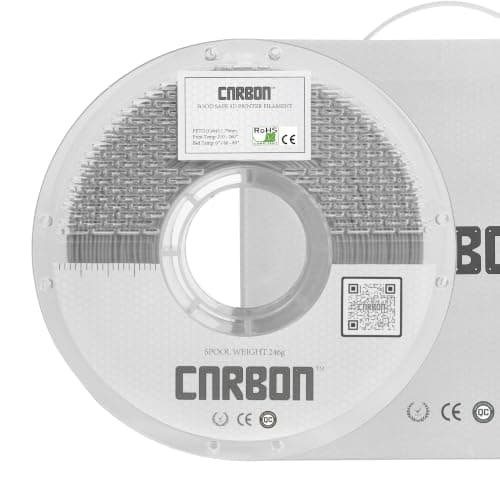 Comfy Materials CARBON Food Grade PETGComfy Materials | Best if you are going to do it properly | 7.5 | $34.99 - Check price on Amazon |
| 2 | 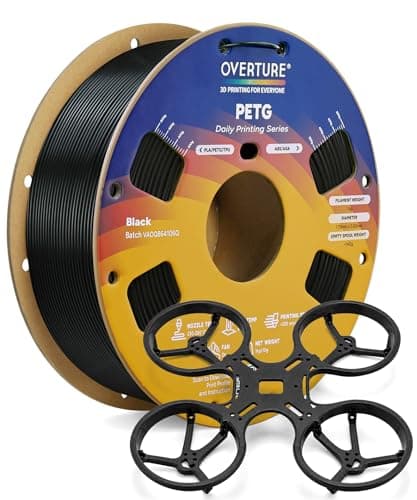 Overture High Speed PETGOverture | Best for kitchen things that never touch food | 7.9 | $14.69 - Check price on Amazon |
| 3 | 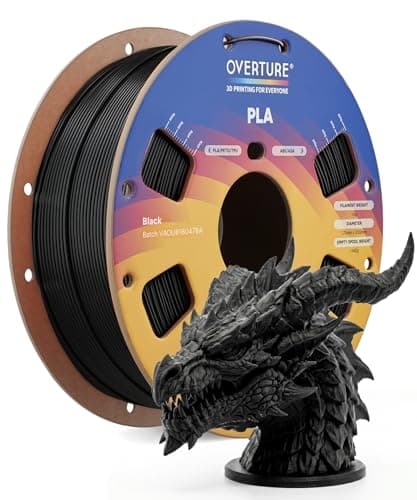 Overture PLAOverture | Best for cookie cutters, used as cookie cutters | 9.0 | $13.98 - Check price on Amazon |
#1 · Best if you are going to do it properly
Comfy Materials CARBON Food Grade PETG
Comfy Materials · A dry-contact kitchen print you are determined to make properly
The only spool in our registry whose maker publishes third-party food-contact testing and names the resin it is extruded from. It is also the only one honest enough to say, on its own product page, that printing it into a new shape means the food-safe qualities have to be reassessed. Both halves of that matter.
#ad Price as of October 19, 2026, from Amazon. Prices change. How we make money.
What it actually is
A 1 kg PETG spool extruded from Eastman GN071 copolyester. Comfy Materials publishes third-party food-grade testing on the filament and tells you to run it through a stainless steel nozzle and all-metal hot end kept separate from your ordinary printing.
Does it fit this page?
The only spool in our registry whose maker publishes third-party food-contact testing (TUV SUD and SGS, referencing 21 CFR 177.1630), names the resin it is extruded from, and states on its own page that printing it into a new shape means the food-safe qualities have to be reassessed.
What the manufacturer states
| Figure | Value | Source |
|---|---|---|
| Food-contact testing | Comfy Materials states the filament is Food Grade Tested by both TUV SUD and SGS with reference to 21 CFR 177.1630 | Comfy Materials CARBON Food Grade PETG product page |
| Biocompatibility | Also ISO 10993 Biocompatible (Skin Safe) Tested by TUV SUD, per Comfy Materials | Comfy Materials CARBON Food Grade PETG product page |
| Base resin | Eastman GN071 copolyester, which Comfy Materials states is certified to NSF/ANSI Standard 51 for Food Equipment Materials | Comfy Materials CARBON Food Grade PETG product page |
| Processing melt temperature | 249 to 271 C | Comfy Materials CARBON Food Grade PETG product page |
| Nozzle requirement | Comfy Materials suggests a stainless steel nozzle and a stainless steel all-metal hot end, and a separate nozzle and hot end reserved for food-grade models | Comfy Materials CARBON Food Grade PETG product page |
| Deflection temperature | 70 C at 0.455 MPa, per ASTM D648 | Comfy Materials CARBON Food Grade PETG product page |
| Tensile strength | 50 +/- 1.1 MPa | Comfy Materials CARBON Food Grade PETG product page |
| Diameter and tolerance | 1.75 mm, +/- 0.02 mm, 1 kg spool | Comfy Materials CARBON Food Grade PETG product page |
| The maker's own caveat | Comfy Materials states: once the filament is molded or extruded into a new shape by the end user, the food safe qualities need to be reassessed | Comfy Materials CARBON Food Grade PETG product page |
Read from Comfy Materials, CARBON Food Grade PETG product page on 2026-10-18. Where a manufacturer does not publish a figure, there is no row for it here.
What is good about it
- Names the resin — Eastman GN071 — rather than saying 'food grade' and stopping there
- Publishes which bodies tested it (TUV SUD and SGS) and against which regulation (21 CFR 177.1630)
- Tells you on its own page that the printed part is a separate question from the filament, which almost no filament listing does
- Specifies the nozzle and hot end it wants, including keeping them separate from your everyday printing
- A published 70 C deflection temperature is a real number to check a hand-wash against, not a marketing adjective
What is not
- Roughly twice the price of an ordinary PETG spool, for a property most prints do not need
- Comfy Materials cites 21 CFR 177.1630 on the product page and 21 CFR 175.300 in its general filament section — two different regulations in two places
- The stainless nozzle and all-metal hot end it asks for are extra purchases, and on several machines we recommend the nozzle is not separately replaceable
- The testing covers the filament. The spool cannot certify the object you print from it, and the maker says so
- A small brand with a thin published datasheet next to Polymaker or Prusament
Skip this one if
Skip it for anything that is not touching food. For a bracket, a shelf clip or a phone stand this is an expensive PETG, and our PETG roundup has better value. Skip it too if you were planning to print a cup or a water bottle — no spool solves that, and the section above explains why.
What we cannot tell you
We have not printed this spool and we have not seen the TUV SUD or SGS reports — we are reporting what Comfy Materials publishes, not verifying the testing ourselves. How it prints next to an ordinary PETG, and whether the certification documents say what the product page says they say, are both unchecked here.
How it scored for a beginner
- Ease for a beginner7.0
- Published data8.5
- Honesty about limits9.5
- Strength7.5
- Value5.5
Beginner fit 7.5 / 10. That is our editorial read of how well this suits someone buying their first printer, taken off the published specifications — not a test result, and not a verdict on absolute quality. It is deliberately not marked up as a rating in this page’s structured data. How we pick.
#2 · Best for kitchen things that never touch food
Overture High Speed PETG
Overture · Parts that have to survive heat or flexing
The second spool, not the first. PETG is what you move to when a part has to survive a hot car, a bit of flex or the outdoors — and it is fussier about stringing and bed adhesion than PLA in exchange.
#ad Price as of October 19, 2026, from Amazon. Prices change. How we make money.
What it actually is
PETG is a tougher, slightly flexible plastic that tolerates heat far better than PLA. It prints hotter, sticks harder to the plate, and strings more. The same material family as a drinks bottle.
Does it fit this page?
Utensil holders, fridge clips, drawer organizers, spice-jar racks. PETG tolerates a hotter hand-wash than PLA and does not soften in a sunny window. Overture publishes no food-contact statement for it, which is exactly why it belongs in this slot rather than the first one.
What the manufacturer states
| Figure | Value | Source |
|---|---|---|
| Diameter | 1.75 mm | Overture published product specification |
| Dimensional accuracy | +/- 0.02 mm | Overture published product specification |
| Recommended nozzle temperature | 230 - 260 C | Overture published product specification |
| Recommended printing speed | 30 - 300 mm/s | Overture published product specification |
Read from Overture, High Speed PETG filament product page on 2026-09-01. Where a manufacturer does not publish a figure, there is no row for it here.
What is good about it
- Handles heat that would soften a PLA part into uselessness
- Tougher and less brittle than PLA, so it survives being dropped
- +/- 0.02 mm published tolerance, the same as Overture's PLA
- A 30 - 300 mm/s published speed range that fits current fast machines
What is not
- Strings between features far more readily than PLA
- 230 - 260 C means your printer's hot end has to be rated for it — the A1 mini's 300 C ceiling is fine, some older machines are not
- It can stick to a smooth PEI plate hard enough to damage the surface
- Absorbs moisture from the air faster than PLA, so an open spool goes off
Skip this one if
Skip it as a first spool. Learn what a good first layer looks like in PLA before you add a material that sticks too well and strings between everything. PETG is a solution to a problem you have not had yet.
What we cannot tell you
We have not printed this filament. How much stringing you get at a given retraction setting, and whether it damages a specific plate, depend on the machine and we have not tested either.
How it scored for a beginner
- Ease for a beginner6.5
- Published tolerance9.5
- Availability9.0
- Value per kilogram8.0
Beginner fit 7.9 / 10. That is our editorial read of how well this suits someone buying their first printer, taken off the published specifications — not a test result, and not a verdict on absolute quality. It is deliberately not marked up as a rating in this page’s structured data. How we pick.
#3 · Best for cookie cutters, used as cookie cutters
Overture PLA
Overture · Your first spool, and your tenth
The default answer to 'what filament should I buy'. A tight published diameter tolerance, a conventional temperature range every printer profile already expects, and it is sold everywhere. Nothing about it is exciting, which is the point.
#ad Price as of October 19, 2026, from Amazon. Prices change. How we make money.
What it actually is
PLA is the plastic beginners should print. It is stiff, it needs no enclosure, it barely smells, and it sticks to a plate at low temperatures. This is a mainstream 1 kg spool of it.
Does it fit this page?
Cheap, easy to print, and genuinely the right material for a cutter pressed into rolled dough and hand-washed cold. Overture states plainly that this spool is not certified for food contact, and we would take that at its word rather than argue with it.
What the manufacturer states
| Figure | Value | Source |
|---|---|---|
| Diameter | 1.75 mm | Overture published product specification |
| Dimensional accuracy | +/- 0.02 mm | Overture published product specification |
| Spool weight | 1 kg (2.2 lb) | Overture published product specification |
| Recommended nozzle temperature | 190 - 220 C | Overture published product specification |
| Recommended bed temperature | 25 - 60 C | Overture published product specification |
| Packaging | Dried before packing and vacuum sealed | Overture published product specification |
Read from Overture, PLA filament product page on 2026-09-01. Where a manufacturer does not publish a figure, there is no row for it here.
What is good about it
- +/- 0.02 mm published tolerance, which is as tight as mainstream PLA is quoted
- 190 - 220 C is squarely inside every stock PLA profile you will meet
- A 25 - 60 C bed range means it will stick even on an unheated or barely warm plate
- Vacuum sealed with desiccant, so a spool bought in advance is still dry when it arrives
What is not
- PLA softens in a hot car or a sunny window — this is a property of the material, not the brand
- Not the cheapest per kilogram once you start printing seriously
- Color consistency between batches of any budget filament is a real thing
- No filament is a fix for a machine that is not leveled
Skip this one if
Skip it if the part you are making will live outdoors or in a car. That is a PETG job, not a PLA one, and no PLA brand changes that.
What we cannot tell you
We have not printed this filament. Batch-to-batch color consistency and how it behaves after a year in a cupboard are things only repeated use reveals.
How it scored for a beginner
- Ease for a beginner9.5
- Published tolerance9.5
- Availability9.5
- Value per kilogram8.0
Beginner fit 9.0 / 10. That is our editorial read of how well this suits someone buying their first printer, taken off the published specifications — not a test result, and not a verdict on absolute quality. It is deliberately not marked up as a rating in this page’s structured data. How we pick.
How these were picked
We have not printed on these machines and we do not pretend to have. What we did was read each manufacturer’s own specification page, take their stated build volume, temperatures and speeds, check that every pick genuinely fits the job in this page’s title, confirm it is still being sold, and pull a live price rather than a remembered one. Every figure names the source it came from, so you can check it yourself in about a minute.
How we pick sets out the full method, including what would change a ranking.
Questions people actually ask
+−Is PLA food safe?
Not as printed. Overture states on its own site that its PLA “is not certified for food contact” and that there is “no guarantee against contamination during the printing process.” Three things have to be true for a printed object to be safe against food — the resin, the nozzle it passed through, and whether the finished shape can be cleaned — and on a stock printer the last two fail regardless of which spool you buy.
+−Is PETG food safe?
PETG is the same polymer family as the PET in drinks bottles and it tolerates a hotter wash than PLA, but a specific spool is only food-contact tested if its maker says so, and most do not. Comfy Materials publishes third-party testing for its CARBON PETG (TUV SUD and SGS, referencing 21 CFR 177.1630). Overture publishes no food-contact statement for its PETG. Either way, the nozzle and the porosity problems still apply.
+−Can you 3D print cookie cutters?
Yes — this is the one food-adjacent print we would actively recommend. Contact is brief, with cold dough, and a cutter is hand-washed in cool water and used a few times a year. Plain PLA is genuinely the right material: cheap, stiff enough to cut, and easy to print. Do not put it in a dishwasher, which will deform it well before hygiene becomes the issue.
+−Are 3D printed cups and water bottles safe?
No, and this is the clearest “do not” on the page. Wet, repeated contact with a porous layered surface that cannot be washed hot is the worst combination of all three problems at once. Even the food-tested PETG here publishes a 70 °C deflection temperature, below a dishwasher sanitize cycle. Buy the cup; print the holder it sits in.
+−Do I need a stainless steel nozzle for food-safe printing?
Comfy Materials, which sells a food-tested spool, says yes: a stainless steel nozzle and all-metal hot end, kept separate from your everyday printing. Stock nozzles are brass, a leaded alloy. The practical catch is that on several machines we recommend — including the Bambu A1 family — the nozzle is part of a hotend assembly rather than a separate part, and the stainless versions available are third-party. On machines where the nozzle unscrews, it is a cheap and sensible change. Note that hardened steel is not stainless steel.
+−Can I make a 3D print food safe with a coating?
In principle, and we are not going to recommend a specific product. The coating has to be certified for food contact, cure fully, and seal every pore of a layered surface — and we have not tested any product’s ability to do the last one. A coating that seals most of the pores has not solved the problem it was bought for. For anything that holds wet food, buying the item remains the right answer.
+−Is PLA toxic?
PLA is made from plant-derived lactic acid — Overture names corn starch as the feedstock — and it is not treated as a toxic material to handle or keep in a house. The concerns on this page are narrower than toxicity: they are about ingestion routes and whether a layered object can be cleaned. Printing fumes are a separate question, covered on the air purifier page.
+−Is 3D printed plastic safe for kids' toys?
For a toy that is handled rather than chewed, PLA is a normal material and plenty of printed toys exist. For anything a baby or toddler will put in their mouth, no — repeated mouth contact plus a sterilizing routine the plastic cannot survive is the same failure pattern as a printed cup. Also watch part size and small printed pieces that can break off. Our printers for kids page covers the wider safety picture.